
What is a CSAT Score? How Do You Measure It?


Many businesses know customer satisfaction matters, but few have a clear, reliable way to measure it after every interaction, purchase, or support experience. Without consistent measurement, dissatisfaction can go unnoticed, quietly affecting customer loyalty, retention, and brand reputation.
The CSAT (Customer Satisfaction Score) solves this problem by capturing direct customer feedback at key moments. It helps organizations quickly understand how customers feel and use real data to improve products, services, and support experiences.
In this guide, we’ll break down what a CSAT score is, how to measure it accurately, why it’s important, and strategies to improve your customer satisfaction levels.
Key Highlights
CSAT is a key performance indicator (KPI) that organizations use to measure the customer satisfaction level after using their products or services.
To measure CSAT, ask customers to rate their satisfaction after a specific interaction, such as a support call, chat, purchase, or service experience, using a 1-5 scale or similar, then use the formula:
(Number of Satisfied Responses / Total Responses) x 100 = CSAT Score %
A good CSAT score is typically 70% or higher, indicating that most customers are satisfied with their experience, though benchmarks may vary by industry.
Measuring CSAT provides direct feedback on customer experience, helping businesses boost loyalty, reduce churn, and drive revenue by identifying specific pain points.
CSAT measures customer satisfaction with a specific interaction, NPS (Net Promoter Score) gauges customer loyalty and likelihood to recommend, and CES (Customer Effort Score) assesses how easy it is for customers to interact with a business.
To boost your CSAT score, gather customer feedback promptly, identify pain points, and tailor your service to resolve issues effectively. Also, equip your team and offer self-service tools to improve the overall customer experience.
What is a CSAT Score?
The CSAT Score is a widely used performance metric that measures how satisfied customers are with a company’s products, services, or recent interactions. It allows businesses to understand how well they met customer expectations at that moment.
To calculate CSAT, you need to collect short surveys where customers rate their experience on a scale, such as 1-5 or 1-10. Then, it is calculated as a percentage ranging from 0% to 100%, where a higher score indicates higher customer satisfaction and a lower score highlights the need for improvement.
How Do You Measure CSAT?
To measure CSAT, collect customer feedback after recent interactions using a defined rating scale and identify those who are satisfied or very satisfied. Then, calculate the score as a percentage of satisfied customers and use it to evaluate overall satisfaction levels.
- Step 1 - Ask Customers for Feedback:
After an interaction, purchase, or service experience, ask customers to rate their satisfaction, such as: “How would you rate your overall satisfaction with our product or service?” Provide a defined rating scale, such as 1 to 5. - Step 2 - Collect Responses:
Gather responses from customers through email, in-app surveys, website pop-ups, or after support interactions. - Step 3 - Identify "Satisfied" Customers:
Count how many customers rated their experience as "Satisfied" (4) or "Very Satisfied" (5). - Step 4 - Calculate the CSAT Score:
CSAT (%) = (Number of satisfied customers ÷ Total number of responses) × 100 - Step 5 - Interpret the Score:
- 90 - 100%: Excellent
- 70 - 89%: Good
- 50 - 69%: Average
- Below 50%: Poor
For example, you collect 50 survey responses in total. Out of these, 30 customers rate their experience as satisfied or very satisfied (such as giving a 4 or 5 on the scale).
To calculate CSAT, divide the number of satisfied responses by the total number of responses and multiply by 100:
(30 ÷ 50) × 100 = 60%.
This means 60% of customers were satisfied with their experience.
When Should You Measure CSAT?
CSAT can be measured at certain time intervals, such as weekly, monthly, quarterly, or annually, depending on your business goals and how often customers interact with your product or service. It is most effective when calculated immediately after customer interactions. At this stage, customers can clearly recall what went well and what didn’t, making it easier to identify strengths and pain points across different touchpoints in the customer journey.
Businesses with frequent, fast-moving interactions, such as e-commerce platforms, SaaS products, customer support teams, and food delivery services, can benefit from daily CSAT tracking to monitor performance and address issues quickly. In contrast, businesses with less frequent or longer customer cycles, such as B2B services, subscription-based companies, consulting firms, and real estate, may find it more effective to review CSAT weekly, monthly, or quarterly.
What is a Good CSAT Score?
A good CSAT score generally falls between 70% and 80%, indicating that most customers are satisfied with their experience. Scores above 80% are considered excellent and suggest strong customer loyalty and effective service delivery.
However, what qualifies as a “good” CSAT score can vary by industry benchmarks, customer expectations, and the type of interaction being measured. So, it’s best to compare the score against past performance and relevant industry benchmarks.
Key Benefits of Measuring the CSAT Score
Measuring CSAT helps businesses understand customer concerns, improve experiences, and address dissatisfaction before it impacts loyalty. By tracking satisfaction over time, organizations can strengthen service quality, retain customers, and build a positive brand reputation.
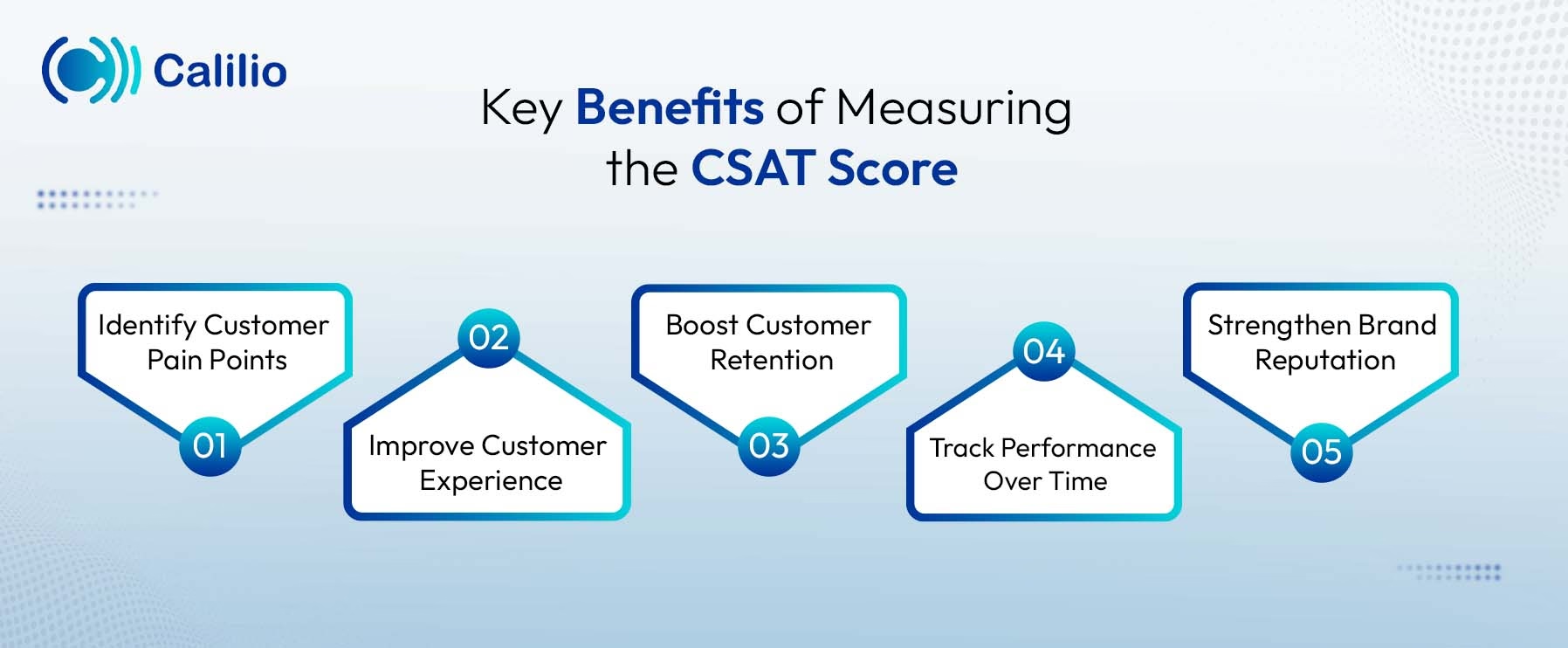
- Identify Customer Pain Points: Measuring CSAT helps businesses spot areas where customers are unhappy. By identifying these pain points, companies can take immediate action to resolve issues and prevent negative experiences from recurring.
- Improve Customer Experience: CSAT feedback provides actionable insights into what customers like and dislike. Using this information, businesses can optimize their products, services, and processes to enhance customer experience.
- Boost Customer Retention: Satisfied customers are more likely to stay loyal and make repeat purchases. Monitoring CSAT allows companies to address dissatisfaction early, reducing churn and increasing long-term revenue.
- Track Performance Over Time: Regular CSAT calculation helps track improvements and identify trends in customer satisfaction. It enables businesses to evaluate the impact of changes and set realistic benchmarks for service quality.
- Strengthen Brand Reputation: Consistently high CSAT scores signal a strong commitment to customer satisfaction. This builds trust, improves brand perception, and encourages positive word-of-mouth referrals.
CSAT Vs NPS Vs CES
CSAT, NPS, and CES are key customer experience (CX) metrics that measure different aspects of the customer journey: immediate satisfaction, long-term loyalty, and ease of interaction, respectively.
Although the aim of all three indicators sounds similar, revolving around customer satisfaction, the process and intention are entirely different.
Here is a quick comparison table:
Metric | CSAT | NPS | CES |
| Focus | Satisfaction with a specific interaction or experience. | Likelihood of customers recommending your brand. | How easy it is for customers to complete a task or resolve an issue. |
| Question Example | How satisfied were you with your experience? Please tell us why you gave this rating. | How likely are you to recommend us to others? What is the main reason for your score? | How easy was it to resolve your issue? What made it easy or difficult? |
| When to Measure | After purchases, support interactions, or service touchpoints. | Periodically (e.g., quarterly, yearly). | Immediately after a task or service interaction. |
| Best For | mproving individual touchpoints and short-term experience. | Measuring loyalty, growth potential, and advocacy. | Reducing friction and improving processes. |
| Limitation | Doesn’t measure long-term loyalty. | Doesn’t give detailed feedback on specific issues. | Doesn’t capture emotional satisfaction or overall loyalty. |
How to Increase Your CSAT Score?
Conclusion
The CSAT score serves as a clear indicator of how customers perceive their experience with a business. It provides a quick, easy-to-understand snapshot of customer sentiment and helps organizations stay aligned with customer expectations. When used consistently, CSAT supports informed decision-making and reinforces a customer-focused approach across the business.
To turn CSAT insights into real improvements, businesses need effective communication systems that support better customer interactions. Calilio, a cloud-based business phone system, helps bridge this gap by providing tools that directly improve customer satisfaction.
With Calilio’s AI-powered call sentiment analysis, teams can better understand customer emotions in real-time. Automatic call routing and IVR help connect customers to the right agent quickly, reducing wait times and unnecessary transfers. Customizable business hour settings ensure calls are handled professionally at all times, while call recording and analytics provide valuable data to monitor performance, train agents, and continuously improve service quality.
Summarize this blog with:
Frequently asked questions
What is the scoring system for customer satisfaction?
The scoring system for customer satisfaction, or CSAT, ranges from 0% to 100%. It represents the percentage of customers who are satisfied with a product or service. Higher percentages indicate greater satisfaction.
What is NPS and CSAT?
How do you measure customer satisfaction?
What is a good CSAT score?
What is CSAT score 1 to 10?
What are some common challenges with customer satisfaction scores?

Still have questions?
Can’t find the answer you’re looking for? Please chat with our friendly team.
Stay in the loop
Get the latest call insights, trends, and updates delivered straight to your inbox.
By subscribing, you agree to receive updates from Calilio.
You can unsubscribe anytime.
Enter the World of AI Business Phone System with Calilio
Improve your business operation with Calilio's advanced virtual phone system. Join today for a better way to connect.