- Partners
- Contact Us
- Log in
The Evolution of the Telephone: History & Key Eras

Today, telephones are a vital part of everyday life. We use them to stay in touch with family, run businesses, and connect instantly from almost anywhere. This level of convenience feels normal now, but it did not come easily.
Before the telephone, communication over distance was slow and uncertain. Speaking to someone far away in real time was impossible. Over many years, new inventions and technologies gradually changed this. Each stage improved how calls worked, how far they could travel, and how easily people could connect.
In this article, we explore the evolution of the telephone from its earliest invention in 1876 to today. It covers the key eras that shaped modern calling and explains how the telephone slowly became the powerful communication tool people rely on today.
Key Highlights:
Communication evolved from slow, physical methods like letters and telegraphs to real-time voice calls over time.
Early telephone systems proved voice transmission was possible, but relied on manual processes and fixed infrastructure.
Advances such as automatic exchanges, digital networks, and mobile devices made communication faster, more private, and less dependent on specific locations.
The shift to internet-based and cloud telephony removed many traditional telecom limitations, enabling flexible, device-independent communication with advanced call management through software.
Communication Before the Telephone
Before the telephone, people communicated over distance using letters, messengers, and printed notices. These methods worked to transfer the messages, but they were slow and dependent on physical delivery. A message could take days or even weeks to reach its destination.
A major shift came with the introduction of the telegraph in 1837, developed by Samuel Morse. It improved long-distance communication by sending coded signals over wires. However, it required special training and did not allow direct voice conversation. Messages still needed interpretation, which limited speed and clarity.
During the same period, inventors explored sound in different ways to improve long-distance communication. In 1857, Edouard-Leon Scott de Martinville created a device that recorded sound waves as visual traces but could not transmit speech. However, it provided the basis for understanding that sound could be captured and represented in a physical form. This idea became a key foundation and set the stage for the development of the telephone in the future.
The Invention & Early Telephone Era (1876 – 1920s)
This era marks the start of practical voice communication over wires. The early systems were focused on transferring the human voice electrically and on building basic networks to connect callers.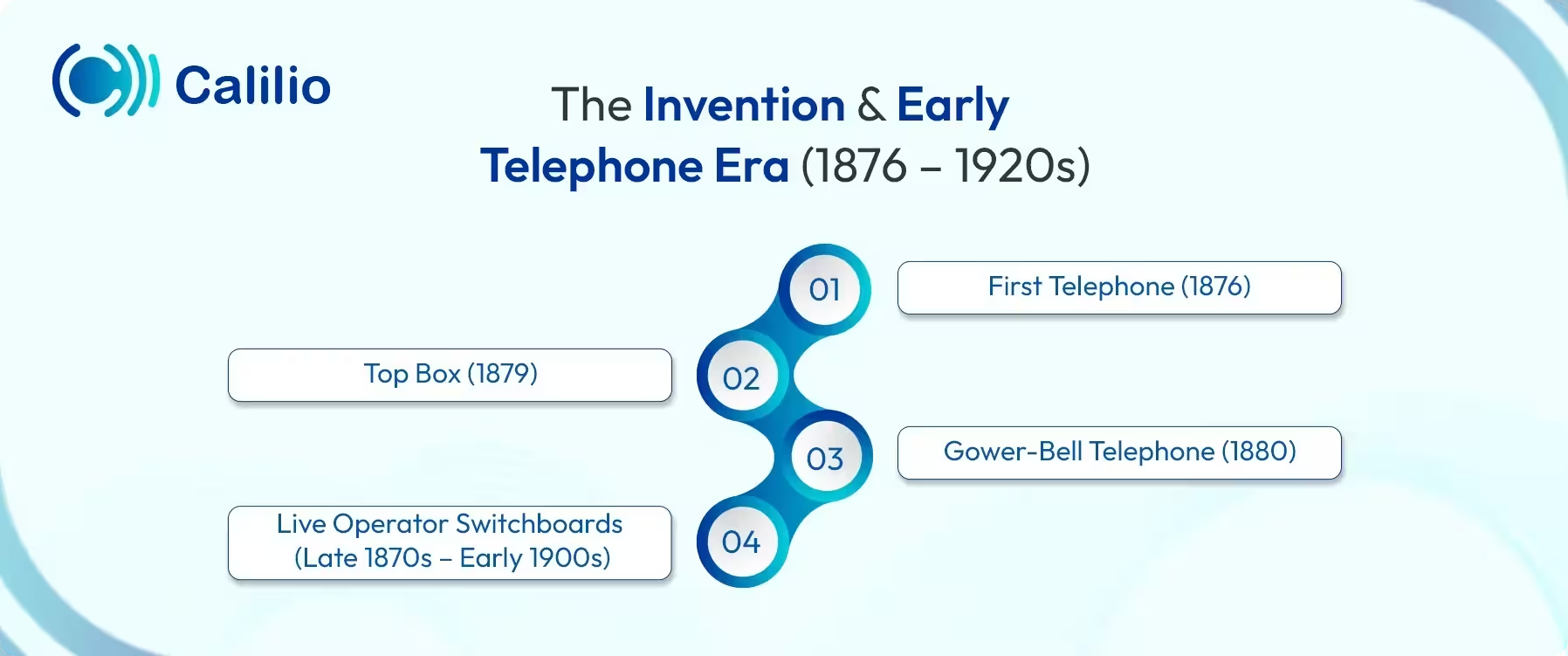
First Telephone (1876)
In 1876, Alexander Graham Bell introduced the first practical telephone, making real-time voice communication over wires possible. His work grew out of earlier experiments with the harmonic telegraph, which focused on sending multiple signals through a single wire. The telephone worked by converting voice vibrations into electrical signals using a diaphragm and then turning those signals back into sound at the receiving end.
Around the same time, another inventor, Elisha Gray, was also working on a similar concept of transferring voice messages through electronic devices. However, Bell was the first to file and secure a full patent for the telephone on March 7, 1876, which established him as the inventor of the telephone.
Three days later, on March 10, 1876, Bell made the first successful telephone call to his assistant, Thomas Watson, saying, “Mr. Watson, come here, I want to see you,” marking the start of modern voice communication.
Top Box (1879)
The top box was one of the earliest practical telephone designs used in the late 19th century. Established in 1879, it featured a fixed, wall-mounted structure with the transmitter placed in a wooden box and the receiver attached by a cord. It became common in homes, offices, and public places. Although simple, the top box helped standardize early telephone use and supported the gradual expansion of telephone networks during this period.
Gower-Bell Telephone (1880)
In 1880, the Gower-Bell telephone was introduced for regular, everyday use. It used a diaphragm and a separate receiver. Compared to earlier designs, the Gower-Bell was more durable and reliable. These improvements helped deliver clearer sound and supported wider use of telephones in offices and public spaces.
Live Operator Switchboards (Late 1870s – Early 1900s)
Live operator switchboards were a key part of the earliest telephone exchanges and were used to connect calls manually. When a caller lifted the receiver, the call went to a central exchange where a human operator linked the caller to the intended recipient by plugging cords into the correct jacks.
This system made it easy for early telephones to connect, but it depended entirely on operators, which was very time-consuming. This limit later led to the development of automatic telephone exchange systems.
Automatic Telephone Exchange (1891)
In 1891, Almon Brown Strowger invented the automatic telephone exchange. This system allowed callers to dial numbers directly without operator assistance. By removing the need for manual call handling, it reduced waiting time, improved privacy, and made large telephone networks possible.
This invention marked a turning point in telephone history and directly led to the next phase of telecommunication.
Landline & Rotary Era (1910s – 1960s)
Building on automatic exchanges, telephone use expanded rapidly with the advent of landline networks. Homes and businesses increasingly relied on telephones for everyday communication.
As telephone use increased, the need for strong network connectivity also became more important. To address this need, in 1913, the US government and the American Telephone and Telegraph Company (AT&T) reached an agreement known as the Kingsbury Commitment.
Under this agreement, AT&T was required to connect its network with independent telephone companies. This decision allowed different telephone networks to work together, supported nationwide communication, and made long-distance calling more practical across regions.
Telephone technology then crossed national borders. In 1927, the first transatlantic telephone call successfully connected New York and London, marking an early milestone in international voice communication.
During this same period, rotary dial telephones became the standard device for users. These phones featured a circular dial with numbered finger holes, a fixed handset, and internal mechanical components connected to the exchange. When users rotated and released the dial, the phone sent electrical pulses through the landline to represent each digit.
Digital Telephone Era (1960s – 1990s)
In this era, telephone networks moved beyond purely analog and mechanical systems and began using digital and electronic technologies. Earlier networks carried voice as continuous electrical signals, while digital systems converted voice into data that could be processed more efficiently. This shift improved call quality, reduced interference, and increased network capacity.
Push-button telephones gradually replaced rotary phones as digital signaling became more common. Instead of electrical pulses, these phones used tones to represent numbers, which allowed faster and more reliable call processing. Switching to a digital system also made it possible to introduce new telephony features such as call waiting, caller ID, and voicemail, which were not practical in earlier systems.
This period also saw the early development of mobile communication. Basic cellular phones allowed calls outside fixed locations but were expensive and limited by coverage and network availability. As a result, most people continued using landlines, while mobile calling remained limited to specific use cases.
Smartphone & Internet Calling Era (2000s)
Mobile communication changed significantly in the 2000s with the rise of smartphones and widespread internet access. Phones were no longer limited to voice calls and text messages. Instead, a single handheld device combined calling, messaging, and internet browsing, and apps into a single tool, which changed how people communicated in daily life.
Internet-based calling also became more common during this time. Instead of relying only on traditional telephone networks, voice calls could travel over the internet using data connections. This made long-distance and international communication more affordable and accessible, especially for personal use.
Smartphones powered by platforms like Apple’s iPhone and Android devices played a major role in this shift. With these smartphones and internet-based calling apps, people could communicate from almost anywhere. This flexibility reduced the dependence on fixed phone lines and prepared the way for fully cloud-based and software-driven phone systems that developed in later years.
VoIP & Cloud Telephony Era (2010s – Today)
In this era, Voice over Internet Protocol (VoIP) and cloud telephony shifted telephone communication fully to the internet. Now, calls no longer depend on physical phone lines or on-site hardware. Instead, voice is sent as data over the internet connections and managed using cloud servers. This change has reshaped how phone systems are set up, operated, and maintained.
Business communication has also evolved during this period. Phone numbers have become virtual rather than tied to a physical location or device. The call handling features, such as call routing, call queues, forwarding, and recording, have shifted into software dashboards. Moreover, teams can make and receive business calls from smartphones, laptops, or desktops, regardless of location.
Wrapping Up
The evolution of the telephone reflects how communication has adapted to changing needs over time. What began as a wired device for basic voice transmission gradually developed through manual exchanges, landline networks, digital systems, mobile phones, and internet-based calling. Each stage improved speed, reach, and ease of use, while reducing dependence on physical distance and infrastructure.
Today’s cloud-based phone systems represent the latest stage in this progression. By moving calling, numbers, and call management to software and the internet, modern telephony removes many limits found in traditional systems. Thus, users can communicate across devices, locations, and networks with greater flexibility and control.



Summarize this blog with:
Frequently Asked Questions
Why were early mobile phones not widely used by the public?
Early mobile phones were bulky, expensive, and limited by coverage and battery life. Most people continued to rely on landlines until mobile technology became more compact and affordable.
How is cloud telephony different from traditional VoIP calling apps?
Are traditional landline phones still in use today?

Still have questions?
Can’t find the answer you’re looking for? Please chat with our friendly team.
Stay in the loop
Get the latest call insights, trends, and updates delivered straight to your inbox.
By subscribing, you agree to receive updates from Calilio.
You can unsubscribe anytime.
Enter the World of AI Business Phone System with Calilio
Improve your business operation with Calilio's advanced virtual phone system. Join today for a better way to connect.