- Partners
- Contact Us
- Log in
Top 10 Avaya Alternatives for Your Business

Avaya has long been a trusted name in business communications, best known for on-premise phone systems, with cloud and hybrid options as well. However, many organizations today find the platform difficult to adapt to modern requirements. Its complex licensing, rising costs, slow upgrades, and heavy infrastructure management of the system can feel more frustrating than productive.
To address these gaps, businesses are turning to Avaya competitors that support cloud-first communication and simpler management. Modern Avaya alternatives help teams deploy faster, manage calls with ease, and integrate communication with daily workflows, without spending a lot.
In this guide, we’ll break down the 10 best Avaya competitors and alternatives for businesses in 2026. We’ll also cover each provider’s features, pricing, benefits, and limitations, helping you choose the right solution for your business.
Methodology: This list of Avaya alternatives was created by comparing pricing, key features, ease of use, and performance of each platform. We analyzed AI capabilities, CRM integrations, and global coverage to see how they differ from Avaya’s setup. Similarly, we reviewed user feedback from G2, Capterra, and Trustpilot to capture real-world experiences and determine the best solutions for businesses of varying sizes.
Key Highlights:
Avaya is a long-established communication system known for its traditional PBX and on-premise phone systems.
Many businesses look for alternatives due to Avaya’s complex licensing, hardware dependencies, higher operating costs, and slower adoption of modern cloud and AI capabilities.
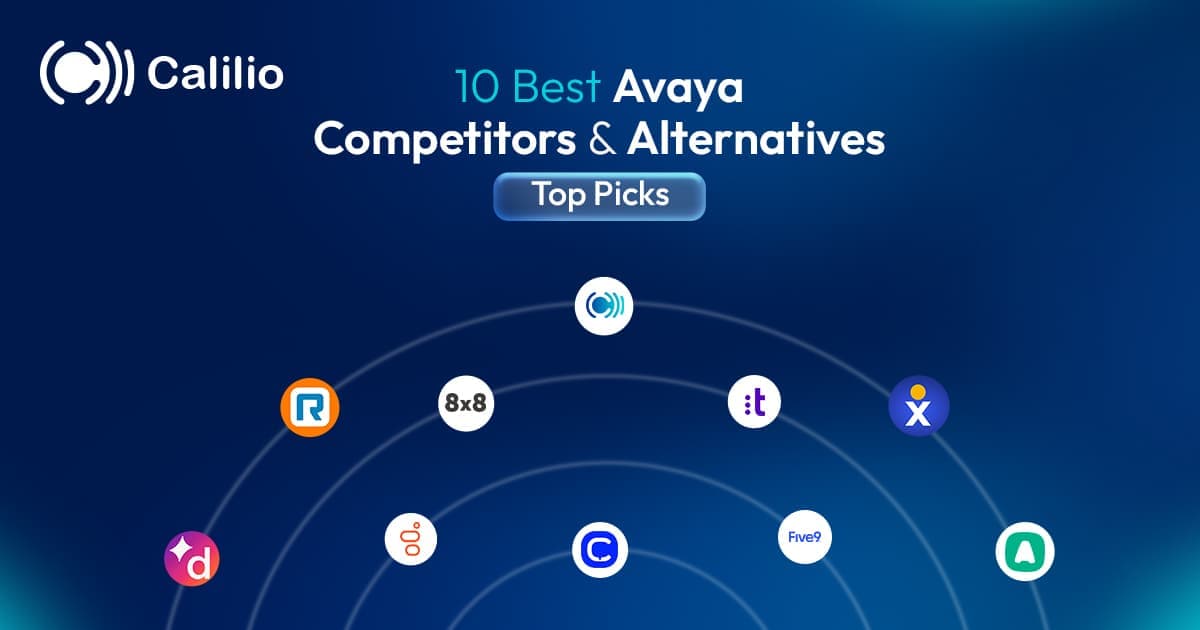
Top providers like Calilio, RingCentral, Nextiva, Dialpad, Aircall, CloudTalk, 8x8, Talkdesk, Five9, and Genesys address different Avaya limitations, from AI automation to global calling support.
Why do Businesses Look for an Avaya Alternative?
Many modern businesses look for Avaya alternatives because the platform’s hardware dependence, complex licensing, and higher overall costs can limit scalability. In addition, its slower adoption of cloud and AI features, limited flexibility for remote teams, and discontinuation of services like SIP trunking create uncertainty and push organizations to seek more flexible, cloud-first solutions.
1. Expensive Licensing
Avaya’s licensing structure separates many everyday features into multiple tiers. As a result, functions that most teams expect, such as call recording, analytics, or CRM connections, may require higher-level plans. This layering increases overall spending and makes long-term budgeting harder for growing businesses.
2. Hardware Dependency
Although Avaya offers cloud and hybrid options, many deployments still rely on PBX equipment. This means businesses must handle installation, maintenance, and periodic replacement of equipment. For teams that want to operate fully on the cloud, this dependence on hardware adds cost, slows scalability, and increases IT workload.
3. Costly Upgrades
Since many users are still on Avaya’s hardware-based system, expanding the system often requires professional services or custom configuration. Whether a business wants to add users, improve routing, or access new features, these upgrades tend to involve extra fees and scheduled downtime, making it difficult to adapt quickly to changing needs.
4. Focus on Large Enterprises
Avaya has adjusted its strategy to prioritize large enterprise clients. This shift leaves small and mid-sized businesses with fewer tailored options, limited account attention, and reduced long-term support compared to cloud providers that actively serve SMB markets.
5. Discontinued Services
Some Avaya cloud products, including Session Initiation Protocol (SIP) Trunking and Communications Platform as a Service (CPaaS) APIs, are being phased out. This creates operational gaps for customers who depend on these services, pushing them to seek alternatives sooner than expected.
6. Slow Adoption of Cloud and AI
While many modern platforms deliver cloud-native features and AI tools that work out of the box, Avaya’s transition has been slower and more complex. Implementing automation, omnichannel routing, or AI insights typically requires third-party components or costly upgrades, making innovation harder.
7. Less Optimized for Remote-first Team
Avaya supports remote work, including in its cloud offerings, but it is primarily designed for traditional enterprise setups. User setup on on-premise systems often needs more configuration and IT involvement. Avaya’s softphone experience can also feel more limited compared to competitors built for flexible, cloud-first work.
8. Complex Administration
Managing Avaya systems can be challenging without specialized IT staff. Simple tasks, such as adding users, adjusting routing paths, or updating system settings, may require technical expertise, slowing down daily operations and increasing dependence on IT resources.
10 Best Avaya Competitors for Businesses
The top Avaya alternatives include Calilio, RingCentral, Nextiva, Dialpad, Aircall, CloudTalk, 8x8, Talkdesk, Five9, and Genesys.
1. Calilio
Calilio is a strong Avaya alternative for small and mid-sized businesses with a predictable pricing structure and an easy setup. Calilio is a complete cloud-based phone system, so there’s no PBX hardware to install or maintain. Everything runs through a desktop or mobile app, making it simple to set up and manage. Unlike Avaya, which often requires higher-tier plans for features like call recording, analytics, or CRM integration, Calilio includes these tools by default and also offers built-in AI features such as call transcriptions and summaries. With plans starting at $15/user/month, Calilio keeps costs manageable compared to Avaya’s cloud plans, which typically start at $25/user/month.
Pros
- Affordable subscription plans
- Simple setup
- AI-powered call reports
- Easy access to global phone numbers
Cons
- Fewer integrations with business apps
Switch to Calilio for an Easy Cloud Setup with Affordable Pricing!
2. RingCentral
RingCentral offers businesses a unified communication system. It brings calling, messaging, video meetings, and contact center tools into one app, removing the need to manage multiple platforms or rely on separate tools for different communication needs. With a 99.999% uptime Service Level Agreement (SLA), RingCentral delivers reliable service without the hardware, maintenance, or complex setup often associated with Avaya’s on-premise or hybrid systems. Similarly, it also supports more than 300 third-party integrations, making it easy to connect with global CRMs and other business management tools.
Pros
- Reliable service with minimal downtime
- 300+ app integrations
- High-quality video meetings
Cons
- Slow customer support
- Difficult cancellation process
3. Nextiva
Nextiva provides an easy-to-manage system for businesses that want a simpler daily workflow. Avaya’s setup and configuration often require technical expertise, while Nextiva lets teams manage users, call flows, and settings through a simple online dashboard. This reduces the need for specialized IT staff and keeps administration straightforward. The platform also fits well for remote and hybrid work. Its modern desktop and mobile apps give users a consistent calling and messaging experience, without the need for on-premise hardware or complex configuration. This simplicity is backed by Nextiva’s “Amazing Service” team, helping businesses stay supported without the ongoing complexity common in Avaya environments.
Pros
- Highly rated 24/7 customer support
- Easy to manage from a central dashboard
- Strong security and encryption
Cons
- Glitchy mobile app
- Limited customization on entry plans
4. Dialpad
Dialpad is ideal for enterprises that want to move from a legacy setup to a modern, AI communication system. It directly addresses Avaya’s slower adoption of cloud and AI tools, where features like call transcription or agent assistance often require third-party software and complex integrations. Dialpad keeps everything in one place. Dialpad’s proprietary Dialpad AI operates across all plans. The built-in technology generates live call transcriptions, automated action items, and sentiment analysis without extra setup or add-on costs. This gives teams real-time visibility into conversations, helping both support and sales roles work faster and more confidently.
Pros
- Real-time AI call transcription
- Simple and intuitive design
- Fast deployment for global teams
Cons
- Limited features for desk phone users
- Slow support response times
5. Aircall
Aircall stands out as a strong Avaya competitor for sales and customer success teams that depend on tight CRM workflows. Avaya integrations often require CTI connectors, custom API work, and paid professional services, which increases both cost and complexity. Aircall removes those barriers with native, one-click integrations that activate immediately. This ensures screen pops, call logging, and contact syncing work the moment a user signs in, reducing setup time and avoiding extra costs. In addition, Aircall supports unlimited simultaneous outbound calls and offers more than 100 prebuilt integrations. This allows sales teams to launch calling campaigns, track activity, and measure performance without ongoing reliance on technical support.
Pros
- Fast and simple CRM integrations
- Easy number management
- Helpful live activity monitoring
Cons
- Requires at least three users to start
- No built-in video calling
6. CloudTalk
CloudTalk is a cloud-based phone system built for growing contact centers and outbound sales teams that need fast, automated calling. It includes tools like the Power Dialer, Smart Dialer, and a fully customizable call flow designer as standard features. These capabilities automate sequential calling, prioritize leads based on CRM data, and route customers to the right agents through skill-based and automated workflows. CloudTalk also helps businesses expand beyond local markets. It offers instant access to numbers in over 160 countries, helping organizations improve answer rates and build trust in international regions.
Pros
- Strong dialing tools for sales teams
- AI mood analysis during calls
- Flexible call flow customization
Cons
- Outdated documentation
- Occasional call lagging
7. 8x8
8x8 offers a unified approach for businesses that want both UCaaS and CCaaS in a single platform. Teams manage internal communication and customer interactions from one dashboard, removing the need for multiple systems. This gives companies better visibility into their operations and reduces the work required to maintain separate tools. Its global capabilities stand out, especially for companies operating in many countries. With calling included to up to 48 countries and Global Reach Public Switched Telephone Network (PSTN) access in more than 55 locations, 8x8 helps businesses maintain reliable communication across continents.
Pros
- High-quality calls
- Unlimited calling to 48 countries
- UCaaS + CCaaS Integration
Cons
- Technical and complex settings
- Longer initial setup time
8. Talkdesk
Talkdesk is a reliable Avaya alternative for organizations that want automation and AI built into their contact center. Instead of relying on add-ons or complex integrations like Avaya, Talkdesk delivers an automation-first platform through Talkdesk CX Cloud™, which includes tools like Talkdesk Autopilot. This AI virtual agent can handle routine and complex workflows across voice and digital channels. Talkdesk also removes the operational complexity found in traditional systems. The entire platform runs in the browser, where managers can design and update omnichannel journeys in real time. Plus, features like Talkdesk Navigator for intelligent routing and Talkdesk Identity for secure authentication give teams modern capabilities without technical overhead.
Pros
- Strong security with voice identity verification
- No-code visual editor for call flows
- High level of automation for daily tasks
Cons
- Higher cost compared to standard Voice over Internet Protocol (VoIP)
- Heavy browser memory usage
9. Five9
Five9 is designed for enterprises that run large, high-performance contact centers. Its platform uses Genius AI and the “Agentic CX” model, which blends AI automation with human expertise to improve speed, accuracy, and customer satisfaction. This design gives teams stronger real-time support and insight. For organizations with heavy outbound activity, Five9 offers a full suite of Telephone Consumer Protection Act (TCPA) compliant dialers (Predictive, Progressive, and Power) designed to manage high volumes efficiently. These tools help optimize agent time and streamline lead generation without relying on extra plugins or complex configurations.
Pros
- Reliable outbound dialers
- Live AI assistance for agents
- Strong compliance tools
Cons
- Complex configuration
- Outdated interface
10. Genesys
Genesys Cloud, as an Avaya alternative, offers enterprises a unified, customer experience-focused platform. It brings voice, chat, email, and social channels together in one system, giving agents a complete view of each customer without switching tools. Its drag-and-drop workflow builder makes it easy to update routing and processes without complex configuration work. Genesys also supports seamless omnichannel handling. All digital channels operate within a single agent desktop, allowing interactions to flow naturally without losing context. This unified approach creates a more consistent customer experience and helps teams handle conversations more efficiently.
Pros
- AI tools for predicting customer needs
- Excellent workforce planning features
- Highly secure infrastructure
Cons
- Costly and complex setup
- Too advanced for small teams
Comparing the Best CloudTalk Alternatives [Features & Pricing]
Provider Pricing Plans Core CapabilitiesCalilio RingCentral Nextiva Dialpad Aircall CloudTalk 8x8 Talkdesk Five9 Genesys
(billed annually)
Conclusion
Avaya has been a dependable choice for traditional setups, but its higher licensing costs, hardware dependence, and slower transition to cloud technology make scaling difficult for many businesses.
Fortunately, modern cloud platforms offer flexible pricing, easier configuration, and built-in tools that support today’s remote and hybrid teams. The providers listed above solve the challenges that come with Avaya, offering simpler management, stronger automation, and more reliable performance.
Calilio, in particular, stands out for teams that want an easy-to-use platform and predictable pricing. With plans starting at $15/user/month and built-in AI tools such as sentiment analysis, call transcription, and automatic summaries, it gives SMBs a modern communication system without the complexity of hardware-based setups.



Summarize this blog with:
Frequently Asked Questions
What is the best Avaya alternative?
The best alternative depends on your business size, budget, and communication needs. Providers like Calilio, RingCentral, and Nextiva are ideal for SMBs that want simple pricing and built-in AI tools. Similarly, Five9 and Genesys are better suited for large contact centers that need advanced automation.
Are cloud-based phone systems more reliable than Avaya?
How do I choose the right Avaya competitor for my business?

Still have questions?
Can’t find the answer you’re looking for? Please chat with our friendly team.
Stay in the loop
Get the latest call insights, trends, and updates delivered straight to your inbox.
By subscribing, you agree to receive updates from Calilio.
You can unsubscribe anytime.
Enter the World of AI Business Phone System with Calilio
Improve your business operation with Calilio's advanced virtual phone system. Join today for a better way to connect.