

What Is a Call Transcript?
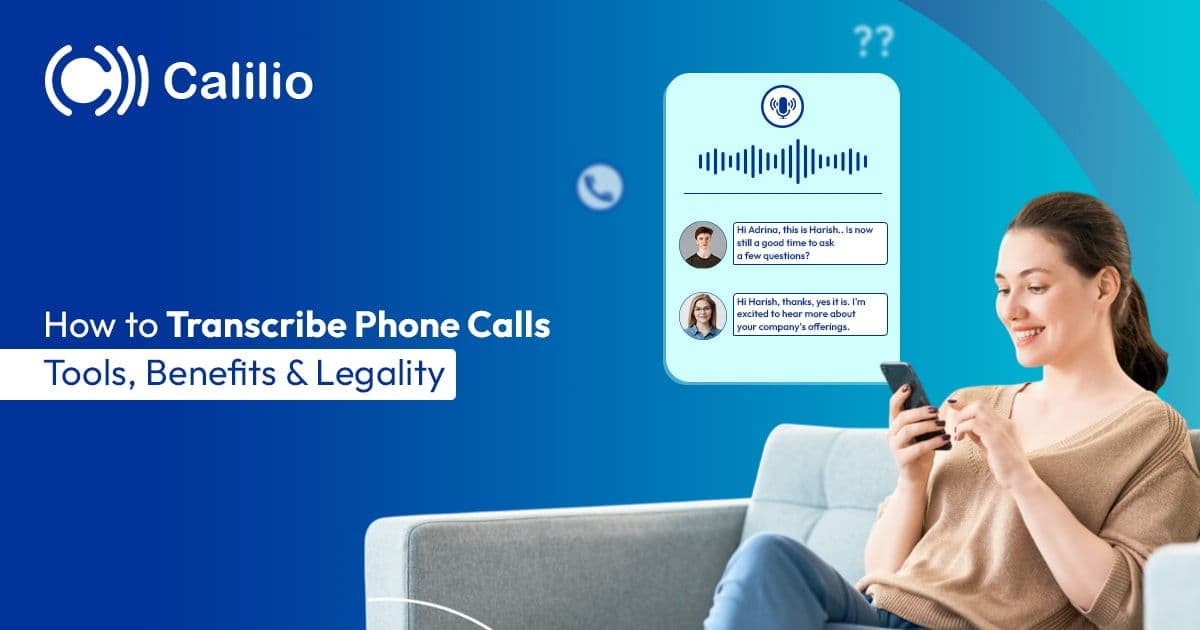
A call transcript is a written record of what was said on a phone call, produced by converting the audio to text. Most transcripts label who is speaking and add timestamps, so you can jump to the exact moment in the recording.
Transcripts come in a few styles. A verbatim transcript captures every word, including filler words, false starts and pauses, which is useful for legal or research work. An edited transcript removes the filler and repetition and fixes grammar so it reads cleanly. A lightly edited, sometimes called intelligent, transcript keeps the speaker's wording but fixes only the errors that distract. Many AI tools also add a short summary and a list of action items beneath the full text.
A transcript is not the same as a recording. The recording is the audio file, and the transcript is the text made from it. Teams usually keep both, because the text is quick to search and the audio is the proof of tone and exact wording.
How Does Call Transcription Work?
Call transcription works by capturing the audio, passing it through speech recognition, and formatting the output as text. The same pipeline sits behind a phone app, a cloud phone system and an upload website, only the starting point differs.
- Capture the audio: The call is recorded on a phone system, a recorder app or a separate device. On a cloud phone system, the audio is captured on the provider's servers as the call happens.
- Process the speech: An automatic speech recognition (ASR) engine converts sound into words. It uses language models to guess the most likely word when audio is unclear, which is why names, jargon and heavy accents are harder.
- Separate the speakers: The software tags who is talking, a step called speaker diarization. This works best on two-person calls and gets harder with several voices at once.
- Format the text: Punctuation, timestamps and paragraphs are added, and some tools add a summary, keywords or a sentiment score.
- Deliver and store: The transcript appears in an app, a call log, an email or a CRM record, where you can search, edit and export it.
Transcription can run live, with captions appearing while people talk, or after the call ends. Live captions help during the call itself, while post-call transcripts are better for records, because they get a second pass for accuracy and formatting.
What Are the Ways to Transcribe a Phone Call?
There are four practical routes, and the right one depends on how many calls you handle and how accurate the text must be.
| Method | How it works | Speed | Accuracy | Best for |
| Phone system with built-in transcription | Calls are recorded and transcribed automatically inside the system | Minutes after the call | Good on clear audio | Businesses and teams |
| Phone's built-in feature or app | Record on the handset, then read the transcript in the app | Minutes | Good on clear audio | Individuals |
| Recorder app plus upload tool | Record, export the file, upload it to a transcription service | Minutes to hours | Good to very good | Occasional calls |
| Human transcription service | A person types or edits the text | Hours to days | Highest, especially on noisy audio | Legal, research, formal records |
Phone system with built-in transcription: A cloud phone system records calls on the server and transcribes them without any extra step. The transcript sits next to the call in the call log, with the contact, the date and any notes. For a business that takes many calls a day, this removes the upload work, and every agent's calls are handled the same way.
The phone's own feature or an app Call recording on handsets varies by device and country. Some recent iPhones running iOS 18.1 or later can record calls and show a transcript in the Notes app in supported languages and regions, and the other party is told the call is being recorded. On Android, call recording depends on the manufacturer and country, so many people use a recorder or live-caption app instead. Google Voice transcribes voicemail, not calls.
A recorder app plus an upload tool You record the call with an app, export the audio file, and upload it to an AI transcription service. Common formats such as MP3, WAV and M4A are accepted by most services, and the results are usually exported as TXT, DOCX, PDF or SRT. This works well for a handful of calls a month, but it becomes tedious at volume, since each call needs its own export and upload.
A human transcription service A professional transcriber types or corrects the transcript. It is slower and priced per audio minute, but it handles accents, crosstalk and bad audio better than software. Pick it for depositions, research interviews or any record where one wrong word matters.
How Do You Transcribe a Phone Call Step by Step?
This process fits any method. The only difference is whether the tool does steps 2 to 4 for you.
Step 1: Check the consent rules for every location involved. Decide who needs to be told about the recording and add the notice to your greeting or opening line.
Step 2: Record the call in the cleanest way available. Use a headset, a quiet room and a stable connection, and avoid speakerphone when possible.
Step 3: Run the audio through speech recognition. In a phone system this happens automatically, and with an upload tool you drag in the file and pick the language.
Step 4: Review the transcript. Check names, numbers, addresses and anything legal or financial against the audio, since these are the details AI most often gets wrong.
Step 5: Store and label the result. Save the transcript with the contact, date and topic, set a retention period and restrict access to people who need it.
Step 6: Use it. Add action items to your task list, log the summary in your CRM, or flag the call for coaching.
How Accurate Is Call Transcription?
Accuracy depends mostly on the audio. Clean, two-person calls in a quiet room often come out very well, while crosstalk, speakerphone, bad cell coverage and heavy background noise can cause many errors. Vendors publish different accuracy figures, and few of them are tested on real phone audio, so treat any single percentage as a best case rather than a guarantee.
Phone audio is a harder test than studio audio. Landline and cellular calls are compressed to a narrow band of frequencies, which strips detail that speech recognition relies on. Calls over VoIP can sound better when the connection is stable, and a call recording taken at the source usually beats a recording of a speaker with a second device.
| Factor | Effect on accuracy | What to do |
| Background noise | Large | Use a quiet room and a noise-canceling headset |
| Several speakers talking at once | Large | Ask people to take turns |
| Accents and dialects | Moderate | Pick a tool that supports the language variant |
| Jargon, names and product terms | Moderate | Add a custom vocabulary if the tool allows it |
| Poor network quality | Moderate | Test the connection before important calls |
| Speakerphone or second-device recording | Large | Record at the source instead |
A short checklist keeps transcripts reliable. Speak clearly and at an even pace, spell out names and numbers, confirm key details back to the caller, and skim every transcript that feeds a contract, invoice or dispute.
What Can You Do With Call Transcripts?
A transcript turns a one-time conversation into data your team can search and reuse. These are the most common uses, and each one saves time that would otherwise go to replaying audio.
Accurate records and follow-ups A transcript captures the exact quote, the promised delivery date and the agreed price, so nobody relies on memory. The sales rep can paste the key lines into a CRM note and send a confirmation email the same day.
Searching past conversations Typing a keyword into a transcript archive is far faster than listening to hours of audio. A support lead can find every call that mentioned a specific product name or error message in seconds.
Coaching and training Managers can read real calls, mark strong and weak moments, and use them as examples for new hires. Reading a call is quicker than listening to it, so reviews cover more calls in the same time. Teams that go deeper can track sales call transcript analysis metrics such as talk-to-listen ratio and question count.
Trend spotting Counting how often a word or complaint appears across hundreds of calls shows patterns that individual calls hide, such as a recurring billing question or a competitor name. Marketing, product and operations teams can all use that input.
Customer experience and sentiment Words, tone and repeated frustration signal how a customer felt. Text analysis can flag unhappy calls for follow-up, a technique known as customer sentiment analysis.
Compliance and disputes A written record of disclosures, consent statements and instructions makes it easier to resolve disagreements and show that required wording was used. Some industries have formal retention rules, so check what applies to you.
Accessibility Text lets people who are deaf or hard of hearing, or who work in loud places, follow a conversation.
Voicemail Voicemails can be transcribed too, so a message can be read in a meeting without playing audio. Voicemail transcription is often the first transcription feature a small business turns on.
Is It Legal to Transcribe a Phone Call?
Laws apply mainly to recording the call, and the transcript inherits that status. If a recording was made lawfully, transcribing it is generally lawful too, but storing and sharing the text can raise separate privacy duties. This section is general information and not legal advice, so confirm the rules for your location and industry with a qualified professional.
One-party and all-party consent In the United States, federal law (18 U.S.C. § 2511) allows you to record a call if you are a party to it, or if at least one party consents. States set their own rules. Justia's 50-state survey lists California, Connecticut, Delaware, Florida, Illinois, Maryland, Massachusetts, Michigan, Montana, Nevada, New Hampshire, Oregon, Pennsylvania, Vermont and Washington as states that require, or may require, all parties to agree, and several have exceptions. Canada also requires care, since at least one participant must consent and notice is the safest practice.
Calls across borders When the people on a call are in different places, the stricter rule is the safest to follow. A call from a one-party state to an all-party state should be treated as an all-party call.
Outside North America Many countries add data protection laws on top of recording rules. In the European Union and the United Kingdom, voice and transcripts that identify a person can count as personal data under GDPR, which requires a lawful basis, a clear notice, limits on how long you keep them and rights for people to see their data.
Practical safeguards Announce the recording at the start of every call, using a greeting such as "This call may be recorded and transcribed for quality and record-keeping." Keep a written policy for staff, limit who can see transcripts, set a retention period, and delete data you no longer need. Avoid reading out full card numbers on a recorded line, and use pause-and-resume features where your system offers them. Notice, consent and retention are the core of call recording compliance, and the same habits cover transcripts.
How Do You Choose a Call Transcription Tool?
Choose by volume and by where the audio comes from. One person with an occasional call needs a phone feature or a pay-per-minute upload tool. A team that takes calls all day needs transcription tied to the phone system so there is no manual work.
Compare these points before you commit:
- Source of audio: Does the tool capture calls directly, or do you upload files? Direct capture saves hours at scale.
- Languages and accents: Check the specific languages and regional variants you need, not just the headline language count.
- Speaker labels and timestamps: Both make long calls easier to review.
- Search and export: Look for keyword search across all calls and export to TXT, DOCX, PDF or CSV.
- Integrations: A transcript that lands in your CRM or helpdesk saves copy-and-paste. Calilio, for example, connects with Pipedrive, HubSpot, Zoho CRM, Salesforce and Pabbly Connect.
- Security and retention: Look for encryption, access controls and adjustable retention periods.
- Pricing model: Per-minute pricing suits low volume, while monthly plans with an included allowance suit steady volume. Check whether recording, storage and transcription are billed separately.
Dedicated call transcription software is worth shortlisting when you only need transcripts and not a full phone system.
Next step
Ready to Get Started?
Transcribing a phone call comes down to capturing clean audio lawfully, running it through speech recognition or a human transcriber, and checking the details that matter. Individuals can rely on a phone feature or an upload tool, while teams save the most time with transcription built into the phone system. Whichever route you choose, give notice, follow the consent rules where your callers are, and limit who can read the results.
Calilio is a cloud business phone system that records calls and offers AI transcription, AI call reports and sentiment analysis alongside calling, SMS and a shared call log.
Frequently Asked Questions
Can I transcribe a phone call for free?
Yes, within limits. Some phones, apps and free tiers of upload tools transcribe a limited number of minutes at no charge, and manual typing costs only your time. Free options usually cap length or monthly minutes, so check the limits before a long or important call.
Is it legal to transcribe a phone call?
It depends on whether the call was recorded lawfully. In one-party consent places you can usually record a call you are on, while all-party places require everyone to agree. Always tell participants the call is recorded and transcribed, and check local rules.
How do I transcribe a phone call on an iPhone?
Some iPhones with iOS 18.1 or later can record a call and show a transcript in the Notes app, in supported languages and regions. Participants are told a recording has started. If your device or region does not support it, record with an app and upload the audio to a transcription tool.
How do I transcribe a phone call on Android?
Android call recording varies by manufacturer and country, and there is no single built-in transcript feature for calls. Options include a recorder app plus an upload tool, a live-caption app, or a cloud phone app that records and transcribes inside the app.
How accurate are AI call transcripts?
Accuracy ranges widely with audio quality. Clean two-person calls can be very accurate, while noisy, accented or overlapping speech produces more errors. Review names, numbers and dates by hand before relying on a transcript for anything important.
How long does it take to transcribe a phone call?
AI tools usually return text within minutes of the call ending, and some produce live captions during the call. Human services take hours to days depending on length and turnaround. Manual typing can take several times the length of the audio.
Can calls in other languages be transcribed?
Many tools support multiple languages, and some detect the language automatically. Support is uneven, so check the exact language and regional variant. Calls that switch languages mid-conversation are the hardest case and may need human review.
What is the difference between call recording and call transcription?
Recording saves the audio of a call, and transcription converts that audio into text. You need a recording, or live audio, to transcribe. Keeping both gives you searchable text and the original audio as proof.
Can voicemails be transcribed too?
Yes. Many carriers and phone systems convert voicemail to text and send it by email or show it in an app. Accuracy follows the same rules as calls, so short, clear messages work best.
Is call transcription useful for small businesses?
Yes. A small team without a note-taker benefits most, because the transcript acts as a record of quotes, appointments and promises. It also helps owners review how staff handle calls without sitting in on them.