
Top 10 eVoice Alternatives for Your Business

eVoice is a virtual phone service that helps businesses handle calls using tools such as call forwarding, voicemail, and basic number management. However, many modern businesses find it limiting due to a lack of essential features like power dialers, call queues, and advanced call reporting, affecting day-to-day operations and sales.
That’s why businesses are looking for alternatives for better call management and team collaboration.
In this guide, we’ll explore the best eVoice alternatives, comparing their features, pricing, pros, and cons to help you choose the right phone system for your business.
Key Highlights:
eVoice is a widely used virtual phone system, but it falls short in key areas like essential VoIP capabilities, call analytics, multi-channel support, and integrations.
Businesses look for eVoice alternatives to get better call management features, AI-powered insights, team collaboration tools, and flexible communication options.
Calilio, Nextiva, RingCentral, Grasshopper, Dialpad, Ooma Office, Aircall, Quo, Vonage, and 8×8 are some of the top alternatives.
Among them, Calilio stands out for its AI-driven call reports, power dialer, IVR, unified callbox, and cost-effective plans that fit teams of all sizes.
Why Do Businesses Switch from eVoice to Other Alternatives?
Businesses switch from eVoice because it lacks some of the essential telephony features and useful integrations like those found in modern phone systems. Its outdated interface, limited functionality, and unclear pricing make it harder to scale. Plus, it offers a limited texting feature, which limits how businesses engage with customers.
- Outdated and Clunky UI: Using eVoice often feels slower. The interface looks old, and everyday tasks like managing users or call settings take extra effort. Over time, this affects productivity.
- Missing Key Features: eVoice lacks telephony features like call queues, IVR menus, and detailed call insights. Without these, managing sales and support calls becomes harder to scale.
- Lacks Essential Integrations: eVoice connects with very few business tools. It can be limiting for modern teams that rely on CRMs and other business tools to keep work connected.
- Limited Texting Capabilities: Managing SMS conversations or using texts for follow-ups feels restrictive with eVoice. It can affect the sales teams that depend on quick responses.
- Hidden and Unclear Costs: While the base rates in eVoice may seem affordable at first, extra charges often appear for additional features. These unexpected fees make it difficult for businesses to predict monthly costs.
Top 10 Best eVoice Alternatives for Your Business
Calilio, Nextiva, RingCentral, Grasshopper, Dialpad, Ooma Office, Aircall, Quo, Vonage, and 8x8 are some of the best eVoice alternatives.
1. Calilio
Calilio is the best eVoice alternative for businesses looking for an advanced VoIP (Voice over Internet Protocol) phone system. eVoice relies on simple call routing with an auto attendant, whereas Calilio supports intelligent call routing through an Interactive Voice Response (IVR) system. It also allows you to customize your business hours and direct customer calls to voicemail or forward to another number as required. Moreover, Calilio also gives you clearer call outcomes through its detailed call dashboard and analytics, along with AI-powered call reports. While eVoice offers only basic call logs, Calilio’s call reports include call summaries, sentiment analysis, and call conclusions. Also, Calilio provides the power dialer to automate outbound calling and boost sales campaigns, which eVoice doesn’t offer.
Pros and Cons:
Pros | Cons |
|
|
Switch from Evoice to a Feature-Rich Cloud Phone System at an Affordable Price
2. Nextiva
Nextiva offers an AI-powered unified CXM (Customer Experience Management) platform built for businesses that handle customer conversations across multiple channels. It brings voice, live chat, SMS, email, social channels, reviews, video, and messaging apps into one unified communications system. With a shared inbox, internal team messaging, and team rooms, your team can manage all conversations from a single place instead of switching between tools, which is a clear step up from eVoice’s limited setup. Nextiva also supports advanced call handling and performance tracking. It includes call queues, call barging, call park, and call pull to manage live calls more effectively. Furthermore, it also supports auto dialers and boosts outbound calling through automated dialing.
Pros and Cons:
Pros | Cons |
|
|
3. RingCentral
RingCentral is an all-in-one AI communications platform built for teams that need voice, messaging, and meetings in one system. Unlike eVoice, which only offers basic calling and requires add-ons for even call recording, RingCentral includes automatic call recording, business SMS, and the ability to call directly from a computer softphone. RingCentral also includes features like shared lines, call delegation, call park, call flip, and push-to-talk, making it easier for teams to manage calls across devices and locations. Plus, its visual voicemail ensures no messages are missed, and real-time analytics track agent performance, call trends, and detailed metrics. Moreover, with CRM and productivity integrations, it helps teams stay organized and connected as they scale.
Pros and Cons:
Pros | Cons |
|
|
4. Grasshopper
Grasshopper offers a strong phone system choice for small businesses and solopreneurs. Unlike eVoice’s limited live answering service, Grasshopper offers deep, native integration with Ruby, allowing for smoother hand-offs between the virtual system and live agents. Furthermore, Grasshopper also provides automatic call recording for both inbound and outbound calls on every extension, along with conversation filters and voicemail transcription. It supports custom extensions and flexible call forwarding, so multiple users can manage calls with their own extensions while keeping setup simple. Moreover, users also find Grasshopper’s app more modern and easier to navigate, compared to eVoice’s outdated and less intuitive system.
Pros and Cons:
Pros | Cons |
|
|
5. Dialpad
Dialpad is a strong eVoice alternative for businesses that need an AI platform for communication. While eVoice is a basic virtual phone system for voice calls, Dialpad offers a full Unified Communications as a Service (UCaaS) platform that combines calling, messaging, meetings, and AI in one place. Furthermore, Dialpad supports SMS, MMS, and team chat through a unified inbox for efficient team collaboration. Dialpad also includes native video conferencing and live analytics dashboards, giving managers clear insights into call activity.
Pros and Cons:
Pros | Cons |
|
|
6. Ooma Office
Ooma Office is a complete business phone system and a solid eVoice competitor. Though eVoice pricing starts from $14 and Ooma office starts at $19, Ooma comes with more advanced features right from the basic plan, making the price totally worth it. Its basic plan includes a virtual receptionist, unlimited calling in the US, Canada, Mexico, and Puerto Rico, along with other 50+ standard features. In addition to voice calling, Ooma Office includes built-in video conferencing through Ooma Meetings, internal team chat, and MMS for sending images and files. It also includes advanced call management tools such as call queuing, hot desking, and an auto-dialer, along with CRM integrations like Salesforce and HubSpot.
Pros and Cons:
Pros | Cons |
|
|
7. Aircall
Aircall is one of the best VoIP phone systems and a strong alternative to eVoice for small businesses. Unlike eVoice, which is a basic virtual phone system, Aircall is an AI-powered communication platform. It offers live call coaching tools such as call whispering, call barging, and warm transfers, allowing managers to support agents in real time and share context before handoffs. Aircall also provides live dashboards to track agent availability, wait times, and performance, along with features like shared call inboxes for handling high call volumes. Moreover, Aircall includes a built-in power dialer to automate outbound dialing, something that eVoice lacks, making it a better fit for sales and support teams.
Pros and Cons:
Pros | Cons |
|
|
8. Quo
Quo, formerly OpenPhone, stands out as a top eVoice alternative for startups and growing teams due to its feature-rich system and easy scalability. Unlike eVoice, Quo offers shared inboxes and collaborative numbers, allowing multiple team members to view calls, texts, and voicemails from the same contact in a single thread.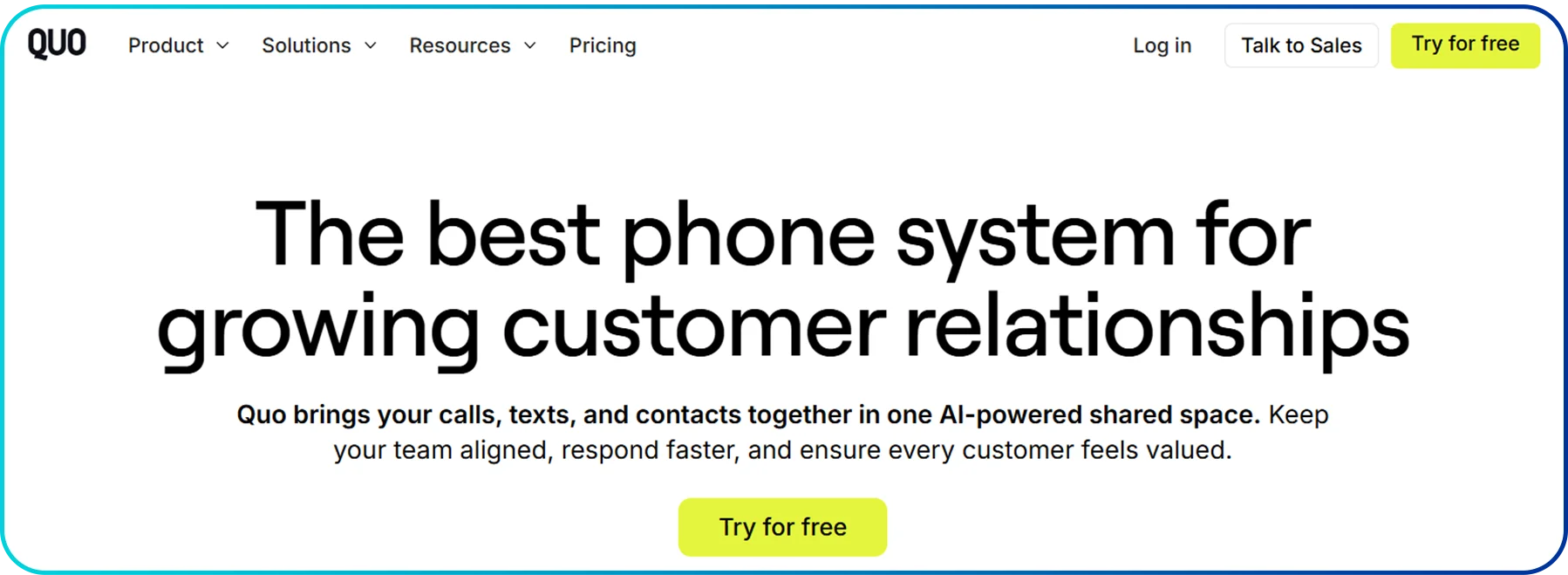 Quo also provides deep third-party integrations, connecting with over 7,000 apps, including popular tools like Salesforce, HubSpot, Slack, and Zapier, which eVoice lacks. Plus, it also includes additional features for texting, such as message scheduling and auto-replies for missed texts or calls. It also includes an AI agent through the Sona AI assistant, whereas eVoice only has a live receptionist, which limits automation and after-hours call handling.
Pros and Cons:
Pros | Cons |
|
|
9. Vonage
Vonage offers a full UCaaS platform with features that go beyond what eVoice offers. While eVoice only supports video calling with up to 25 participants, Vonage supports up to 200 participants with screen sharing, whiteboarding, and recording. In addition, Vonage integrates with over 20 third-party tools, including Salesforce, HubSpot, Zendesk, Slack, and Microsoft Teams, which helps teams manage CRM and daily workflows more easily. In terms of security, eVoice provides basic privacy and data protection, while Vonage provides enterprise-grade protection with global compliance certifications like ISO (International Organization for Standardization) 27001, SOC 2 (Security Operations Center), PCI-DSS (Payment Card Industry Data Security Standard), and HIPAA (Health Insurance Portability and Accountability Act), along with regular third-party audits.
Pros and Cons:
Pros | Cons |
|
|
10. 8x8
8x8 is one of the best alternatives to eVoice, especially for businesses that need a scalable, all-in-one communication platform. While eVoice mainly focuses on simple call handling, 8x8 is built as a full CCaaS (Contact Center as a Service) and UCaaS (Unified Communications as a Service) platform. It comes with advanced omnichannel contact center capabilities and workforce engagement tools. Moreover, 8x8 offers mobile, local, and toll-free numbers in over 100 countries, while eVoice provides local numbers only in the U.S. and Canada.
Pros and Cons:
Pros | Cons |
|
|
Comparing the Best eVoice Competitors [Pricing & Features]
Provider | Standout Features | Starting Price (/user/month) | G2 Rating | Capterra Rating |
| Calilio | AI-powered call reports, power dialer, IVR, unified callbox, shared numbers | $15 | 4.7/5 | 4.3/5 |
| Nextiva | AI-powered unified CXM, multi-channel (voice, chat, email, social), call queues, real-time analytics | $23 | 4.5/5 | 4.6/5 |
| RingCentral | All-in-one AI communications, call flip/park/delegation, live transcription, sentiment analysis | $30 | 4.3/5 | 4.5/5 |
| Grasshopper | Virtual phone numbers (vanity, toll-free, local), number porting, custom extensions, voicemail transcription | $29 | 4.3 | 4.2 |
| Dialpad | AI voice intelligence, real-time transcription & sentiment analysis, unified inbox, outbound dialer | $27 | 4.4/5 | 4.2/5 |
| Ooma Office | VoIP support for desk phones & analog devices, MMS, internal chat, auto-dialer | $19.95 | 4.2 | 4.1 |
| Aircall | Live call coaching (whisper & barge), shared inbox, power dialer, AI voice agent | $40 | 4.4/5 | 4.2/5 |
| Quo | Shared inbox, collaborative numbers, Sona AI 24/7 voice agent, auto-replies | $25 | 4.7/5 | 4.2/5 |
| Vonage | UCaaS platform, IP desk phones, built-in video conferencing, analytics dashboards | $19.99 | 4.3/5 | 4/5 |
| 8x8 | CPaaS + UCaaS + CCaaS, programmable voice & IVR, messaging apps integration, automation builder | $25 | 4.2/5 | 4.1/5 |
Conclusion
eVoice is a reliable virtual phone system for small businesses. However, due to its limited features, outdated setups and UI, businesses often look for other alternatives to access more advanced telephony features, AI-driven insights, and multi-channel support. Alternatives like Calilio, Nextiva, RingCentral, and Dialpad provide advanced features and better performance compared to eVoice.
Choosing the best eVoice alternative depends on your business needs. If you’re looking for a simple, budget-friendly, yet feature-rich cloud phone system, Calilio is a suitable choice. It stands out for its competitive pricing, quick setup, and easy scalability. Along with basic call management tools, it also offers advanced telephony features such as AI-powered call reports for detailed interaction analysis and a power dialer to automate manual dialing and boost sales campaigns.
With plans starting at just $12 per user per month (annual pricing), Calilio is a mix of advanced call management and AI tools at an affordable price.
Summarize this blog with:
Frequently asked questions
Is eVoice good for small businesses?
eVoice can work for very small teams that only need basic call forwarding and voicemail. However, it lacks modern essential VoIP features, integrations, and multi-channel communication, which makes scaling or managing larger call volumes difficult. Small businesses that want easy scalability and advanced features benefit more from alternatives like Calilio, Grasshopper, or Aircall.
Are eVoice alternatives more cost-effective than eVoice?

Still have questions?
Can’t find the answer you’re looking for? Please chat with our friendly team.
Stay in the loop
Get the latest call insights, trends, and updates delivered straight to your inbox.
By subscribing, you agree to receive updates from Calilio.
You can unsubscribe anytime.
Enter the World of AI Business Phone System with Calilio
Improve your business operation with Calilio's advanced virtual phone system. Join today for a better way to connect.