
How to Reduce International Calling Costs for Your Business?
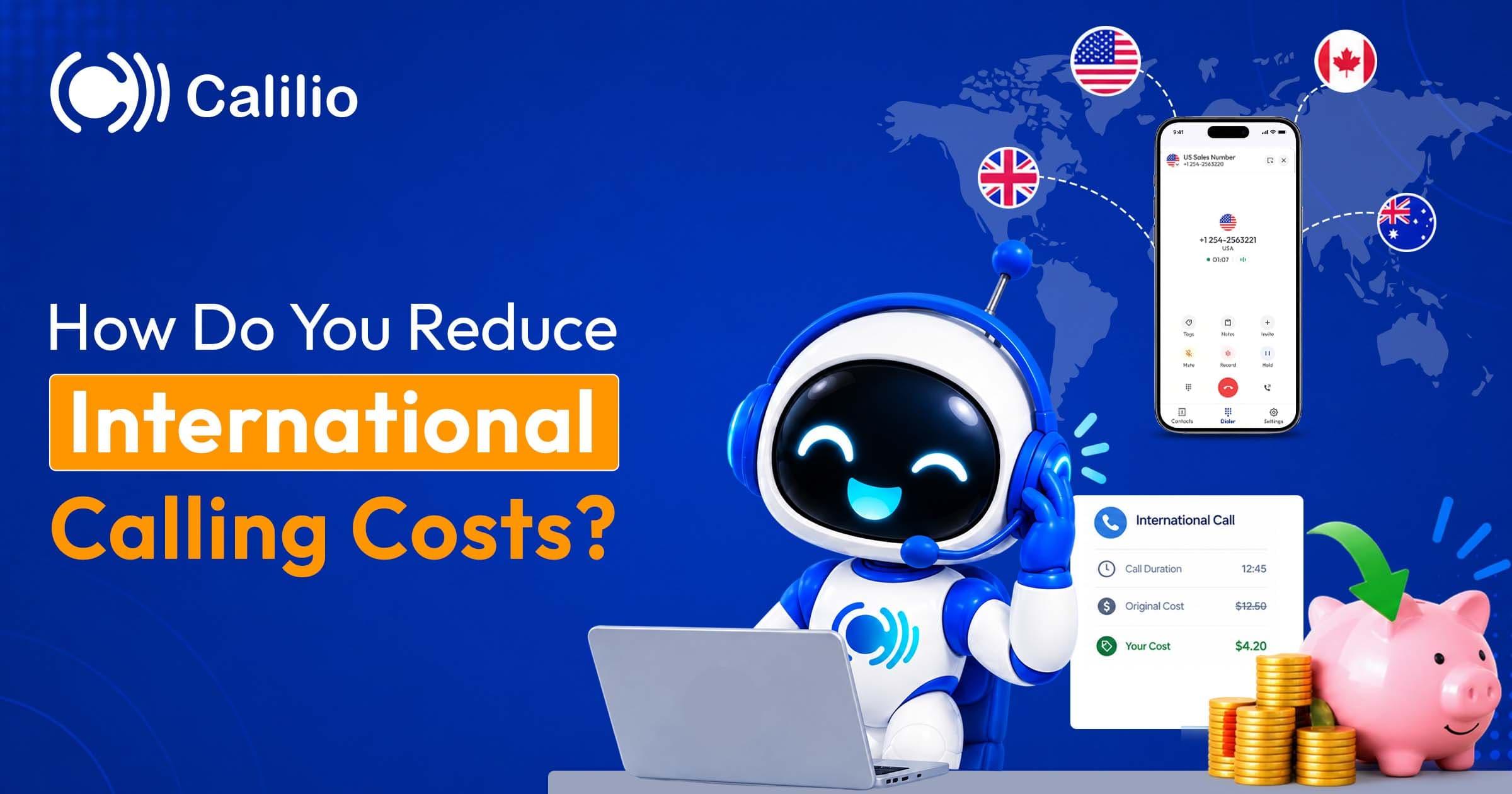

International calls are one of the few business costs that can quietly double without anyone noticing. A sales team that starts calling Australia, a support desk that picks up a client in Germany, a founder who takes calls on a mobile while travelling. Each one adds a few dollars a day, and the phone bill at the end of the quarter looks nothing like the one before.
The good news is that most of that cost is avoidable. The price of an international call depends far more on how it is carried and paid for than on the distance it travels. Below is what actually drives the cost, followed by nine ways to bring it down.
In short: move international calls off landline and mobile carriers onto a cloud phone system, check what calling your plan really includes, and buy prepaid country packs for the destinations you call every day instead of paying per minute.
The internet leg of a call costs almost nothing. What you pay is mostly the destination carrier’s termination fee, plus your provider’s margin.
Calls to mobiles cost more than calls to landlines in the same country, often by three or four times.
A prepaid country pack is cheaper per minute than the standard rate, but only if you use most of it.
Roaming, per-call connection fees and minute rounding often add more than the headline rate.
Why international calls cost what they do
Every international call has two halves. Your provider carries it from you to the destination country, and a local carrier there delivers it to the phone. The second half is called termination, and the destination carrier charges for it. That charge is the reason a call to a mobile in one country can cost four times a call to a landline in the same country. Mobile networks charge more to terminate a call than landline operators do.
The first half is where the real difference between providers appears. A traditional landline or mobile carrier prices international calls as a premium service and adds its own margin on top of termination, which is why rates of $1 to $3 a minute are still common on business mobile contracts. A cloud phone system carries the same call over the internet for almost nothing and only pays the termination fee at the far end, so its rate is close to the termination cost itself.
Then there are the extras that do not appear in the headline rate: connection fees per call, rounding up to the next full minute, minimum call charges, and roaming charges when the person calling is abroad. On a busy line these can add more than the rate does.
What you are paying for | Who sets it | What moves it |
| Termination fee | Carrier in the destination country | Landline vs mobile, and the country itself. This is the floor no provider can go below. |
| Carriage and margin | Your provider | Landline and mobile carriers add a premium; cloud systems add very little. |
| Connection fee | Your provider | A flat charge per call. Painful for short calls and voicemails. |
| Billing increment | Your provider | Per-second billing vs rounding up to the full minute. Adds up on high volumes. |
| Roaming | The mobile network where the caller is | Applies when you call from abroad using the phone’s own dialler rather than an app. |
Nine ways to reduce international calling costs
These are in rough order of how much they save for a typical small or mid-sized team. The first three do most of the work. The rest close the gaps.
1. Move international calls to a cloud phone system
This is the single largest saving and everything else builds on it. A cloud phone system (VoIP) carries the call over your internet connection and hands it to a local carrier at the destination, so you pay something close to the termination fee instead of a carrier’s international tariff. For most countries that turns a call priced in dollars per minute into one priced in cents.
It also removes the need for a separate international calling card or add-on, because international destinations are simply part of the rate sheet.
Do this: Pull the last three months of international minutes by country from your current bill. Price the same minutes on a cloud provider’s rate sheet. The gap is usually large enough to settle the question.
2. Know what calling your plan actually includes
Cloud phone plans differ a lot here. Some include a set number of free calling minutes each month. Some advertise unlimited calling, which in practice means unlimited to a short list of countries, subject to a fair-use cap and often excluding mobiles. Others include nothing and bill every minute from the first. The word on the pricing page tells you very little about what you will pay for international calls.
Where minutes are included, they renew every month whether you use them or not, and teams often leave them unused because nobody knows they are there.
Do this: Read the plan terms, not the headline. Check how many minutes are included, which countries they cover, whether mobiles count, and what the fair-use limit is on anything called unlimited. Then make sure the people who call abroad are the ones on that plan.
200 outgoing + 100 incoming minutes
100 outbound + 100 inbound SMS
1,000 outgoing + 500 incoming minutes
500 outbound + 500 inbound SMS
3. Buy a prepaid pack for the countries you call every day
Once any included minutes are used, paying the standard rate for every call is the default, but not the cheapest option for regular destinations. A country pack is a fixed price for a block of minutes to one country, and the effective rate per minute is lower than paying as you go. If a sales team calls the USA all day, a USA pack costs less than the same minutes at the standard rate.
The trade-off is that unused minutes expire. So packs are for the two or three countries that dominate your bill, not for every destination you ever call.
Do this: Rank your destinations by minutes per month. Price a pack for the top two or three and compare against last month’s per-minute spend on each.
4. Get local numbers where your customers are
A local number in the country you serve does two things. Customers there call you at local rates, so they are more likely to call at all. And your outbound calls show a local caller ID, which improves answer rates so you spend fewer minutes on unanswered calls and voicemails.
Do this: For each country with a meaningful customer base, add a local number and route it to the team that handles that market. Many providers include one number free with the plan.
5. Check whether you are calling mobiles or landlines
The same country can have a mobile rate several times its landline rate, because mobile networks charge more to terminate calls. If your contact list is mostly mobiles, that is where the cost is, and it will not show up if you only look at the country total.
Do this: Split last month’s minutes by destination type. Where mobiles dominate, that is the country to buy a pack for first, since the saving per minute is larger.
6. Stop roaming: use the app, not the dialler
A team member abroad who calls from their phone’s native dialler pays the local mobile network’s roaming rate, which can be the most expensive minute in the whole business. The same call placed from your business phone app over Wi-Fi or data is carried over the internet and billed at your provider’s normal rate.
Do this: Install the mobile app for everyone who travels, and make it the default for business calls. Calls placed through the app also show the business number, not a personal one.
7. Keep team-to-team calls inside the system
Distributed teams generate a lot of international minutes calling each other. On a cloud phone system, calls between users on the same account do not touch the public phone network at all, so they are free regardless of where each person is.
Do this: Make sure everyone who needs to reach colleagues abroad has a user seat, and use internal calling or the team chat instead of dialling each other’s mobiles.
8. Send a text where a call is not needed
Appointment confirmations, delivery updates and simple follow-ups do not need a call. An international SMS costs a fraction of a cent to a few cents, which is usually less than the first minute of a call and does not depend on anyone answering.
Do this: List the outbound calls that only deliver a short piece of information. Move those to SMS, and use a scheduled or bulk send for the repetitive ones.
9. Audit the bill once a quarter
Rates change, teams change and numbers get forgotten. A number bought for a market you no longer serve keeps billing monthly. A destination that was rare last year may now be your busiest. A quarterly look at the bill is enough to catch these, and it takes fifteen minutes.
Do this: Review numbers you pay for against numbers in use, minutes by country against the packs you hold, and any destination whose rate looks out of line with the rest.
Pay per minute or buy a pack? A simple rule
Once you are on a cloud phone system, the biggest remaining decision is how to pay for calls beyond whatever your plan includes. There are two options, and the right one depends on how often you call a given country.
Pay per minute means each call is charged at the standard rate for that destination and taken from your account balance. Nothing is wasted, but nothing is discounted either. A country pack is a fixed price for a block of minutes or SMS to one country, valid for a set period. The price per minute inside the pack is lower than the standard rate, but minutes you do not use before it expires are gone.
You call the country a few times a month or less
Your volume to that country changes a lot month to month
You are still working out which destinations matter
One country makes up a large share of your outbound minutes
The volume is steady enough that you will use most of the pack
You mostly call mobiles there, where the per-minute saving is biggest
A quick way to decide: look at last month's bill, find the countries that account for most of the minutes, and price a pack for each of those. If you would have used most of the pack, buy it. If you would have used half, pay per minute.
How this works in Calilio
Calilio is a cloud phone system, so international calls are already carried over the internet and priced close to termination cost. For example, outgoing calls to the USA cost between $0.0178 and $0.0837 per minute depending on whether you reach a landline or a mobile. Every plan also includes free calling minutes and SMS each month, which are used before anything is charged.
Plan | Free calling minutes | Free SMS |
| Standard · $15/user/mo ($12 annually) | 300 min (200 outgoing + 100 incoming) | 200 (100 outbound + 100 inbound) |
| Premium · $35/user/mo ($28 annually) | 1,500 min (1,000 outgoing + 500 incoming) | 1,000 (500 outbound + 500 inbound) |
When the free minutes run out, you choose. Calls can continue at the standard per-minute rate from your wallet, or you can open Calilio Hub inside the app and activate a prepaid pack for the country you call most. Packs come as call-only, SMS-only or combined, and calls to that country draw from the pack before touching the wallet. You can see the remaining balance and expiry on each active pack and renew it when it runs low.
Two other things help. Each paid subscription includes a free local number in the USA, Canada or UK, so customers in those countries can call you at local rates. And calls between team members inside Calilio are free, wherever they are, which removes a surprising amount of international cost for distributed teams.
Four mistakes that keep the bill high
Buying packs for every country. A pack you use a third of is more expensive than paying per minute. Buy packs only for destinations that dominate the bill, and pay as you go for the rest.
Looking at the country total instead of landline vs mobile. A country can look cheap on average while every call your team actually makes goes to a mobile at the high rate. Split the numbers before you decide anything.
Letting travelling staff use the native dialler. One week of roaming calls can cost more than a month of the whole team’s VoIP usage. The app over Wi-Fi solves it completely.
Comparing providers on the headline rate only. Per-call connection fees and rounding to the full minute can double the real cost of short calls. Check the billing increment and any per-call charge before comparing rates.
The bottom line
International calling is expensive when it runs through carriers built to charge a premium for it. Carried over the internet, the same call costs a few cents, and most of the remaining cost comes down to how you pay for it.
Start with the switch to a cloud phone system, check what calling the plan really includes, and buy packs for the two or three countries you call every day. Then check the bill once a quarter for mobile-heavy destinations, roaming and unused numbers. That routine keeps the cost where it should be without anyone having to think about it.
Pay Less for the Countries You Call Most
Calilio carries international calls over the internet at per-minute rates close to cost, and Calilio Hub lets you activate a prepaid pack for any country you call often. Plans start at $12 per user per month.

Frequently Asked Questions
Summarize this blog with:

Still have questions?
Can’t find the answer you’re looking for? Please chat with our friendly team.
Stay in the loop
Get the latest call insights, trends, and updates delivered straight to your inbox.
By subscribing, you agree to receive updates from Calilio.
You can unsubscribe anytime.
Enter the World of AI Business Phone System with Calilio
Improve your business operation with Calilio's advanced virtual phone system. Join today for a better way to connect.