
Hosted VoIP is a business phone service that carries calls as data over an internet connection, with the calling infrastructure run and managed by your provider rather than installed in your office. VoIP is the technology; hosted means somebody else owns and runs the servers.
- Your voice is digitised, split into packets, and reassembled at the other end — thousands of times a second.
- A call needs only about 85–100 kbps each way. Quality problems come from jitter and packet loss, not speed.
- Hosted VoIP, cloud VoIP, hosted PBX and cloud phone system all describe the same arrangement.
- It can be very secure, but check for TLS and SRTP encryption — neither is universal.
How a VoIP Call Actually Works
A traditional phone call was one continuous electrical signal travelling down a dedicated copper circuit. A VoIP call is thousands of tiny data packets taking whatever route is available and being reassembled in order at the other end. Five stages, all happening continuously in both directions.
A microphone in a headset, handset or phone converts sound waves into an electrical signal, which is sampled thousands of times per second and turned into digital values. This is the same process as recording audio on a computer.
A codec — coder-decoder — shrinks that audio so it can travel efficiently. G.711 keeps more detail and uses around 64 kbps; Opus and G.729 compress harder for constrained connections. This choice is the main trade-off between audio richness and bandwidth.
The compressed audio is chopped into small packets, each stamped with a sequence number so it can be put back in order. They travel over your internet connection to your provider, taking whatever network path is available rather than a dedicated circuit.
The packets arrive at the provider’s servers, which handle signalling — setting up, holding and ending the call — and apply your rules: a greeting, a phone menu, business hours, which device should ring. This routing layer is what makes it a phone system rather than just audio transport.
At the destination the packets are reordered using their sequence numbers, decompressed and played back as audio. A small buffer holds them briefly to smooth out uneven arrival, which is why there is always a fraction of delay on a VoIP call.
Hosted VoIP vs Running VoIP Yourself
VoIP describes the technology, not who operates it. There are three ways to use it, and the word “hosted” is what distinguishes the first from the other two.
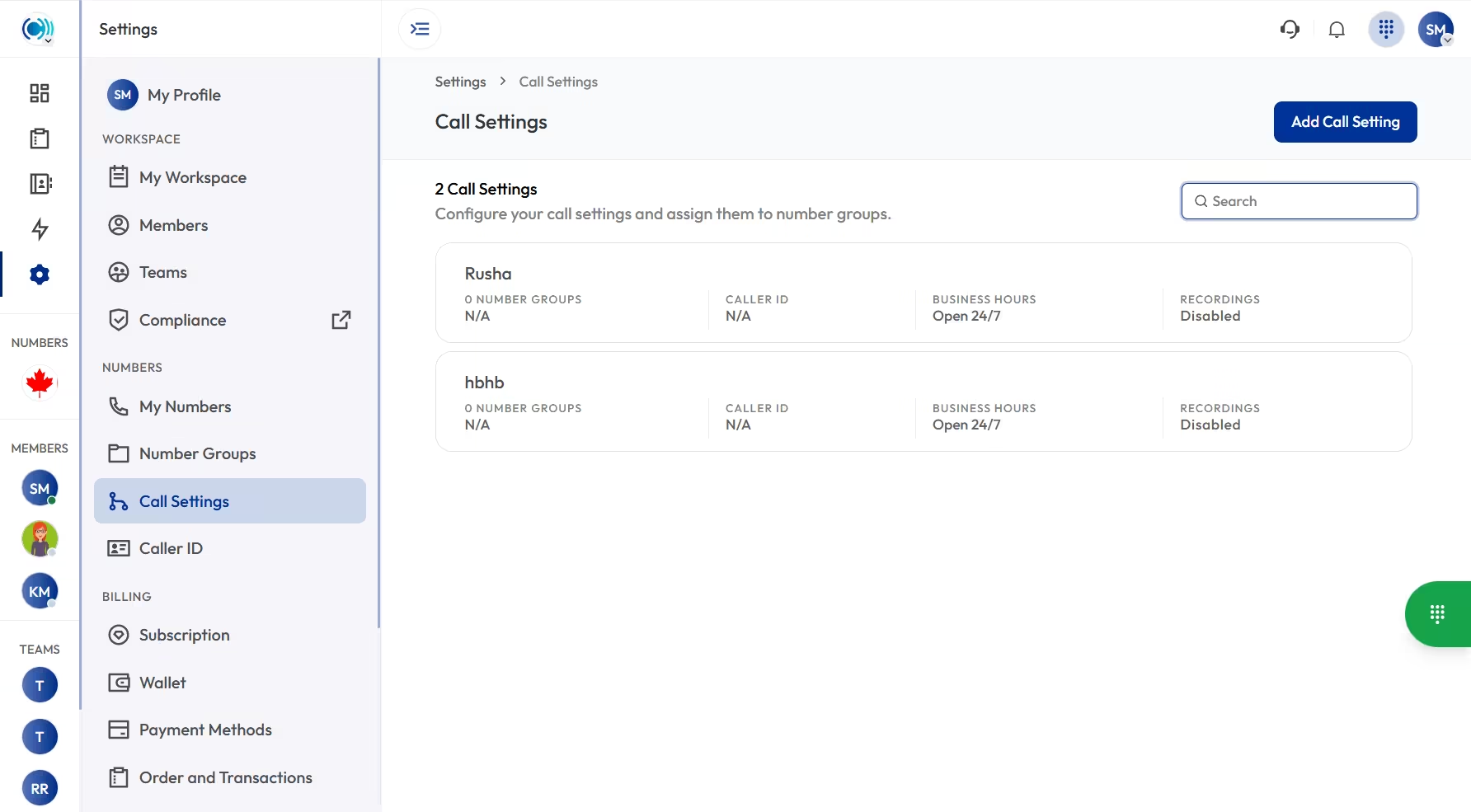
Your provider owns and runs the servers, the routing and the connections to the public phone network. You buy numbers, configure your call flows in a browser, and use apps or IP handsets. Nothing is installed on site.
You run your own PBX software — on a server in your building or a cloud instance you rent — and buy SIP trunks from a carrier to connect it to the public phone network. Common where an organisation wants full control or has unusual requirements.
App-to-app calling services also use VoIP, but they usually have no business phone numbers, no call routing, no shared inbox and no reporting. Fine for talking to colleagues, not for being the number customers call.
What Call Quality Really Depends On
This is the most misunderstood part of VoIP. Businesses upgrade to a faster internet package to fix choppy calls and are surprised when nothing improves, because speed was never the problem.
A single call needs roughly 85 to 100 kbps in each direction — a rounding error on any modern connection. What matters is consistency, measured by four numbers.
Measure | What It Is | Target | What It Sounds Like When Bad |
| Latency | How long a packet takes to reach the other end, one way | Under 150 ms | People talk over each other; awkward gaps |
| Jitter | Variation in packet arrival times | Under 30 ms | Stuttering, robotic or warbling audio |
| Packet loss | Share of packets that never arrive | Under 1% | Words or syllables dropping out mid-sentence |
| Bandwidth | Capacity available per concurrent call | 85–100 kbps each way | Only a problem when genuinely saturated |
The practical implication: test with a real trial on your actual connection before migrating a team. A speed test tells you almost nothing useful about how your calls will sound.
What You Need to Run Hosted VoIP
Less than most people expect. The infrastructure is your provider’s problem, so your side of it comes down to six things — and only the first two matter much.
- A stable internet connection: Not necessarily a fast one. Business-grade connectivity with consistent performance beats a faster consumer line that fluctuates through the day.
- A decent headset: The cheapest meaningful upgrade to call quality. A laptop’s built-in microphone picks up the room; a headset picks up you.
- Apps, or optional IP handsets: Desktop and mobile apps are enough for most teams. IP desk phones are optional and useful where people share a workspace, such as a shop or clinic.
- QoS on your router, if calls compete: Quality of Service rules prioritise voice packets over file downloads and video streaming. Worth configuring in a busy office, unnecessary for a handful of people.
- Business phone numbers: Either ported from your existing provider or bought new. Numbers belong to your account rather than to a physical line.
- A power-cut plan: Digital lines carry no power of their own, so mains failure takes desk phones down. Mobile apps on cellular are the practical fallback.
Is Hosted VoIP Secure?
It can be, but it is not secure by default, and the risk people worry about is not the one that actually costs businesses money. Two things to insist on, and three that get overlooked.
✓
Transport Layer Security encrypts the instructions that set up, transfer and end calls. Without it, someone on the network path can see who called whom and potentially interfere with the call setup.
✓
Secure Real-time Transport Protocol encrypts the voice packets themselves. TLS without SRTP protects the envelope but not the letter — ask providers about both, since only one is sometimes offered.
!
Interception makes better headlines, but the common attack is account compromise followed by thousands of dollars of premium-rate international calls in a weekend. Strong passwords, two-factor authentication and international dialling limits matter more than encryption specifics.
!
A recorded call archive holds names, addresses, card discussions and sometimes health information. Ask where recordings are stored, whether they are encrypted at rest, and who inside your business can retrieve them.
!
Because a VoIP number is not tied to a building, emergency services cannot infer your location. Registered addresses must be kept current, particularly for staff who move between sites.
Hosted VoIP vs a Traditional Landline
This comparison is becoming academic — carriers worldwide are retiring analogue networks — but the differences explain why the migration is happening at all.
# | Hosted VoIP | Analogue landline |
| How calls travel | Data packets over the internet | Continuous signal over copper |
| Numbers tied to | Your account | A physical line into a building |
| Cost model | Monthly per user | Line rental plus per-minute charges |
| Remote working | Built in | Not possible without forwarding |
| Adding a line | A setting, minutes | An engineer visit |
| In a power cut | Needs mains power; use mobile apps | Basic corded phones often still work |
| Long-term availability | The current standard | Being retired by carriers worldwide |
What Hosted VoIP Costs
Pricing is per user per month with no equipment to buy, but the advertised seat price is rarely the whole invoice. Five line items make up the real monthly cost.
One question settles it on a sales call: what is the total monthly invoice for my exact number of people, on the plan that includes the features I just described? Anything other than a single figure needs following up.
The Bottom Line
Hosted VoIP is simply how business phone calls work now. The technology is settled, the naming is needlessly confusing, and the two things worth your attention are both practical rather than technical.
First, connection stability decides call quality — not speed, so test on a real trial rather than trusting a speed test. Second, ask specifically about TLS and SRTP encryption and about international dialling limits, because toll fraud costs businesses far more than interception ever has.
Try Hosted VoIP on Your Own Connection
Port your existing number to Calilio and get a multi-level phone menu, business hours, call recording, voicemail and apps for desktop and mobile. From $12 per user per month with a 14-day money-back guarantee.