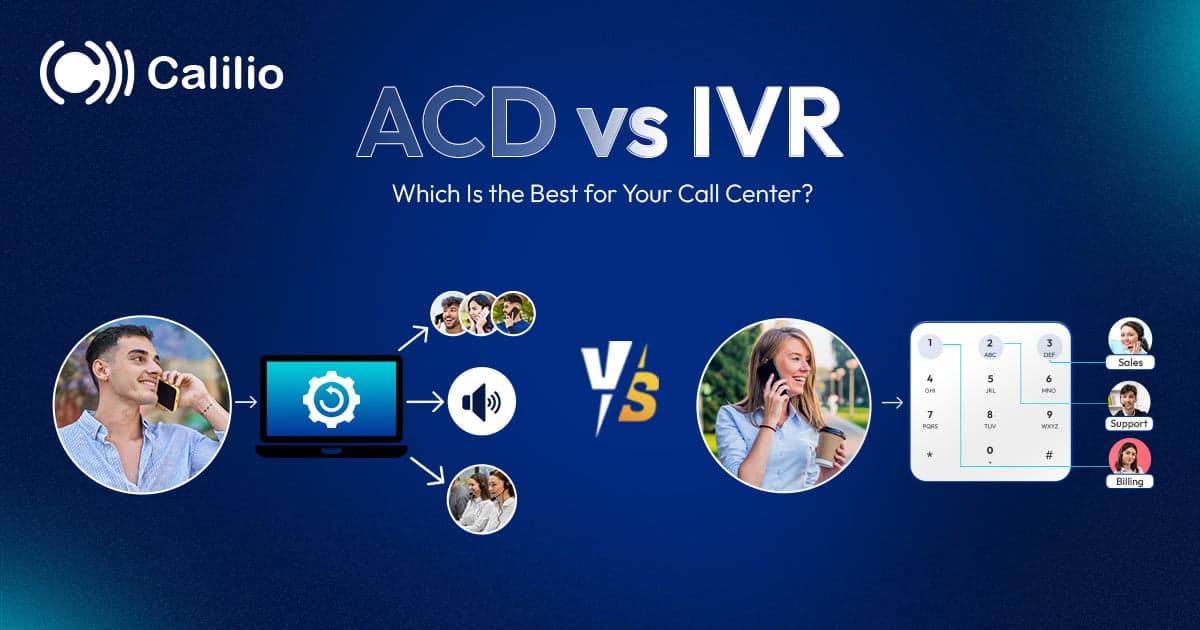
Automatic Call Distribution (ACD) and Interactive Voice Response (IVR) are critical features for managing a high volume of calls in call centers. While ACD efficiently routes incoming calls to the appropriate agent based on predefined criteria, IVR provides automated responses, and routes calls through voice or keypad inputs.
Understanding the difference between ACD and IVR helps you choose the best feature for your business and optimize your call center operations.
What is IVR?
IVR is the automated voice a caller interacts with. It greets the caller, offers a menu ("Press 1 for sales, press 2 for support"), and accepts keypad or spoken input. Its job is to identify the reason for the call — and, where possible, resolve it without an agent: business hours, order status, appointment confirmations, account balances.
The simplest IVR is an auto attendant — a menu that routes. More advanced IVRs branch through multiple levels, look up records, and increasingly hand the conversation to conversational AI that understands natural speech instead of keypresses. In Calilio, the IVR lives in Call Flows: you build the menu, assign an action to each key — route to a team member, play a message, take a voicemail — and set what happens when a call goes unanswered.
What is ACD?
ACD is the engine that assigns calls to people. Once the system knows where a call should go — because the IVR classified it, or because it arrived on a specific number — the ACD holds it in a queue if everyone is busy and then picks the agent who should take it, using distribution rules:
⇶
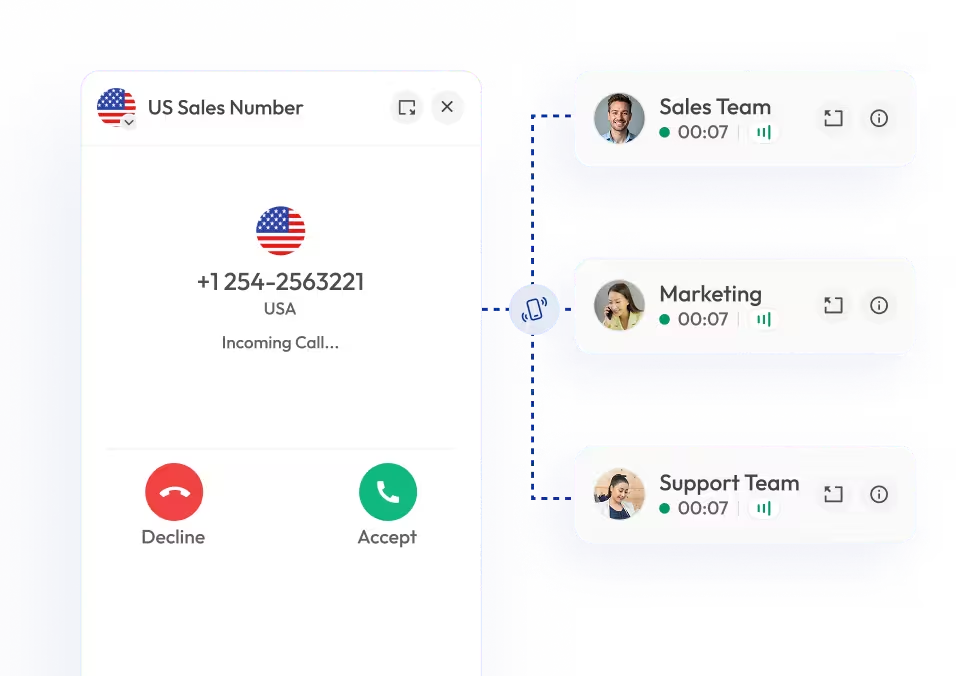
Simultaneous ring
Every available agent rings at once; the first to answer takes the call.
→
Sequential ringing
Agents ring one after another in a fixed order until someone picks up.
⟳
Round robin
Calls rotate evenly through the team, so workload stays balanced.
◎
Skills-based routing
The call goes to the agent whose skills match — language, product line, seniority. A full-ACD feature for larger operations.
The caller never "sees" the ACD — no menu, no voice. They just experience its results: how long they wait, and who picks up. That invisibility is exactly why the two get confused; the IVR is the only part of the machinery a caller can hear.
Queues, distribution rules, agent availability tracking
Can it resolve a call alone?
Yes — hours, status checks, FAQs, voicemail
No — it always ends at a human
Where it sits in the call
First — before any human is involved
Second — after the call is classified
Typical buyer
Any business with more than one department or high routine volume
Call centers and support teams with many agents
How they work together on one call
Follow a support call through a typical call center and the division of labor is obvious:
IVR
The IVR greets and asks
"Thanks for calling. Press 1 for orders, 2 for technical support." The caller presses 2. The call is now classified — no human involved yet.
IVR
Self-service gets a chance
The IVR offers "press 1 to check ticket status." If the caller just wants a status, the call ends here and no agent was needed.
ACD
The ACD queues the call
The caller needs a person. The ACD places the call in the technical support queue and holds it — hold music, position announcements.
ACD
The ACD picks the agent
Applying its rule — say, round robin — the ACD selects the next agent in rotation who is available and rings them.
☎
The agent answers with context
The agent picks up already knowing the caller chose technical support, with screen-pop history if the CRM is connected.
Which one does your business need?
Full ACD platforms — queues, skill-based routing, hold-position announcements — are call-center machinery, priced accordingly. Most small and mid-sized businesses need less than they think:
If this is you
A small team where two or more people answer one number.
What you need
An IVR menu (or even just a greeting) plus a ring strategy — simultaneous, sequential or round robin. That covers classification and distribution without an ACD platform.
If this is you
A support or sales team taking dozens of calls a day, with mostly routine questions.
What you need
IVR for the menu, ring strategies for distribution, and an AI voice agent to resolve the routine calls outright — so fewer calls need a human at all.
If this is you
A call center with dozens of agents, SLAs and skill groups.
What you need
A true ACD earns its cost here: queues with position management, skills-based routing, workforce dashboards. This is dedicated contact-center software territory.
That middle tier is where Calilio sits: the IVR (on Premium) handles the caller-facing menu, and ring strategies — simultaneous ring, sequential ringing and round robin routing — do the distribution work that most teams would otherwise buy an ACD for. On top of that, the AI voice agent answers routine calls entirely, which shrinks the volume that needs distributing at all.
Conclusion
IVR and ACD answer different questions about the same call. IVR answers "what does this caller want?" — it is the menu and voice the caller interacts with. ACD answers "which person should take it?" — the invisible queue-and-assignment engine behind the scenes. Call centers run both as a pipeline; smaller teams usually need an IVR menu plus sensible ring strategies, and can leave full ACD platforms to operations with dozens of agents.
Route Calls Right Without Call-Center Machinery
Build your IVR menu in Calilio's Call Flows, distribute calls with simultaneous, sequential or round robin ringing, and let the AI voice agent absorb the routine calls.
What is the difference between ACD and IVR in simple terms?
IVR is the voice and menu the caller interacts with — it figures out what the caller wants. ACD is the invisible engine that queues the call and picks which agent answers it. IVR classifies; ACD assigns.
Does IVR include ACD?
No, but they are usually sold together. Business phone systems bundle an IVR with distribution rules (ring strategies), while contact center platforms bundle IVR with a full ACD — queues, skills-based routing and workforce dashboards.
Is an auto attendant the same as IVR?
An auto attendant is the simplest form of IVR — a greeting and a routing menu. Full IVR goes further: it can take input, look up information and self-serve requests like order status without an agent.
Do small businesses need an ACD?
Usually not. A small team gets the same practical outcome from an IVR menu plus ring strategies — simultaneous ring, sequential ringing or round robin routing — which is how Calilio handles distribution. Full ACD platforms make sense from roughly a dozen agents with queues and SLAs.
What replaces the IVR menu in modern systems?
Conversational AI. Instead of 'press 1,' an AI voice agent asks 'how can I help?', understands the answer in natural language, and either resolves the call or routes it. Calilio's AI voice agent works this way for incoming calls, answering routine questions 24/7 before routing the rest.
Which Calilio plan includes the IVR?
IVR is a Premium feature ($35/user/month, or $28 billed annually). Ring strategies — simultaneous, sequential and round robin — are on both plans, and the AI voice agent is included on both plans with free monthly AI minutes.
Summarize this blog with:
Still have questions?
Can’t find the answer you’re looking for? Please chat with our friendly team.
Stay in the loop
Get the latest call insights, trends, and updates delivered straight to your inbox.
By subscribing, you agree to receive updates from Calilio. You can unsubscribe anytime.