
Quick Answer
Three shortlists cover most people:
Personal vs business VoIP apps — know which you need
The two categories look alike on the surface — an app that makes calls — but they are built for different jobs and priced completely differently.
# | Personal VoIP app | Business VoIP app |
| Who it serves | One person, one number | A team sharing numbers, queues and rules |
| Typical cost | Free to ~$10/month | $10-35 per user per month |
| Core features | Calling, texting, voicemail | IVR, recording, analytics, integrations, shared lines |
| Number types | One local number | Local, toll-free and international numbers |
| When it stops fitting | The moment two people need to answer one number | Rarely — plans scale with the team |
How we compared them
We weighted 6 criteria across both categories, judging each app against its own job rather than forcing personal and business apps onto one scale.
Pricing and features come from each provider’s published pages as of August 2026, read alongside current G2, Capterra and Trustpilot reviews so we could see where users actually hit problems — call quality drops, surprise charges, or apps that drain a battery in a day. No provider paid for placement, and this article has no affiliate links.
Calilio is a business VoIP app, so we compete in part of this list. Our entry states its limits plainly, and the verdict names other apps — including free personal ones we do not compete with — as the better choice where they are.
The 9 best VoIP apps in 2026
Ordered by overall value, spanning personal, business and the apps that work for both.
# | App | Use | Best for | Pricing |
| 1 | Calilio | Both | Solos and small teams that want full features, a free US/Canada/UK number and free minutes | $15/user/mo ($12 annual) · Premium $35 ($28 annual) |
| 2 | Google Voice | Both | A free personal US number; simple paid business tiers | Free personal · business from $10/user/mo |
| 3 | Zoom Phone | Business | Cheapest entry into a big-vendor phone system | From $10/user/mo metered · $15 unlimited US/CA |
| 4 | RingCentral | Business | The deepest business feature set and integrations | From $20/user/mo (annual) on RingEX Core |
| 5 | Dialpad | Business | AI-first calling with live transcription | From $15/user/mo (annual) |
| 6 | Nextiva | Business | Unified customer-communication platform | From $20/user/mo (annual) |
| 7 | Ooma | Both | Home VoIP (Telo) and simple office plans | Telo from ~$0/mo + taxes · Office from $19.95/user/mo |
| 8 | TextNow | Personal | Completely free calling and texting with ads | Free · ad-free from ~$9.99/mo |
| 9 | Grasshopper | Business | Solo operators who want a flat-rate business line | From $14/mo flat (True Solo) |
Pricing reflects each provider's published rates as of August 2026, usually the annual-billing rate. Confirm current tiers on their own pricing pages before committing.
1. Calilio
A full phone system in an app — for one person or a whole team
Calilio works at both ends of this list. Every plan includes one free US, Canada or UK number, so a solo user gets a second line with generous free calling and SMS built in, while a team gets a complete business phone system — numbers in 100+ countries, IVR, call recording, analytics and a unified callbox — on the same app across iOS, Android and the web. The feature that separates it in 2026 is the built-in AI receptionist: it answers incoming calls 24/7 from knowledge you connect, with full transcripts, on both plans.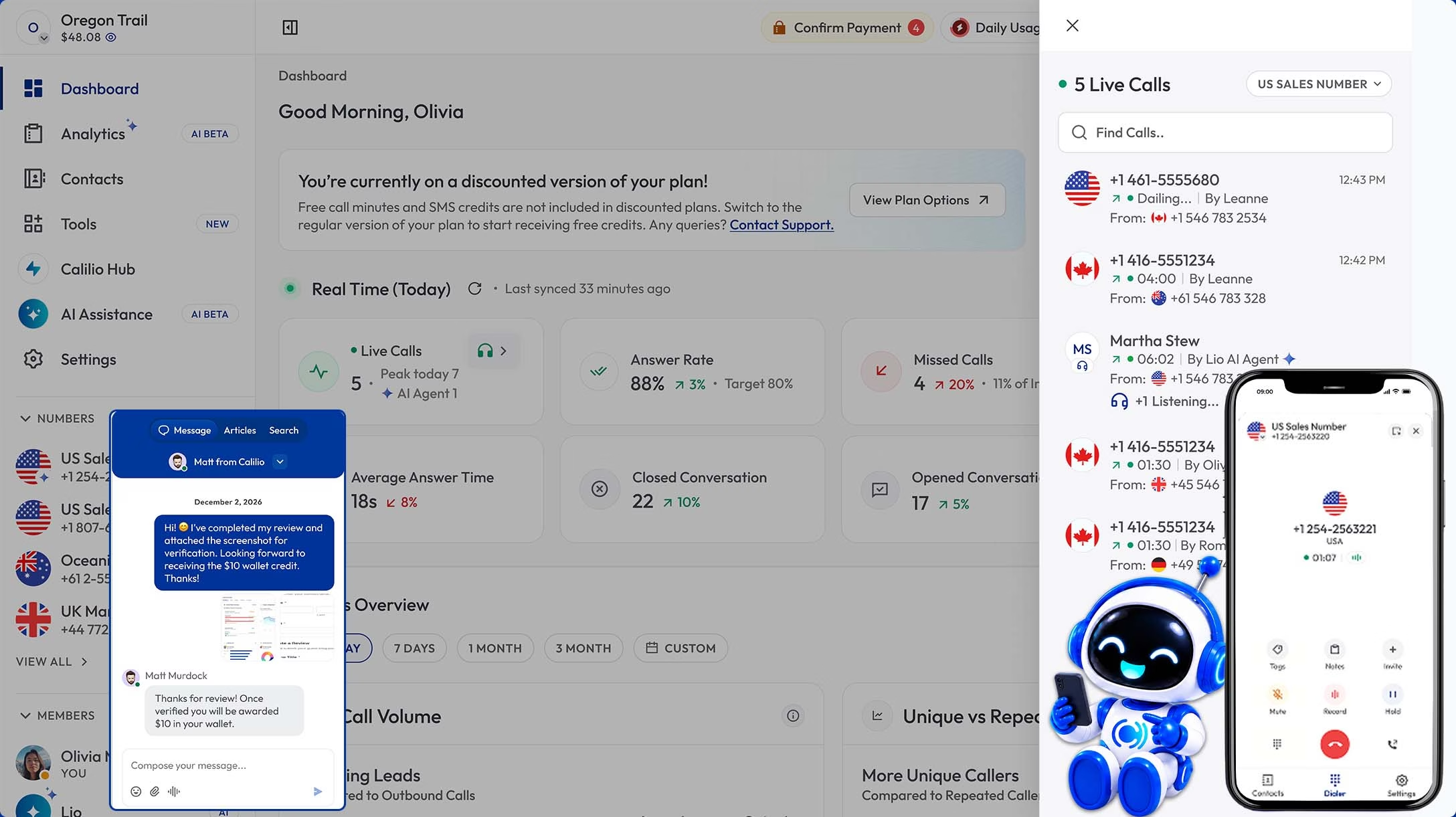
Every plan comes with generous free calling minutes and SMS on top of the free number, which is what makes it work as a personal line too. There is no permanently free tier, though — if you want a number that costs nothing at all, the free personal apps below fit better.
2. Google Voice
The best free personal VoIP number — and a simple business option
For US users, Google Voice remains the easiest answer to "I want a second number that costs nothing." You get a real local number with calling, texting, voicemail transcription and solid spam filtering, tied to your Google account and usable from any device.
The business version (via Google Workspace) is clean and cheap but deliberately simple — ring groups and basic auto-attendant, not much more. It suits teams already living in Workspace that need light phone features rather than a real phone system.
3. Zoom Phone
The cheapest entry into a big-vendor business phone system
Zoom Phone attaches a full cloud phone system to the meetings app most teams already use. The metered plan at $10/user/month is the lowest published entry price among the major vendors, and call quality benefits from the same infrastructure that carries Zoom meetings.
The catch is that the headline price is metered — outbound calls bill per minute until you step up to the $15 unlimited US/CA tier — and the deeper phone features assume you are also a Zoom Workplace customer.
4. RingCentral
The deepest feature set in business VoIP
RingCentral's RingEX is the reference point the rest of the category gets measured against: hundreds of integrations, mature admin controls, strong analytics and an AI assistant now bundled across plans. If a phone-system capability exists, RingCentral almost certainly has it.
You pay for that depth — real-world cost lands higher than the entry price once you add the features most teams actually want — and reviewers consistently describe the platform as more than a small team needs.
5. Dialpad
AI-first calling with the best live transcription
Dialpad built its product around AI before it was fashionable: every plan includes live transcription, real-time coaching cues and automatic call summaries, powered by its own speech models. For teams that treat calls as data — sales and support especially — that is a genuine differentiator.
The core phone features are solid rather than exceptional, and the platform leans hard on its AI story; if you just want a reliable dial tone, the AI features are paying for capability you may not use.
6. Nextiva
A unified customer-communication platform, not just a phone app
Nextiva has evolved from business VoIP into a platform that pulls calls, SMS, video, email and social messaging into one customer-conversation view. For a business that wants every customer interaction in one place, that breadth is the sell.
As a pure VoIP app it is competent and reliable, but you are buying the platform vision — pricing starts higher than app-first competitors and climbs steeply through tiers that unlock the unified features.
7. Ooma
The home-VoIP standby, with a simple office product
Ooma is two products: Telo, the home device that gives you nearly free residential calling after the hardware purchase, and Ooma Office, a straightforward small-business system with an app, virtual receptionist and ring groups.
Telo remains one of the best landline replacements for a household. Office is easy to run but plainer than the competition — fewer integrations, simpler analytics — which suits businesses that want a phone system to be boring.
8. TextNow
Completely free personal calling and texting
TextNow gives you a real US number with unlimited calling and texting for nothing — the product is ad-supported, and it even offers free essential data service on a compatible SIM in the US. As a zero-cost personal line or a burner-style second number, nothing matches it.
It is unapologetically a consumer product: ads in the app, no business features, and number recycling if you go inactive. Treat it as a free personal tool, not infrastructure.
9. Grasshopper
A flat-rate virtual business line for solo operators
Grasshopper adds a business number and phone menu on top of your existing mobile phone — calls forward to your cell, and the app keeps business and personal separate. Flat pricing rather than per-user makes it unusually predictable for solos and very small teams.
It is a virtual number service, not a full VoIP system: no video, no integrations to speak of, and calls ultimately ride on your existing phone service. That is fine for its audience and limiting for everyone else.
How to choose
Five common situations and where to start.
The Verdict
Decide which job you are hiring the app for. For a personal number, start free: Google Voice if you are in the US, TextNow if you want calling and texting with no bill at all. Neither will grow into a business phone system, and neither needs to.
For business use, RingCentral has the deepest feature set and Zoom Phone the friendliest entry price in a big-vendor suite. Calilio sits between them — a full phone system with a free US/CA/UK number, hundreds of free calling minutes, call recording, IVR and an AI receptionist from $12 per user per month — which is why it tops this list for solos and small teams alike.
Get a Business Number in Your Pocket Today
Calilio's app puts your line on any device — one free US, Canada or UK number, free monthly calling minutes and SMS, plus recording, IVR and a 24/7 AI receptionist, from $12 per user per month.