Every VoIP app advertises cheap international calls. The rate you see is usually the rate to a landline in a major country, and the destinations you actually call are often three or four times that. Mobile numbers cost more than landlines nearly everywhere, and a handful of countries cost more than everything else combined.
We compared 23 apps and kept the 9 best, split by what you are actually trying to do — call a business contact who needs to ring you back, call family abroad cheaply, or talk to someone who has the same app.
THE SHORT ANSWER
The best VoIP app for international calls depends on whether the person you are calling needs to be able to call you back.
→
They need to call you back — business calling — You need local numbers in the countries you call. Calilio ($12/user/mo) and CloudTalk cover 100+ and 160+ countries respectively, so your calls show a familiar area code and people can return them at local rates.
→
You just need to reach a landline or mobile cheaply — Credit-based apps are the lowest cost per minute. Google Voice is very cheap from the US, Viber Out sells prepaid credit with no subscription, and most business systems also sell per-minute international minutes.
→
Both of you have the same app — WhatsApp and similar services are free over data or Wi-Fi with no per-minute charge at all. The limitation is that it only works when both people have installed it, which rules out calling a business.
How We Compared VoIP Apps for International Calling
We weighted 6 criteria to compare 23 VoIP apps and kept the 9 best. Rates and coverage were taken from each provider’s own published rate tables rather than reseller summaries.
✓
Real per-minute rates: Not the headline rate to a US landline, but what it costs to reach mobiles in the countries you actually call. Mobile rates are higher than landline almost everywhere.
✓
Local number availability: Whether you can buy a number in the countries you call, so recipients see a familiar area code and can call you back at local cost.
✓
Country coverage: How many destinations you can call and how many you can hold numbers in — two very different figures that providers often blur.
✓
Call quality on long routes:International calls cross more network hops, so latency, jitter and codec handling matter more than they do domestically.
✓
How you are billed: Bundled minutes, prepaid credit, or pay-as-you-go — and whether unused minutes roll over or expire each month.
✓
Business features: Whether you get shared numbers, call recording, routing and a team inbox, or just a dialler for personal calls.
WHY YOU SHOULD TRUST THIS COMPARISON
Everything here comes from each provider’s own pricing pages and product documentation, checked in August 2026, alongside current G2 and Capterra reviews so we could see where real customers hit problems with call quality, support and billing rather than taking marketing claims at face value. No provider paid to be included, ranked higher, or have criticism removed, and this article contains no affiliate links.
Calilio sells a cloud phone system, so we compete in this category. Our own entry states its limitations in the same detail as everyone else’s, and the verdict names other providers as the better choice where they are. This is desk research, not nine parallel deployments — use it to build a shortlist, then demo your final two.
Three Kinds of International Calling
Most disappointment in this category comes from buying the wrong kind of product rather than the wrong brand. Work out which of these three you need first, and the shortlist follows.
1. Business VoIP With Local Numbers
Business VoIP services let you hold real phone numbers in different markets, so your international calls can display a local area code and customers can return calls at local rates.
STRENGTH
You hold real numbers in each market, so calls display a local area code, get answered more often, and can be returned at local rates.
TRADE-OFF
Monthly per-user subscription plus a fee per number, so it costs more than credit apps for low volumes.
2. Credit-Based Calling Apps
Credit-based calling apps let you call international landlines and mobile numbers at low per-minute rates, usually without a subscription or long-term commitment.
STRENGTH
Lowest cost per minute to reach any landline or mobile, usually with no subscription and no commitment.
TRADE-OFF
Your outbound number is foreign or unrecognised, answer rates suffer, and there is no real business functionality.
3. App-to-App Calling
App-to-app calling lets you make free voice calls over mobile data or Wi-Fi, provided both people use the same compatible calling app.
STRENGTH
Completely free over data or Wi-Fi with no per-minute cost, and usually excellent quality on a good connection.
TRADE-OFF
Only works when both parties have the app installed, making it unsuitable for calling a business or landline.
#
Calling Type
What It Does
Right For
1.
Business VoIP with local numbers
Uses real local numbers in different international markets
Anyone calling customers, prospects, or suppliers abroad as part of their work
2.
Credit-based calling apps
Lets you call international landlines and mobiles using prepaid or usage-based credit
Personal calls to family abroad, or occasional low-volume business calls
3.
App-to-app calling
Makes calls over data or Wi-Fi between users of the same app
Staying in touch with people you know personally
The 9 Best VoIP Apps for International Calls in 2026
#
Provider
Best For
Starting Price
Reach
1
Calilio
Best value business calling with local numbers
$12/user/month
Numbers in 100+ countries
2
CloudTalk
Widest country coverage for numbers
$25–29/user/month
Numbers in 160+ countries
3
Google Voice
Cheapest rates from the US
From ~$10/user/month
Calls to most countries
4
Zoom Phone
Cheapest entry point overall
From ~$10–12/user/month
40+ countries, metered calling
5
Dialpad
Best AI features with international calling
From ~$15/user/month
70+ countries
6
RingCentral
Best for large teams needing global coverage
$20/user/month (Core, annual)
100+ countries
7
Ooma
Best for very small offices
From ~$20/user/month
Rates to 60+ countries
8
Viber Out
Best prepaid credit with no subscription
Prepaid credit
Calls worldwide
9
WhatsApp
Best free app-to-app calling
Free over data
App users only
1. Calilio
Best value for business calling into multiple countries
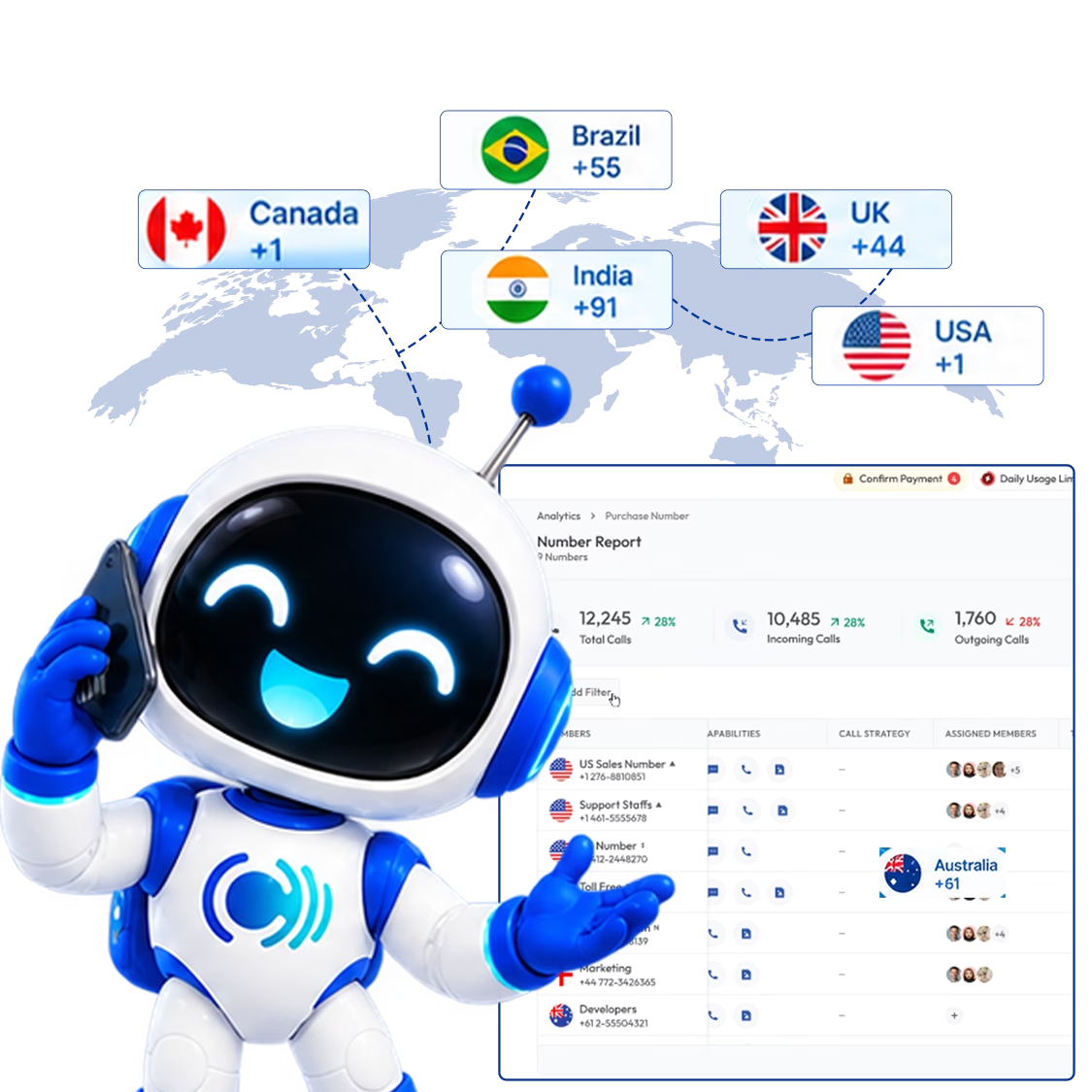
Calilio gives you local, mobile and toll-free numbers in over 100 countries, so a call into a market displays a number people there recognise. That single detail changes outcomes more than the per-minute rate does — unfamiliar international numbers are frequently ignored, and a local number also gives the recipient a way to call you back without paying international rates.
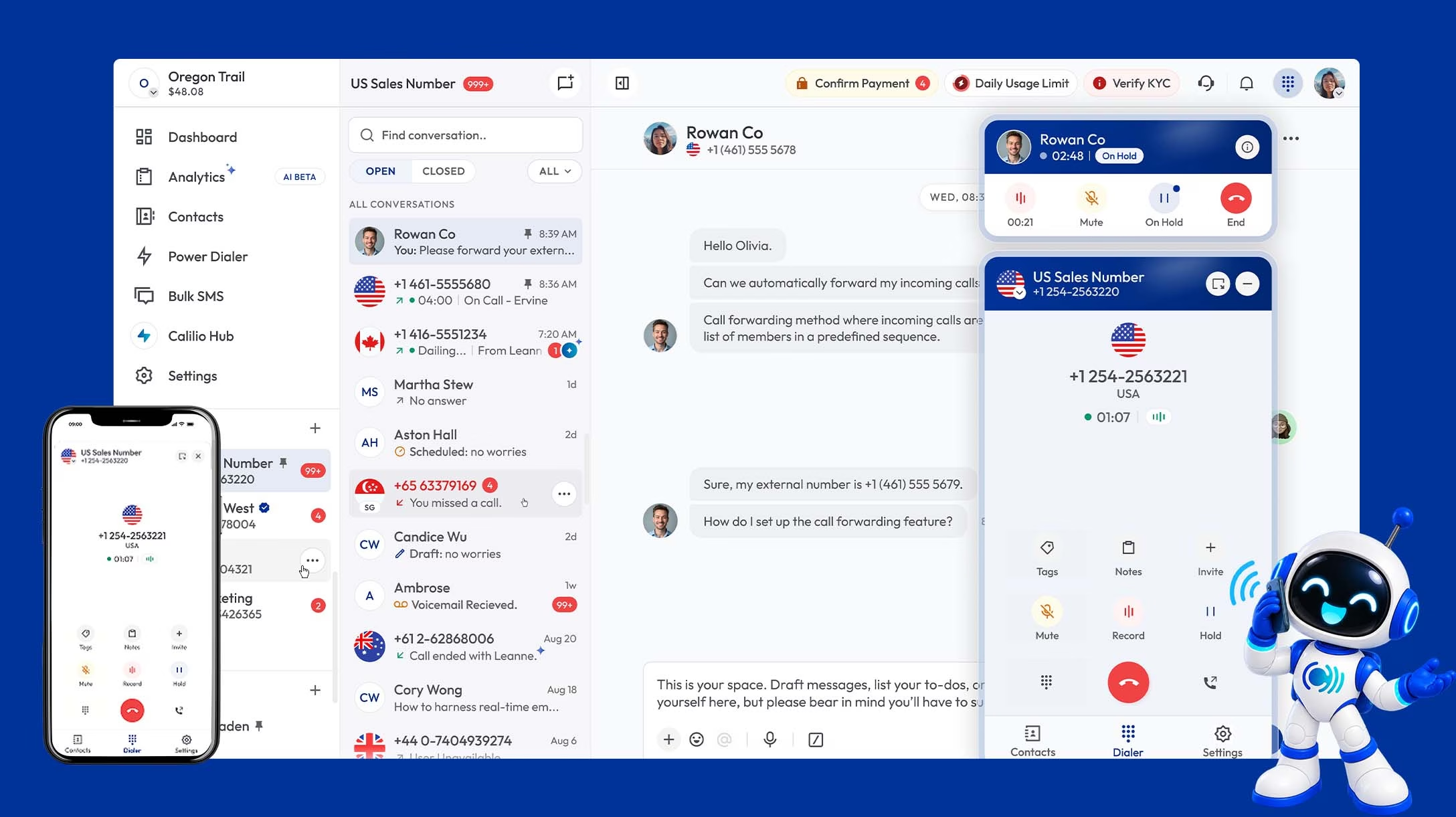
Because it is a full phone system rather than a dialler, the international calling sits alongside IVR menus, call recording, shared inboxes and reporting, and calls from any country land in one place with your notes and history attached. The entry plan is $12 per user per month and includes IVR and recording. What it is not is a cheap prepaid credit app — outbound international minutes are charged on usage beyond your plan allowance, so for occasional personal calls to one country it is more system than you need.
What Works
✓Local, mobile and toll-free numbers in 100+ countries
✓Calls display a familiar local number, improving answer rates
✓Full phone system included — IVR, recording, shared inbox, reporting
✓Entry plan at $12/user/mo includes IVR and call recording
✓One call history across every country you call
What to Watch
✕Per-user subscription, so more expensive than credit apps at low volume
✕International minutes charged on usage beyond plan allowance
✕Each additional country number carries its own monthly fee
✕Built for business calling, not personal calls abroad
Pricing:
Standard $12/user per month billed annually
Premium $28/user per month adds Power Dialer, monitoring and AI reports
Numbers and international minutes charged separately
Reach:Numbers in 100+ countries
Verdict:Best value if people in those countries need to recognize and return your calls.
If your calling spans a genuinely large number of markets, CloudTalk’s inventory of numbers in over 160 countries is the broadest available and the main reason to choose it. Like Calilio it is a full phone system, so inbound routing, recording and call flows sit alongside the outbound calling, and its visual Call Flow Designer makes complex international routing easier to build.
The pricing structure is the thing to check carefully. Its cheapest tier does not include IVR — that begins on the plan above — and several features including AI conversation intelligence are separate paid add-ons. Minimum user requirements also apply on some plans, so a very small team may find the effective floor higher than the per-seat figure suggests.
What Works
✓Numbers available in 160+ countries — the widest coverage here
✓Full phone system with visual Call Flow Designer
✓Skills-based routing and callback on the mid tier
✓Manage multiple international numbers in one account
What to Watch
✕Number prices vary significantly by country
✕AI conversation intelligence is a separate paid add-on
✕Minimum user requirements apply on some plans
✕More expensive than Calilio for comparable capability
Pricing:
Starter around $25/user per month — no IVR
Essential around $29/user per month — IVR and routing included
Add-ons charged separately International numbers and pay-as-you-go calling rates are charged separately and vary by country.
Reach:Numbers in 160+ countries
Verdict:The pick when you need numbers in more markets than anyone else offers.
3. Google Voice
Cheapest per-minute rates if you are calling from the US
Google Voice has some of the lowest published international rates available, with calls to many major destinations costing around a cent a minute. It integrates cleanly with Google Workspace, works on desktop and mobile, and includes voicemail transcription — a genuinely good deal for a small team already using Google tools.
The constraint is availability rather than price. Google Voice for business requires Google Workspace and is only offered in a limited set of countries, so where you are based matters as much as where you are calling. It also gives you far fewer number options abroad than a dedicated international provider, so it is much stronger for calling out cheaply than for being reachable locally.
What Works
✓Among the lowest international per-minute rates published
✓Clean integration with Google Workspace
✓Voicemail transcription included
✓Simple, familiar interface with very little setup
What to Watch
✕Requires Google Workspace and is available in limited countries
✕Very limited international number availability
✕Sparse business phone features compared with dedicated systems
✕Not suitable if you need local numbers in many markets
Pricing:
Starts at $10/user per month with a Google Workspace subscription.
International calls are charged per minute in addition to the monthly plan.
Reach:Calls to most countries; limited number availability
Verdict:Excellent value for cheap outbound calling from a Google-based team.
4. Zoom Phone
The lowest entry price, with a catch on outbound minutes
Zoom Phone’s Metered plan starts at roughly $10 to $12 per user per month and includes unlimited auto attendants and IVR routing, which is unusually generous at that price. Numbers are available in over 40 countries and it escalates to a Zoom meeting in a click, which suits teams already running international calls on Zoom.
On the Metered plan every outbound call is billed per minute, so international calling volume translates directly into cost. That is fine for inbound-heavy teams and expensive for anyone doing sustained outbound calling abroad — past a few hours a month the Unlimited tier works out cheaper. Its coverage is also narrower than Calilio’s or CloudTalk’s.
What Works
✓Lowest entry price among business systems here
✓Unlimited auto attendants and IVR on every plan
✓Numbers available in 40+ countries
✓Tight integration with Zoom Meetings
What to Watch
✕Metered plan bills every outbound call per minute
✕Works out expensive for sustained outbound international calling
✕Narrower country coverage than dedicated providers
✕Weaker outbound sales tooling
Pricing:
US & CA Unlimited: $16/user per month when billed annually
Pro Plus: $20.50/user per month when billed annually
Business Plus: $24.50/user per month when billed annually
International calls are charged separately at per-minute rates based on the destination.
Reach:Numbers in 40+ countries
Verdict:Good for inbound-heavy international teams; check your outbound minutes.
5. Dialpad
Best combination of AI features and international reach
Dialpad includes international numbers, multi-level IVR and call queues from around $15 per user per month, and adds live AI transcription at that entry price — genuinely useful on international calls where accents and line quality make notes harder to take accurately. Coverage spans around 70 countries.
It is a leaner platform than RingCentral or CloudTalk, with fewer multi-site administration controls and a contact center product priced separately. Its transcription accuracy also varies more on heavily accented speech, which is worth testing against your own markets before relying on it.
What Works
✓Live AI transcription included at the entry price
✓Free calls between Dialpad users
✓Numbers available in around 70 countries
✓Clean, well-regarded admin experience
What to Watch
✕Leaner platform than RingCentral or CloudTalk
✕International number availability varies by country
✕Contact center features priced as a separate product
Pricing:
Starts at $15/user per month when billed annually
International calls are billed at destination-based rates.
Global Unlimited Calling add-on is available, which includes up to 8,000 international minutes per license/month across 65+ countries.
Reach:Numbers in around 70 countries
Verdict:Strong pick if AI notes on international calls are valuable to you.
6. RingCentral
The safe choice for larger teams needing global coverage
RingCentral offers numbers in over 100 countries, includes IVR on all RingEX plans, and brings the largest integration ecosystem in this comparison. Core is $20 per user per month billed annually or $30 monthly, and for a larger organization the procurement comfort and support depth are a real part of the value.
Core is thinner than the price suggests: no automatic call recording, no CRM integrations, no analytics dashboards. Multi-site management and deeper automation begin on Advanced at $25 annual or $35 monthly, and international calling plans are priced separately on top. Budget the tier that contains what you need rather than the entry rate.
What Works
✓Numbers available in 100+ countries
✓International calling to worldwide destinations
✓Largest integration ecosystem in this comparison
✓Strong support and procurement credibility
What to Watch
✕Core lacks recording, CRM integrations and analytics
✕Multi-site routing requires Advanced at $25 annual or $35 monthly
✕International calling plans priced separately
✕More expensive than Calilio for comparable coverage
Pricing:
Core: $20/user per month when billed annually
Advanced: $25/user per month when billed annually
Ultra: $35/user per month when billed annually.
International Calling Credit Bundles available for higher usage.
Reach:Numbers in 100+ countries
Verdict:Right when brand safety and integrations matter more than price.
7. Ooma
Simplest option for a very small office
Ooma is built for small offices that want a phone system without a project. Setup is close to plug-and-play, there is no annual contract requirement on its main business plans, and it publishes international rates to more than 60 countries with a World Plan add-on for teams calling abroad regularly.
It is deliberately basic. There is little in the way of advanced routing, analytics or CRM integration, and international number availability is limited compared with the dedicated providers here. If you need to be reachable on a local number in several markets, this is not the tool; if you need to call out cheaply from one small office, it does that simply.
What Works
✓Very simple setup with plug-and-play hardware
✓No annual contract required on main business plans
✓Published international rates to 60+ countries
✓World Plan add-on for regular international callers
What to Watch
✕Limited international number availability
✕Basic routing, analytics and integrations
✕Not suited to teams needing presence in many markets
✕Hardware-oriented approach feels dated for remote teams
Pricing:
Essentials: $19.95/user per month
Pro: $24.95/user per month
Pro Plus: $29.95/user per month.
All three plans include unlimited calling in the U.S., Canada, Mexico, and Puerto Rico.
Calls to other countries are billed separately at destination-based international rates.
Reach:Rates to 60+ countries
Verdict:Fine for a small single-office team calling abroad occasionally.
8. Viber Out
Best prepaid credit option with no subscription
Viber Out lets you call any landline or mobile worldwide using prepaid credit or a country-specific subscription, with no monthly platform fee. For someone who calls one or two countries regularly and wants no commitment, it is one of the most practical options available, and the app itself is free for app-to-app calls.
It is a consumer product. There is no business functionality, no local number in the country you are calling, no call recording and no team features, so recipients see an unfamiliar number and cannot easily call you back. Treat it as a cheap way to place calls rather than a way to be contactable.
What Works
✓No subscription — prepaid credit only
✓Calls to landlines and mobiles worldwide
✓Free app-to-app calling included
✓Country-specific plans available for frequent destinations
What to Watch
✕No local number, so answer rates suffer
✕No business features, recording or team functionality
✕Recipients cannot easily call you back
✕Consumer support only
Pricing:
Viber-to-Viber international calls are free over Wi-Fi or mobile data.
Viber Out calls to landlines and mobile numbers are paid through prepaid credit or calling plans.
Rates vary by destination, while the World Unlimited plan is available at $5.99/month.
Reach:Calls worldwide via credit
Verdict:The practical choice for cheap personal calls with no commitment.
9. WhatsApp
Free app-to-app calling, when both people have it
For calls between two people who both have the app, WhatsApp costs nothing beyond data and quality is usually very good on a decent connection. Its ubiquity in many countries makes it the practical default for reaching people abroad, and encryption means the call content is private.
It cannot call a landline or a mobile number that does not have the app, which rules out most business use. There is no local number, no way for someone to reach you on a normal phone number, and no business calling features. It belongs on this list because for a large share of international personal calls it is the right answer, not because it competes with a phone system.
What Works
✓Completely free over data or Wi-Fi
✓Very good quality on a stable connection
✓End-to-end encrypted calls
✓Near-universal adoption in many countries
What to Watch
✕Only works if both parties have the app
✕Cannot call landlines or non-app mobile numbers
✕No local number or business functionality
✕Depends entirely on data connection quality
Pricing:
Free over Wi-Fi
International roaming charges may apply when using cellular data abroad
Reach:App-to-app only
Verdict:The default for personal international calls; not a business option.
How International Rates Really Work
$
Mobile costs more than landline nearly everywhere
Termination fees to mobile networks are higher than to fixed lines, sometimes several times higher. A provider advertising a low rate is almost always quoting the landline price to a major country.
$
A few destinations cost far more than the rest
Satellite numbers, some Caribbean and African destinations, and certain premium ranges can cost dollars per minute rather than cents. Check your specific destinations against the rate table before committing.
$
Bundled minutes usually expire monthly
Most business plans include an allowance that resets each month rather than rolling over. If your calling is seasonal or uneven, prepaid credit can work out cheaper than a bundle you underuse.
$
Numbers cost money to hold, not just to call
Each local number in each country carries its own monthly fee, typically a few dollars. Presence in ten markets means ten recurring line items on top of your per-user cost.
$
Toll-free numbers cost the owner, not the caller
A toll-free number in another country is free for the person calling you and billed to you per minute received, usually at a higher rate than a local number. Useful for inbound sales, expensive if abused.
Getting Good Call Quality on International VoIP Calls
1
Latency and jitter matter more than speed
A single voice call needs only about 100 kbps each way. International call problems are nearly always about the consistency of the connection, not its bandwidth — a stable 5 Mbps line beats an unstable 200 Mbps one.
2
Use a wired connection where you can
Wi-Fi introduces variability that voice traffic notices immediately. For anyone taking international calls all day, an ethernet cable is the single cheapest quality improvement available.
3
Prioritise voice traffic on your network
Enable QoS on your router so voice packets take priority over file downloads and video streaming. On a shared office connection this prevents one large upload from degrading every call.
4
Choose a provider with local infrastructure
Providers with points of presence near your destinations route calls over fewer hops. This is why two apps quoting similar rates can sound very different on the same route.
5
Test your actual routes before committing
Call quality varies by corridor, not by provider average. Run trial calls to the specific countries and network types you rely on during any free trial period.
The Verdict
If the calls are personal, stop reading comparison articles. WhatsApp is free when both people have it, and Viber Out or Google Voice cost cents a minute to reach a landline. None of them give you a local number, and for calling family that does not matter.
If the calls are business, the per-minute rate is rarely the deciding factor — being recognisable is. A call from a local number gets answered and can be returned; a call from an unfamiliar foreign number often is not. CloudTalk has the widest inventory at 160+ countries and prices accordingly, RingCentral is the safe large-team choice, and Calilio covers 100+ countries with IVR and recording on a $12 per user per month plan. Calilio is not the cheapest way to place a minute of outbound audio and does not pretend to be — it is the cheapest way to have a real presence in several markets at once.
Call 100+ Countries From a Number They Recognise
Buy local, mobile or toll-free numbers wherever you do business, and manage every call from one shared inbox with IVR and recording included. Plans start at $12 per user per month with a 14-day money-back guarantee.
What is the best VoIP app for international calls?
It depends on whether the person you are calling needs to call you back. For business calling where they do, Calilio at $12 per user per month and CloudTalk give you local numbers in 100 and 160 countries respectively, so your calls display a familiar number. For cheap personal calls to landlines and mobiles, Google Voice and Viber Out are the lowest cost. For calls between two people who both have the app, WhatsApp is free over data.
Is VoIP cheaper than international calling with a mobile carrier?
Almost always, and often by a wide margin. Mobile carriers commonly charge between $1 and $3 per minute for international calls without an add-on package, while VoIP rates to most major destinations sit between roughly 1 and 5 cents per minute. The saving is largest on landline calls to major countries and smallest on calls to mobiles in remote destinations.
Do I need a local number in each country I call?
Only if you want people to answer and be able to call you back. Calls from an unfamiliar foreign number are answered far less often than calls showing a local area code, and a local number also lets the recipient return your call at local rates. For outbound business calling into a market this matters a great deal; for occasional personal calls it does not.
How much internet speed do I need for international VoIP calls?
A single voice call needs roughly 100 kbps in each direction, which is very little. Quality problems on international calls are almost never about bandwidth and almost always about latency and jitter — the consistency of the connection rather than its speed. A stable connection at modest speed will outperform a fast but unstable one.
Why are calls to mobile numbers more expensive than landlines?
Mobile networks charge higher termination fees for connecting an incoming call than fixed-line networks do, and providers pass that through. The gap varies by country and can be several times the landline rate, which is why a provider’s advertised rate — almost always the landline price to a major destination — often bears little relation to what you will actually pay.
Can I keep my existing number when moving to a VoIP app?
Usually yes, through porting. Most business VoIP providers support porting local numbers, though the process takes days to weeks depending on the country and the losing carrier, and some number types and regions cannot be ported at all. Confirm your specific number is portable before cancelling anything with your current provider.
Are international VoIP calls secure?
Reputable business providers encrypt call traffic in transit, and consumer app-to-app services such as WhatsApp use end-to-end encryption. What varies is everything around the call — where recordings are stored, who can access them, and retention periods. If you record international calls, check the provider’s data location and retention policy, since consent and privacy rules differ by country.
Can I use a VoIP app for international calls while travelling?
Yes, and it is one of the strongest reasons to use one. Because the service follows your account rather than a SIM card, you can call and be reached on your usual business number from any country with a stable internet connection, avoiding roaming charges entirely. A small number of countries restrict or block VoIP traffic, so check before relying on it in those markets.
Summarize this blog with:
Stay in the loop
Get the latest call insights, trends, and updates delivered straight to your inbox.
By subscribing, you agree to receive updates from Calilio. You can unsubscribe anytime.