A hosted call center is call center software that runs on a provider's servers instead of hardware in your office. Your agents log in through an app or a browser, calls route over the internet, and the provider takes care of the infrastructure, maintenance and updates. You pay a monthly fee per agent instead of buying and running the system yourself.
This guide covers how a hosted call center works, how it differs from on-premise and "cloud" call centers, what it costs, and how to tell whether your business actually needs one.
How does a hosted call center work?
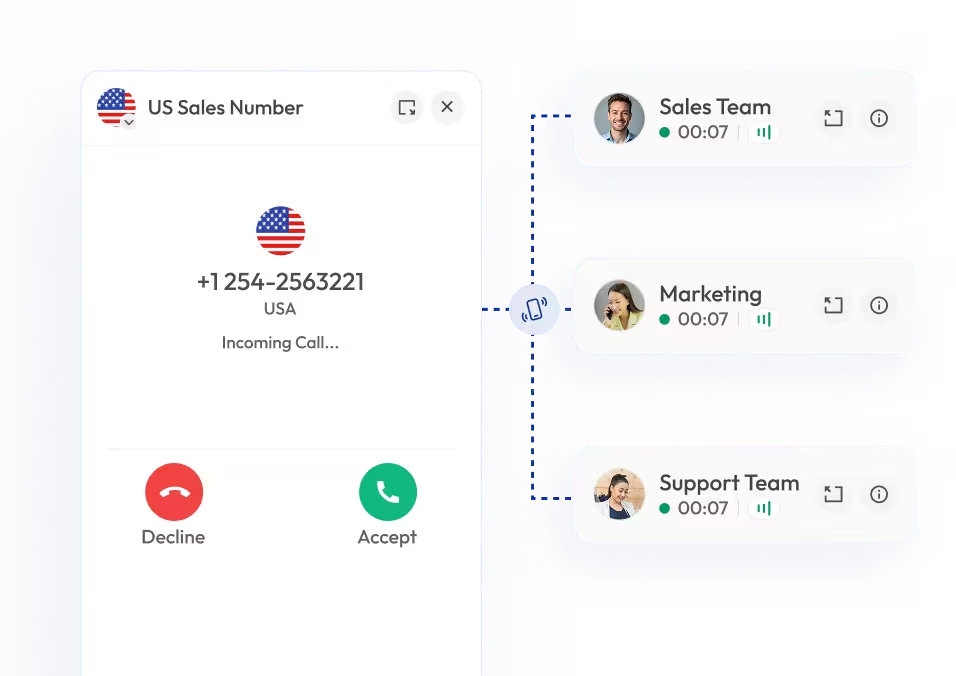
The whole system — phone numbers, routing rules, queues, recordings, analytics — lives in the provider's data centers. What happens on a single inbound call looks like this:
1
A customer dials your number
The number lives with the provider, not on a line into your building. The call arrives at their platform first.
2
The platform decides where it goes
IVR menus, business-hours rules and skill-based routing run in the provider's cloud before any agent is involved.
3
The call enters a queue
Callers hear hold music or a position announcement while the system finds the right available agent — wherever that agent is sitting.
4
An agent answers in the app
The call rings the agent's softphone— a desktop app, mobile app or browser tab — with the caller's history alongside.
5
Everything is captured
Recording, transcription and analytics happen on the platform automatically, visible to supervisors in real time.
Because none of this depends on hardware in one building, agents can work from an office, from home, or from three different countries — the queue treats them the same.
Hosted vs on-premise vs cloud — what the terms mean
"Hosted" and "cloud" are used almost interchangeably today, and for buying decisions the distinction rarely matters. Strictly speaking, hosted means the software runs off-site on the provider's servers — which could be dedicated, single-tenant hardware — while cloud specifically means multi-tenant infrastructure delivered over the internet. Almost every hosted call center sold in 2026 is cloud-based, so in practice you are choosing between two models, not three:
#
Hosted / cloud
On-premise
Upfront cost
None — subscription only
Servers, PBX hardware, licenses, installation
Setup time
Hours to days
Weeks to months
Maintenance
Provider handles updates and uptime
Your IT team, or a paid contractor
Remote agents
Built in — log in from anywhere
Requires VPN and extra configuration
Scaling
Add or remove agents on the plan
Buy capacity ahead of need
Who still picks it
Almost everyone in 2026
Organizations with strict data-residency or regulatory demands
What features does a hosted call center include?
The core set is consistent across providers; the depth varies by plan.
Call queues
Hold callers in order and distribute them to available agents by rules you set.
IVR menus
"Press 1 for sales" routing that sends callers to the right team before an agent picks up.
Call recording
Automatic recording for quality review, training and compliance.
Live monitoring
Supervisors listen to active calls, whisper to agents, or barge in when needed.
Real-time dashboards
Queue length, wait times, abandonment and agent status, live.
Analytics & reports
Call volume, handle time and outcomes over time — increasingly AI-summarized.
CRM integrations
Screen-pop customer records and log calls into the tools your team already uses.
AI answering
Newer platforms add AI agents that resolve routine calls before they reach the queue.
Why businesses choose hosted call centers
Four reasons come up again and again, and they are all versions of the same idea: someone else runs the plumbing.
No infrastructure to buy or babysit
The provider owns the servers, the redundancy and the 3am failures. You pay a predictable monthly fee and your IT team does not run a phone system.
Agents can work from anywhere
The queue does not care where an agent sits. Hybrid teams, home-based agents and multi-country coverage all work out of the box.
Scales with the season
Add ten agents for the holiday rush and remove them in January. On-premise systems make you buy capacity for your busiest week and carry it all year.
Features arrive without projects
When the provider ships AI transcription or a better dashboard, you get it at the next login — no upgrade project, no downtime window.
The trade-offs to know about
Hosted is the right default for most businesses, but it is not free of trade-offs.
!
You depend on your internet connection
If the office connection goes down, so do the calls from that office. Mobile apps and failover routing soften this, but connectivity becomes your critical utility.
!
Less control over data location
Recordings and logs live on the provider's infrastructure. Regulated industries should check where data is stored and what compliance certifications the provider holds.
!
Costs scale linearly forever
Per-agent pricing is cheap to start but never stops. A very large, stable operation can eventually find owning cheaper than renting — the crossover is typically in the hundreds of agents.
How much does a hosted call center cost?
Pricing is per agent per month, and the market splits into two tiers. Business phone systems with call center features — queues, IVR, recording, monitoring, analytics — run roughly $15 to $35 per user per month. Dedicated enterprise contact center platforms — with workforce management, omnichannel routing and deep customization — run $65 to $150+ per agent per month.
Most small and mid-sized teams fit comfortably in the first tier. Calilio sits there: its Standard plan at $15/user/month ($12 billed annually) covers call recording, ring strategies and basic analytics, and the Premium plan at $35/user/month ($28 annually) adds IVR, business hours, call transfer, live call monitoring and AI call reports. A 24/7 AI voice agent that answers routine incoming calls is included on both plans.
Watch the extras
The per-agent price is rarely the whole bill. Check what the plan includes for calling minutes, number rental, international rates and recording storage — these vary far more between providers than the headline price does.
Does your business need one?
You do not need "a call center" in the traditional sense to benefit from hosted call center software. The real test is call volume and structure:
If this is you
Two or more people answer the same number, and callers sometimes wait.
What fits
You already need the basics — a ring strategy that distributes calls across the team, business-hours routing and voicemail handoff. An entry business phone plan covers this.
If this is you
You have a support or sales team taking dozens of calls a day.
What fits
A hosted call center earns its fee in monitoring, recording and analytics — you cannot improve what you cannot see.
If this is you
Most of your calls are routine questions — hours, status, booking.
What fits
Pair your routing with an AI receptionistthat resolves routine calls instantly, so agents only carry the calls that need a person.
If this is you
You run hundreds of agents with strict data-residency rules.
What fits
This is the shrinking case for on-premise or single-tenant hosted deployments — evaluate compliance first, price second.
Conclusion
A hosted call center is simply call center software you rent instead of run — the provider owns the infrastructure, you get the queues, routing, recording and analytics through an app. For anything short of a large enterprise operation, it has become the default choice: faster to set up, cheaper to start, and it lets agents work from anywhere. The decision that actually takes thought is which tier you need — a business phone system with call center features, or a dedicated enterprise platform.
Set up a Hosted Call Center in an Afternoon
Calilio gives you IVR, ring strategies, recording, monitoring and analytics with no hardware — pick a number, add your agents, and take the first call today.
It is call center software you rent instead of run. The system lives on the provider's servers, your agents log in through an app or browser, and you pay per agent per month. No servers, no PBX hardware, no maintenance.
What is the difference between a hosted call center and a cloud call center?
In everyday use, nothing — the terms are used interchangeably. Strictly, "hosted" means the software runs off-site on a provider's servers, which could be dedicated single-tenant hardware, while "cloud" means multi-tenant infrastructure delivered over the internet. Almost every hosted call center sold today is cloud-based.
How much does a hosted call center cost?
Business phone systems with call center features run about $15 to $35 per user per month — Calilio's plans span that range, with IVR, live monitoring and AI call reports on the $35/user/month Premium plan ($28 billed annually). Dedicated enterprise contact center platforms run $65 to $150+ per agent per month. Check what each plan includes for minutes, numbers and recording storage, since extras vary more than headline prices.
Can a hosted call center work with remote agents?
Yes — this is one of its main advantages. Agents log into the same queues from an office, home or anywhere with a decent internet connection, and supervisors monitor everyone in one dashboard regardless of location.
Is a hosted call center reliable?
Major providers publish uptime commitments of 99.99% or better and run redundant data centers. The weak point is usually your own internet connection, not the platform — mobile apps and failover forwarding to cell numbers are the standard safety net.
Do I need special hardware for a hosted call center?
No. Agents need a computer or smartphone and a headset. Desk phones are optional — most providers support them, but softphone apps have become the default because they are cheaper and work anywhere.
Summarize this blog with:
Still have questions?
Can’t find the answer you’re looking for? Please chat with our friendly team.
Stay in the loop
Get the latest call insights, trends, and updates delivered straight to your inbox.
By subscribing, you agree to receive updates from Calilio. You can unsubscribe anytime.