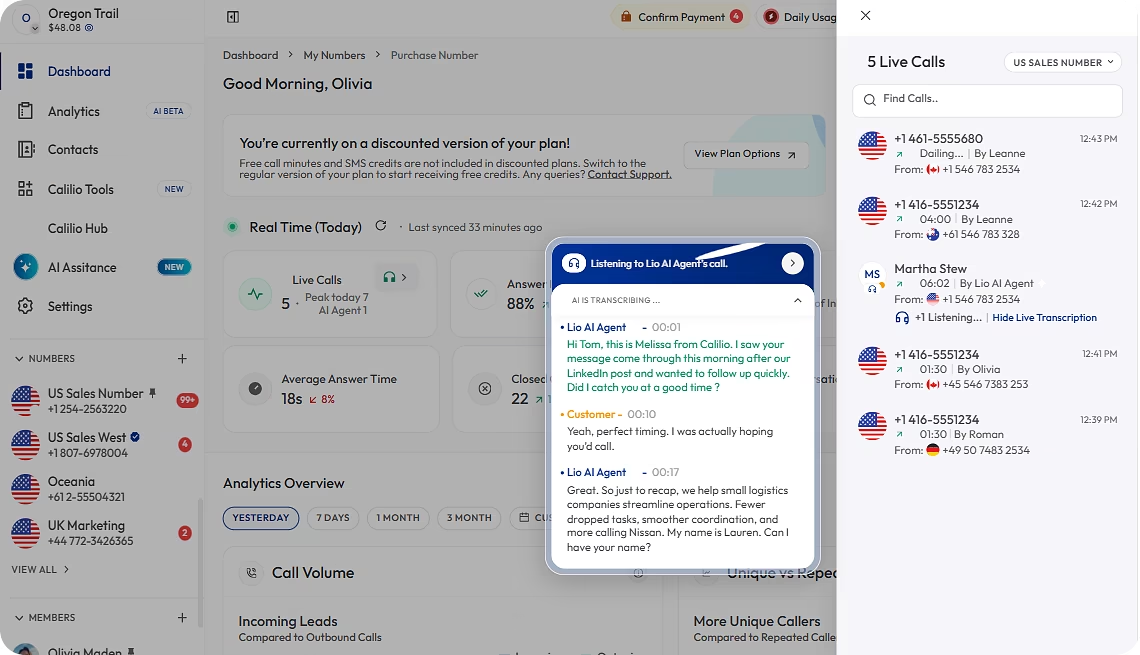

An AI receptionist is software that answers business calls automatically, understands natural speech, and either resolves the request or routes it to the right person — the front-desk job, done without a person on the line.
- It listens and speaks naturally — no keypad menu, no fixed options.
- It draws answers from knowledge you connect: your hours, pricing, calendar, policies.
- It escalates to a person when a call needs judgment or falls outside its scope.
- It runs 24/7 with no extra staffing cost.
How an AI receptionist works
A call moves through a short chain of systems, fast enough to feel like one conversation.
It answers on your business number, often instantly, with no ring delay — the first thing callers notice.
A transcription layer converts what the caller says into text in real time, judging naturally when they have finished speaking.
A language model interprets the request against the instructions and tone you configured — answer directly, look something up, or hand off.
Connected to your calendar, CRM or order system, it can actually check availability or pull up a record, not just describe what it would do.
Outside its knowledge or scope, the call routes to a person, a team, or voicemail — based on rules you set.
AI receptionist vs IVR vs human receptionist
Three different things get called "answering the phone." Here is what actually separates them.
Comparison | AI Receptionist | IVR Menu | Human Receptionist |
| How the caller responds | Speaks naturally | Presses a key | Speaks naturally |
| Handles unexpected requests | Yes, within its knowledge | No — mapped options only | Yes, with judgment |
| Can complete the task | Yes, if connected to your systems | No — routes only | Yes |
| Available 24/7 | Yes, at no extra cost | Yes | Usually a premium add-on |
| Handles emotional calls | Poorly — should escalate | Not applicable | Best option |
| Typical cost | Per call/minute, or bundled | Included in most phone plans | Salary, or per-minute service fee |
What it handles well
The jobs that work share three things: they repeat constantly, have a clear resolution, and the answer lives somewhere the receptionist can reach.
Where a person still wins
Vendors demo the happy path. These are the calls that decide whether a deployment actually works.
!
!
!
!
What it costs
Three pricing models, depending on whether you buy it standalone, bundled, or build on a developer platform.
Model | How It's Billed | Typical Range |
| Standalone dedicated service | Monthly plan plus per-call or per-minute usage above an allowance | $40–$150/month at small-business volume |
| Bundled into a phone system | Included in a plan tier, no separate subscription | Often included from ~$28/user/month |
| Enterprise / developer platform | Usage-based, billed per minute of voice generated | Scales with volume, needs modelling |
Choosing one
Four common situations and where to start.
The bottom line
An AI receptionist earns its place on the calls that repeat constantly and have a clear answer — booking, hours, order status, basic routing. It is not a full replacement for a person, and treating it as one on emotional or ambiguous calls is where deployments go wrong.
The businesses that get the most from one build it around a clear escalation rule rather than trying to make it handle everything — let it resolve the routine calls, and hand off the rest fast.
Build One and Hear It for Yourself
Set up your AI receptionist, connect your knowledge, and run it through the built-in test simulator before it ever answers a real call. Free up to 10 minutes per user a month on Standard, or up to 100 minutes on Premium, then low per-minute rates apply.