
Blog9 Best Sentiment Analysis Tools in 2026

“Sentiment analysis tool” describes three products that share a name and almost nothing else. One reads social posts, one reads survey answers, and one listens to phone calls. Buying the wrong category is the most common and most expensive mistake in this market, because none of them can analyze data they cannot see.

We compared 24 tools across all three and kept the 9 best. Start by working out which data you actually have — everything else follows from that.

Quick Answer

There is no single best sentiment analysis tool — the right choice depends on where your customer feedback comes from. In 2026, three categories cover most teams: tools that analyze phone conversations, platforms that monitor public social and web discussions, and experience-management software that turns surveys, reviews, and written feedback into actionable insights.

Your customers talk to you on the phone
Calilio gives you sentiment on every call inside a business phone system. Gong leads for sales conversations, and CallMiner and Observe.AI for large contact centres.
You need to know what people say about you publicly
Brandwatch and Talkwalker lead on depth of social and web coverage. Sprout Social is the easiest to actually run day to day if you also manage the accounts.
You collect surveys, reviews and feedback forms
Qualtrics and Medallia are the standard for turning open-text feedback into themes and driver analysis, with the enterprise pricing that implies.
Voice tools read tone, pace and interruptions. Text tools only read words — the same sentence can score very differently.
Accuracy is decent in aggregate and unreliable on any single item, so use scores to find calls worth reviewing rather than as verdicts.
Pricing spans from $35 per user per month, or $28 per user per month when billed annually, to six figures a year for enterprise platforms.

How we compared sentiment analysis tools

We weighted 6 criteria to compare 24 tools and kept the 9 best. We reviewed current official product and pricing documentation rather than relying on reseller estimates.

Data source: Whether the tool analyses phone calls, social and web content, or survey and feedback text. This decides everything else.
Coverage: Whether it scores every item automatically or samples, and how far back the historical data goes.
Depth beyond a score: Whether you get topics, drivers, competitor mentions and emotion detection, or just a positive-negative-neutral label.
Real-time capability: Whether sentiment appears during the interaction so someone can act on it, or only afterwards in a report.
Where results land: Whether scores write back to your CRM, helpdesk or BI tool, or stay locked in the vendor dashboard.
Cost clarity: Whether pricing is published, what it scales on, and whether analysis is included or metered separately.

Three kinds of sentiment tool: pick the data source first

A social listening platform cannot tell you why customers are cancelling on the phone. A call analytics platform cannot tell you what people are posting about your brand. They are not competitors — they answer different questions from different data.

1. Voice and call sentiment

These tools transcribe phone conversations and score them, reading tone, pace, pauses, interruptions and talk ratio alongside the words themselves. That extra signal is why voice analysis catches frustration a transcript alone would miss. It is the only category that tells you how customers feel when they actually speak to your team.

Strength
Reads tone and pace, not just words; catches frustration text misses
Trade-off
Only covers calls; transcription errors affect accuracy

2. Social and brand listening

These platforms monitor public posts, reviews, news and forums, then score the mentions and track how sentiment moves over time. They are the right tool for reputation, campaign response and competitive tracking, and they are blind to anything a customer says to you in private. Marketing teams working with a paid media agency often lean on this category specifically, since it shows how sentiment shifts while a campaign is live rather than only after it wraps.
Strength
Tracks reputation and competitors in near real time
Trade-off
Blind to private conversations; heavy noise filtering needed

3. Feedback and experience analytics

These analyse survey responses, review text, support tickets and other structured feedback you have collected. Their strength is grouping thousands of open-text comments into themes and linking them to a metric like NPS, so you can see what is driving a score rather than just watching it move.

Strength
Turns thousands of comments into themes and drivers
Trade-off
Only as good as your response rate; enterprise pricing

#

Type

Analyses

Right for

1.Voice and call sentimentPhone conversations, transcribed and scoredSales, support and contact centre teams
2.Social and brand listeningPublic posts, reviews, news and forumsMarketing, PR and brand teams
3.Feedback and experience analyticsSurveys, reviews, tickets and open-text feedbackCX and research teams with survey programmes

The 9 best sentiment analysis tools in 2026

Grouped by data source rather than ranked against each other, because a call analytics platform and a social listening platform are not alternatives. Within each group the order reflects buyer value, depth of analysis and price transparency.

Note: Most platforms in this category quote privately. Where no price is published we say so rather than inventing a figure. This is desk research from published documentation.

#

Tool

Best for

Price

Data

1CalilioSentiment on every call inside a phone system$35/user/month or $28/user/month annuallyVoice
2GongBest for sales conversation intelligenceCustom quoteVoice
3CallMinerDeepest enterprise speech analyticsCustom quoteVoice
4Observe.AIBest real-time agent assistCustom quoteVoice
5BrandwatchDeepest social and web coverageCustom quoteSocial
6Sprout SocialEasiest social listening to runFrom $399/seat/month annuallySocial
7TalkwalkerBest multilingual and image analysisCustom quoteSocial
8Qualtrics XMBest for structured research programmesCustom quoteFeedback
9MedalliaBest for enterprise CX programmesCustom quoteFeedback

Pricing reflects published rates as of August 2026. Most enterprise platforms in this category are quote-only and priced on data volume, seats and modules, so confirm the fully loaded cost before signing.

No second platform required

Get sentiment on every call, not a sample

Calilio generates a transcript, summary, call reason and sentiment read for every recorded conversation — attached to the contact, included at $28 per user per month.

1. Calilio

Voice

Sentiment on every call, inside the phone system you already use

Calilio generates an AI call report for every recorded conversation: a transcript, a summary, the reason for the call, and a sentiment read. Because it runs at the phone system level, it scores every call automatically rather than a sample, and the result sits with the contact alongside the notes, tags and outcome the agent logged.

The reason it leads this list is not analytical depth — it is coverage and cost. Most teams that want call sentiment are already paying for a phone provider, and here the analysis is part of the plan rather than a second platform at several times the price. What you do not get is the enterprise layer: no custom scoring models, no competitor tracking across a quarter, and no real-time alerting mid-call.

What works
Sentiment, transcript, summary and call reason on every recorded call
Included in the plan, not billed as a separate analytics platform
Results attached to the contact with notes, tags and outcome

Live call monitoring with whisper and barge-in for coaching in the moment
What to watch
No custom or trainable sentiment models
No competitor or topic tracking aggregated across a quarter
No real-time sentiment alerting during a live call
Covers phone calls only, not social or survey data
Pricing:
$35/user per month, or $28/user per month when billed annually.
Sentiment analysis is part of the AI Call Reports feature under the Premium plan.
Analyses: Phone calls
Verdict: Best value for teams that want call sentiment without a second platform.

2. Gong

Voice

The category standard for sales conversation intelligence

Gong analyses every customer conversation across calls, meetings and email, and sentiment is one signal inside a much larger picture. It tracks competitor mentions, objection patterns, talk ratio and deal risk, then links all of it back to whether opportunities actually close. For a sales organisation, that connection between how conversations sound and what the pipeline does is the real product.

The cost is that it assumes an owner. Implementation is a project, adoption needs enforcing, and pricing combines a platform fee with per-seat licences on annual contracts. It is also meeting-first, so a team doing most of its selling on ordinary phone calls will find coverage patchier than the demo suggests.

What works
Sentiment sits inside full deal and pipeline analysis
Competitor and objection tracking across every conversation
Mature coaching workflow with call libraries
Deep Salesforce and HubSpot write-back
What to watch
Quote-only pricing with a platform fee plus per-seat licenses
Some advanced analysis depends on your Gong package.
Meeting-first — weaker coverage of phone-led outbound
Pricing:
Gong has not published official public pricing and provides custom quotes.
Industry data reports suggest pricing generally ranges from $1,300–$1,600/user/year, plus a $5,000–$50,000 annual platform fee.
One-time onboarding costs of $7,500 or more.
Analyses: Calls, meetings and email
Verdict: Excellent with an enablement function behind it, wasted without one.

3. CallMiner

Voice

The deepest speech analytics engine in the category

CallMiner has been doing conversation analytics longer than most of this list and it shows in the depth. It scores emotion rather than just polarity, detects acoustic signals like raised voice and cross-talk, and lets analysts build custom scoring categories tuned to their own business rather than accepting the vendor’s definition of negative.

It is built for organisations with an analyst who will actually use that flexibility. Deployments are enterprise projects, pricing is quote-only, and the interface assumes expertise. For a hundred-agent centre with a dedicated analytics function it is genuinely powerful; for a twenty-person sales team it is unusable.

What works
Emotion and acoustic analysis, not just positive or negative
Custom scoring categories tuned to your business
Very strong at large volumes of historical data
Well proven in regulated and collections environments
What to watch
Quote-only enterprise pricing
Acoustic analysis mainly applies to voice interactions only
Steep learning curve and long implementation
Pricing:
CallMiner provides custom quotes based on users, interaction volume, and required features.
Enterprise contracts can exceed $100,000 per year.
Actual costs vary by deployment size and analytics needs.
Analyses: Phone calls and contact centre interactions
Verdict: The specialist choice when analysis depth is the point.

4. Observe.AI

Voice

Best for coaching agents while the call is still happening

Observe.AI focuses on the contact centre and on acting in the moment. Sentiment is tracked live during the conversation, and supervisors get alerted when a call is going badly rather than reading about it the next day. Automatic QA scoring covers every interaction, which removes the sampling problem most quality teams live with.

Its narrower focus is both the strength and the limit. It is built around agent performance in a contact centre, so it is a strong fit there and a poor one for sales pipeline analysis or brand monitoring. Pricing is quote-only, and the value depends on supervisors actually responding to the alerts.

What works
Live sentiment tracking with supervisor alerts during the call
Automatic QA scoring on every interaction, not a sample
Purpose-built for contact centre agent coaching
Strong real-time agent assist
What to watch
Quote-only pricing
Focused on contact centres rather than sales pipelines
Value depends on supervisors acting on alerts
Not a brand or feedback analysis tool
Pricing:
Observe.AI uses custom pricing rather than publishing a standard rate card.
Its Real-Time AI offering is listed on AWS Marketplace at $828 per agent/year.
Analyses: Contact centre calls
Verdict: The pick when you want to intervene mid-call, not review later.

5. Brandwatch

Social

The deepest social and web listening coverage

Brandwatch indexes an enormous volume of public content — social platforms, forums, review sites, news and blogs — and its query language lets analysts build precise searches rather than accepting broad keyword matching. That precision is what separates useful sentiment tracking from a dashboard full of irrelevant mentions.

It is a professional tool that rewards professional use. The interface is dense, building good queries takes practice, and pricing is quote-only and firmly enterprise. Teams that want to check on their brand occasionally will get more from a lighter product; teams with a research or insights function will get a lot from this one.

What works
Very large index of social, forum, review and news content
Precise query language for accurate filtering
Strong historical data for trend analysis
Good image and logo detection
What to watch
Quote-only enterprise pricing
Dense interface with a real learning curve
Sarcasm and ambiguous language can cause errors.
Pricing:
Brandwatch uses custom pricing.
Industry pricing reports suggest costs range from $800 to $15,000+ per month.
Annual or multi-year contracts are typically required.
Analyses: Social, forums, reviews and news
Verdict: The serious choice for an insights team.

6. Sprout Social

Social

The easiest social sentiment tool to actually run

Sprout Social combines social media management with listening and sentiment, which matters because the person watching sentiment is usually the same person scheduling the posts. Sentiment appears alongside your inbox and publishing calendar rather than in a separate analytics product nobody opens.

Its listening depth is not Brandwatch’s and it does not pretend otherwise. Coverage is narrower, historical data is shallower, and advanced listening sits on higher tiers with a meaningful price step. But it publishes its pricing, it is genuinely usable without training, and for most marketing teams that combination beats depth they will never use.

What works
Sentiment sits alongside publishing and the social inbox
Published pricing, unlike most of this category
Usable without specialist training
Supports custom sentiment classification rules.
What to watch
Listening coverage is narrower than Brandwatch or Talkwalker
Advanced listening is a paid tier step up
Shallower historical data
Per-user pricing adds up on larger teams
Pricing:
Starts at $399 per seat/month when billed annually.
Broader sentiment tracking for brand mentions, competitors, and campaigns requires the separate Social Listening add-on.
Analyses: Social platforms and reviews
Verdict: Best fit when the same team posts and monitors.

7. Talkwalker

Social

Strongest multilingual and visual sentiment coverage

Talkwalker’s distinguishing strengths are language breadth and image recognition. It analyses sentiment across a very wide set of languages rather than treating everything outside English as an afterthought, and it detects logos and brand imagery in pictures, which catches mentions where nobody typed your name at all.

That makes it the natural pick for brands operating across many markets. The trade-offs are familiar for this category: quote-only pricing, a fairly complex interface, and enough capability that a small team will use a fraction of what they pay for.

What works
Very broad multilingual sentiment coverage
Image and logo recognition catches untagged mentions
Strong global media and news monitoring
Also detects contextual signals such as some sarcasm and irony.
What to watch
Quote-only pricing
Complex interface for casual users
Aimed at multi-market brands
Small teams will underuse it
Pricing:
Entry-level costs $9,600–$12,000 per year.
Analyses: Social, news, broadcast and images
Verdict: The pick for multi-language, multi-market brands.

8. Qualtrics XM

Feedback

Best for structured research and survey programmes

Qualtrics analyses the open-text answers in your surveys, groups them into topics, and links sentiment to the metric you are tracking, so instead of watching NPS move you can see which themes are pushing it. Its statistical and research tooling is the strongest here, which matters if the output has to survive scrutiny.

It only knows what you collect. If your response rate is low or your survey asks the wrong questions, no amount of analysis fixes that. It is also a genuine enterprise platform — quote-only, with real implementation effort — so it suits organisations running a formal research programme rather than teams sending an occasional form.

What works
Topic and driver analysis linked to NPS and CSAT
Strongest statistical and research tooling in this list
Handles very large survey programmes
Well established with strong governance controls
What to watch
Quote-only enterprise pricing
Only analyses feedback you actually collect
Meaningful implementation and admin overhead
Too heavy for occasional survey use
Pricing:
To get Qualtrics pricing, you need to request a custom quote.
Annual costs can range from $6,505 to more than $126,000.
Large deployments may add $10,000–$30,000+ for onboarding, configuration, and training.
Analyses: Surveys, reviews and feedback text
Verdict: The standard for a formal research programme.

9. Medallia

Feedback

Best for joined-up enterprise experience programmes

Medallia pulls feedback from many channels — surveys, reviews, messages, and increasingly call and digital signals — into one view of the customer experience, then routes issues to the people who can fix them. Closing the loop with an individual unhappy customer is a first-class workflow rather than an afterthought.

It is built for large organisations with a formal CX function and the process discipline to act on what it surfaces. Pricing is quote-only and firmly enterprise, implementation is a programme, and without someone owning the follow-up it becomes an expensive dashboard.

What works
Feedback from many channels combined into one customer view
Strong closed-loop workflow for following up individuals
Role-based dashboards that route issues to owners
Expanding coverage into voice and digital signals
What to watch
Quote-only enterprise pricing
Requires a formal CX function to be worth it
Video sentiment relies on transcript text, not facial emotion.
More complex than a standalone sentiment tool.
Pricing:
Medallia pricing is available only through a custom quote.
Entry-level deployments can start from $20,000 per year.
Larger multi-module enterprise programs can reach six figures annually.
Analyses: Surveys, reviews, messages and digital signals
Verdict: Right for enterprise CX programmes with an owner.

What sentiment scores do not tell you

Every vendor on this list will show you a dashboard where sentiment moves in a satisfying line. These are the five things that dashboard is quietly hiding, and knowing them is the difference between a useful signal and a misleading one.

!

A single score is a signal, not a verdict
Sentiment models are reasonably reliable across thousands of items and unreliable on any one of them. Use a negative score to find a call worth listening to, never as evidence about a specific customer or agent.

!

Sarcasm and politeness both break it
“Well that’s just brilliant” scores positive. A customer who stays polite while cancelling scores neutral. The most damaging conversations are often the calmest ones, which is exactly where these tools are weakest.

!

Your industry does not sound like the training data
A collections call, a medical triage call and a SaaS demo have completely different baselines for what normal sounds like. Generic models flag ordinary conversations in some industries and miss real problems in others.

!

Transcription errors compound
Voice sentiment runs on a transcript. Strong accents, background noise and speakerphones lower transcription accuracy, and every error carries straight into the score without any warning that it happened.

!

Never score agents on it alone
Sentiment reflects the customer’s situation as much as the agent’s handling. An agent working a queue of complaints will always score worse than one taking renewals. Tie it to context or it becomes a fairness problem quickly.

The Verdict

Pick the data source, not the vendor. If you need to know what people post publicly, that is Brandwatch or Talkwalker, or Sprout Social if the same person also runs the accounts. If you have a survey programme, Qualtrics or Medallia.

If your customers mainly talk to you on the phone, that is where the honest signal is — and the question becomes how much analysis you need. Gong, CallMiner and Observe.AI are worth their cost when someone owns the programme. If you just want to know how calls are going without a second platform, Calilio scores every call as part of the phone system at $28 per user per month, with no custom models and no real-time alerts, which is the honest trade at that price.
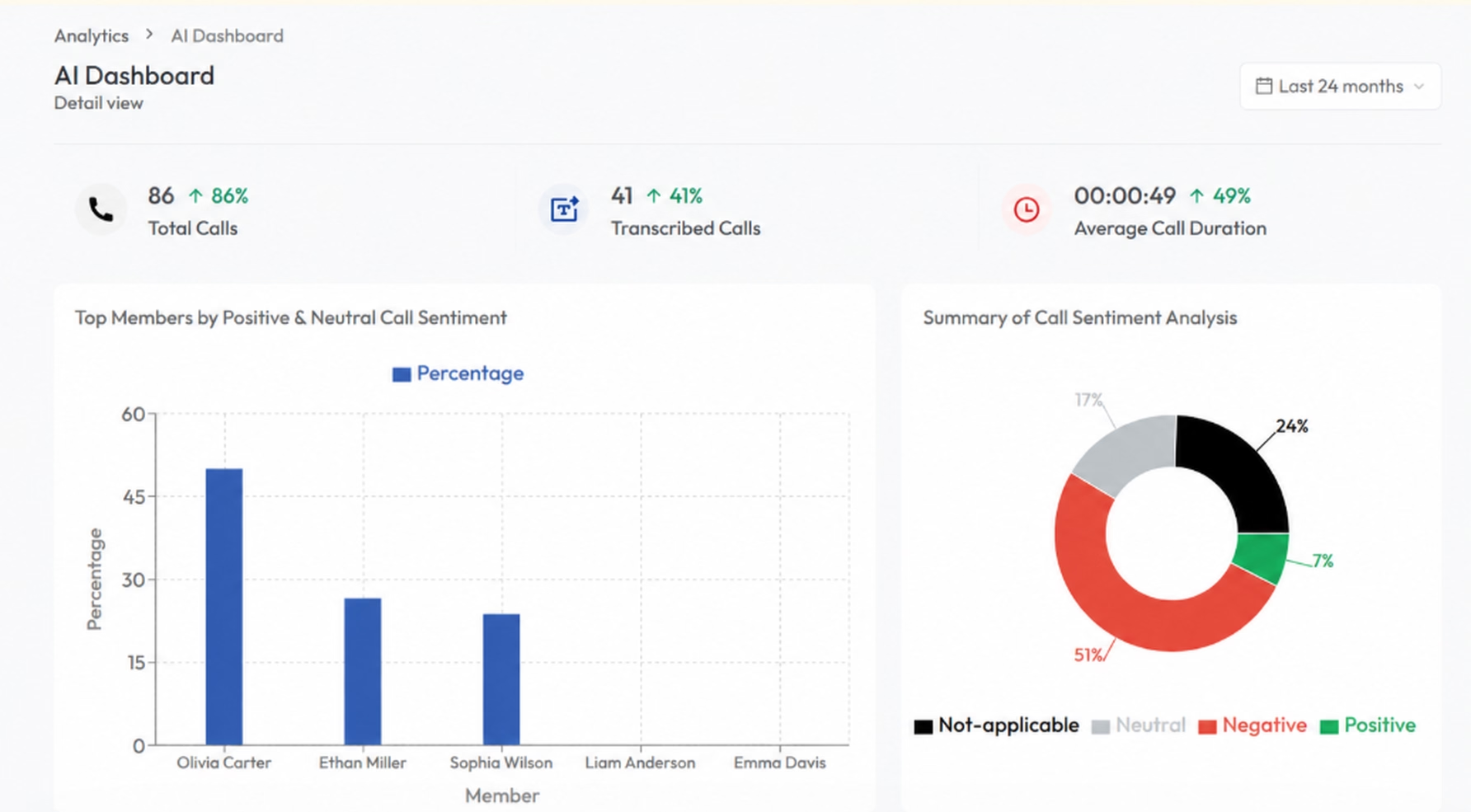

Know How Every Call Actually Went

Transcript, summary, call reason and sentiment on every recorded conversation, attached to the contact. Included at $35 per user per month, or $28 per user per month when billed annually, with a 14-day money-back guarantee.

Calilio call reports showing call analysis and sentiment insights

Frequently Asked Questions

What is sentiment analysis?
Sentiment analysis is software that reads or listens to what customers say and labels it as positive, negative or neutral. Text tools work on the words alone. Voice tools also read tone, pace, pauses and interruptions, which is why the same sentence can score very differently depending on how it was said.
What is the best sentiment analysis tool in 2026?
It depends entirely on the data you have. For phone calls, Calilio gives you sentiment on every call inside a business phone system at $28 per user per month, Gong leads for sales conversations, and CallMiner and Observe.AI for large contact centres. For social and brand monitoring, Brandwatch and Talkwalker lead on depth, with Sprout Social the easiest to run. For survey and feedback text, Qualtrics and Medallia are the standard.
How accurate is sentiment analysis?
Modern tools are generally reliable in aggregate and much weaker on individual items. Sarcasm, industry jargon, mixed messages and cultural differences in how people express dissatisfaction all cause errors, and in voice analysis transcription mistakes carry straight into the score. Treat any single score as a prompt to review the conversation rather than a fact about the customer.
How much do sentiment analysis tools cost?
Pricing varies enormously by category. Sentiment bundled into a business phone system can cost as little as $28 per user per month. Social listening platforms typically start in the hundreds per month, with Sprout Social publishing tiers from around $249 per user. Enterprise speech analytics and experience management platforms are quote-only and usually run into five or six figures a year.
What is the difference between voice and text sentiment analysis?
Text sentiment analysis reads words only. Voice sentiment analysis transcribes the conversation and also reads tone, pace, pauses, interruptions and talk ratio, which gives it signals text cannot provide — a customer can say “that’s fine” in a way that clearly is not fine. Voice is more informative but depends on transcription quality to work.
Can I use sentiment analysis to evaluate my agents?
Only with context, and never on its own. Sentiment reflects the customer’s situation as much as the agent’s handling, so an agent working a complaints queue will always score worse than one handling renewals regardless of skill. Use it to find conversations worth reviewing, then judge the handling by listening.
Do I need a separate sentiment analysis tool?
Often not. If you mainly want to know how customers sound on the phone, many business phone systems now include sentiment in their AI call reports at no extra licence. A dedicated platform earns its cost when you need custom scoring models, real-time alerting, competitor tracking, or analysis across social and survey data as well as calls.
Does sentiment analysis work in other languages?
Coverage varies widely and it is one of the biggest differences between vendors. Talkwalker and the larger enterprise platforms handle many languages well. Smaller tools are often much stronger in English than anywhere else, and accuracy in a second language can be considerably lower without that being obvious from the dashboard. Test with your own data in the languages you actually need.

Summarize this blog with:

Frequently asked questions

Which is the best sentiment analysis tool?

Some of the best sentiment analysis tools are Meltwater, MonkeyLearn, Brand24, Lexalytics, Hootsuite, Sentisum, Social Searcher, Awario, and Talkwalker, majorly for brand monitoring on social media platforms. Calilio and Medallia can be considered for call sentiment analysis.

Is sentiment analysis free?

Can ChatGPT perform sentiment analysis?

Avatar Group

Still have questions?

Can’t find the answer you’re looking for? Please chat with our friendly team.

Stay in the loop

Get the latest call insights, trends, and updates delivered straight to your inbox.

By subscribing, you agree to receive updates from Calilio.
You can unsubscribe anytime.

Enter the World of AI Business Phone System with Calilio

Improve your business operation with Calilio's advanced virtual phone system. Join today for a better way to connect.

4.6
125+ Reviews16+ Badges