- Partners
- Contact Us
- Log in
What is a Survey Call? How It Works, Types, Benefits & Best Practices

A survey call is a direct, voice-based method for gathering feedback and measuring customer sentiment. While digital tools are common, the personal connection of a phone conversation remains one of the most reliable ways to capture nuanced insights that written forms often miss.
In this article, we will break down how survey calls work, explore the different types used by businesses today, and provide a clear roadmap for conducting your own. Whether you're looking to improve customer satisfaction or conduct deep market research, this guide covers the essential features, benefits, and best practices you need to succeed.
Key Highlights:
A survey call is a structured phone-based research method used to collect customer feedback, measure satisfaction (NPS, CSAT, CES), and gather qualitative insights.
Unlike digital surveys, survey calls enable real-time clarification, deeper probing, and richer context through live interaction or IVR systems.
Modern survey operations use CATI software, automated dialers, skip logic, and AI sentiment analysis to improve efficiency and data accuracy.
Survey calls can be live or automated, inbound or outbound, and are often triggered after customer interactions to capture real-time sentiment.
Compliance is critical for survey calls, so organizations must follow TCPA, DNC, GDPR/CCPA regulations and implement STIR/SHAKEN verification to avoid spam labeling and legal risks.
Despite higher operational costs, survey calls deliver stronger B2B response rates, improved data integrity, and immediate service recovery opportunities.
What is a Survey Call?
A survey call is a structured telephone interaction used to collect feedback, opinions, or research data from respondents. Businesses, market research firms, and political organizations use survey calls to measure customer satisfaction, assess service quality, or conduct public opinion research.
Unlike telemarketing calls, survey calls focus solely on data collection rather than selling products. They are typically conducted either by a live interviewer or through an automated Interactive Voice Response (IVR) system.
In professional research environments, live surveys are often managed using Computer-Assisted Telephone Interviewing (CATI) systems. This system helps interviewers through scripted questionnaires, apply real-time skip logic, and record responses directly into a centralized database.
Survey calls are frequently triggered after a transaction or service interaction to capture immediate customer sentiment using metrics such as Net Promoter Score (NPS), Customer Satisfaction Score (CSAT), or Customer Effort Score (CES). Because they allow real-time clarification and probing questions, survey calls often produce deeper qualitative insights than standard digital surveys, which are conducted via emails or texts.
Survey Calls vs. Digital Surveys
Here are the key differences between survey calls and digital surveys:
Feature | Survey Phone Calls | Digital Surveys (Email/Web) |
| Response Quality | High: Respondents provide verbal context and detailed feedback. | Low to Medium: Responses are often brief, rushed, or quickly selected without depth. |
| Reach & Accessibility | Broad: Can reach non-digital populations and older demographics without internet dependency. | Limited: Dependent on internet access, device availability, and email open rates. |
| Engagement Rate | High: Direct interaction increases participation and completion rates. | Very Low: Frequently ignored as digital noise or filtered as spam. |
| Real-time Probing | Yes: Interviewers can clarify questions and probe deeper when needed. | No: Restricted to pre-programmed logic within the survey form. |
| Cost & Speed | Higher: Requires trained personnel or an automated voice infrastructure. | Lower: Large volumes can be distributed instantly at minimal cost. |
How Does a Survey Call Work?
A survey call begins with preparing and legally screening a contact list, then placing calls through a manual or automated dialer. Responses are gathered via live or automated interviews, cleaned, analyzed, and turned into actionable insights.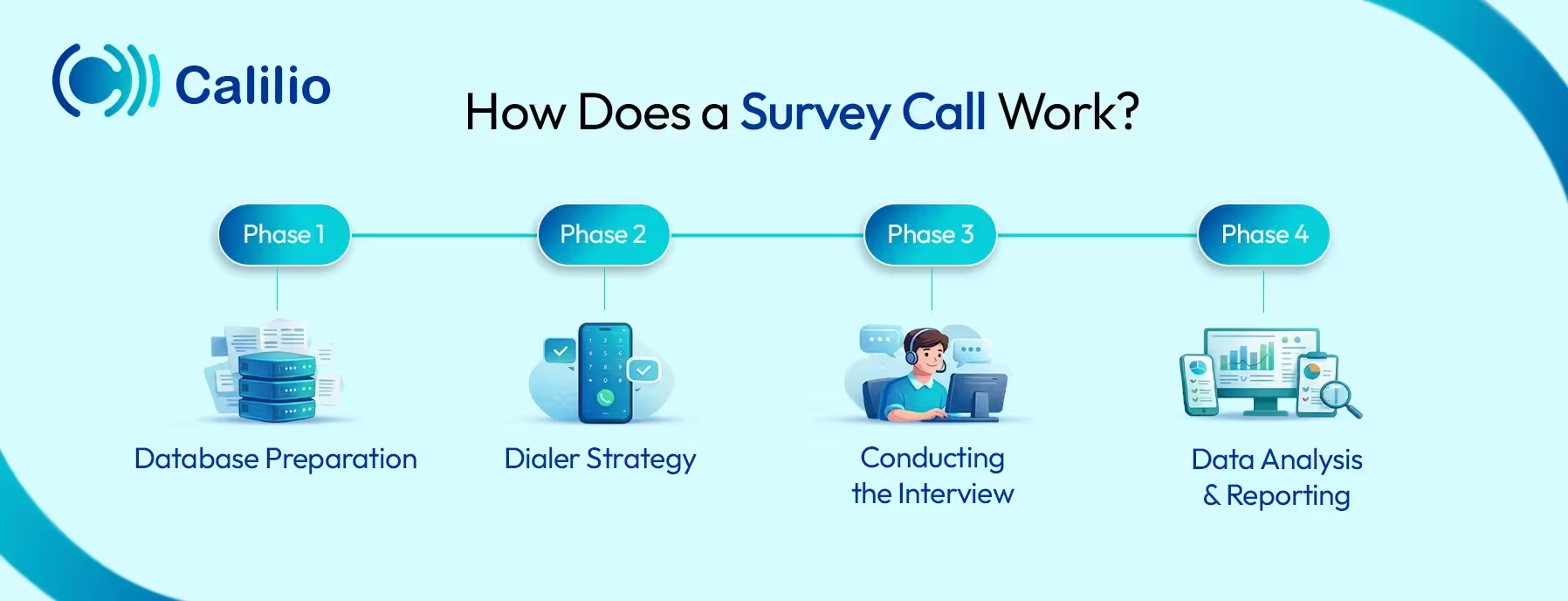
Phase 1: Database Preparation
The process begins with building and refining a contact list based on defined research criteria. The data is cleaned to remove duplicates, inactive numbers, and invalid entries.
A critical step in this phase is compliance verification. The contact list is scrubbed against the Do Not Call (DNC) registries and the Reassigned Number Database (RND) to confirm that the organization has the legal right to contact each respondent.
Phase 2: Dialer Strategy
In the past, interviewers had to manually dial each number one by one to take surveys. However, that process has largely been replaced with modern autodialers in today’s context to make the process faster and more efficient. Therefore, the strategy chosen here determines the efficiency and "pace" of the survey project.
Autodialers Used for Survey Calls
- Power Dialer: With a power dialer, the system calls one number per available interviewer and automatically dials the next contact once a call ends. This approach works best when the priority is quality and personalized interaction.
- Predictive Dialer: A predictive dialer uses algorithms to dial multiple numbers simultaneously based on expected answer rates. Basically, it predicts the availability of the receiver so that when an interviewer finishes one call, another respondent is already connected. As a result, it maximizes efficiency for large-scale survey campaigns.
- Preview Dialer: A preview dialer provides the interviewer with the respondent's information and history before the call is placed. The interviewer can review the data and then manually trigger the dial when they are ready. This is the ideal strategy for high-stakes B2B surveys or complex research where the interviewer needs context to build immediate rapport.
- Robo Dialer: A robo dialer (or voice broadcaster) delivers a pre-recorded message to a massive list of recipients simultaneously without requiring a live agent. It is often paired with IVR technology, allowing respondents to provide answers via their keypad.
Phase 3: Conducting the Interview
The execution of the interview depends on the chosen methodology, human-led or automated. In most Live Interviewer Surveys, a trained interviewer uses a CATI system to guide respondents through a dynamic script, allowing for probing, rapport-building, and clarification of complex questions.
In contrast, Automated IVR Surveys use a pre-recorded system where respondents answer prompts using their keypad or voice. Both approaches rely on skip logic, which automatically adjusts or bypasses irrelevant questions based on previous responses, ensuring the interview remains efficient and relevant.
Phase 4: Data Analysis & Reporting
After data collection, responses are validated and cleaned to eliminate inconsistencies. Analysts then perform cross-tabulation to compare results across demographic or behavioral segments.
The insights are compiled into structured reports highlighting key performance indicators such as NPS and CSAT. These findings provide organizations with measurable insights to support strategic and operational decision-making.
What are the Types of Survey Phone Calls?
The types of survey calls include live interviewer, IVR, outbound and inbound, and trigger-based, which are categorized based on methodology, call direction, and trigger events.
Based on Survey Methodology
Survey calls are commonly divided into human-led and automated approaches on the basis of the methodology of information collection.
1. Live Interviewer Surveys
Often considered the gold standard of market research, live interviewer surveys involve a trained professional speaking directly with the respondent. The human element enables probing, asking follow-up questions when responses are unclear or insightful. So, this approach is ideal for complex Business to Business (B2B) research or sensitive topics where rapport improves response accuracy.
2. IVR Survey Calls
As mentioned before, IVR-based survey calls are fully automated. In particular, a pre-recorded system asks questions, and respondents answer using keypad inputs or simple voice commands. So, this kind of survey calls are highly scalable and cost-efficient, making it suitable for high-volume satisfaction checks where in-depth probing is not required.
Based on Call Direction: Outbound vs Inbound
Based on the initiation point of the call, survey calls are divided into outbound and inbound types.
1. Outbound Survey Calls
Outbound surveys are initiated by the organization, typically using a targeted contact list. They are widely used for political polling, market research, and proactive customer satisfaction studies. This method allows precise control over sampling and demographic targeting.
2. Inbound Feedback Surveys
Inbound surveys are initiated by the customer, often through a phone number provided on a receipt, product packaging, or advertisement. Because participation is voluntary, respondents are usually highly motivated. However, results may skew toward strongly positive or negative experiences.
Trigger-based Survey Calls
Triggered surveys are action-based rather than random. They are launched automatically following a specific customer event.
Post-transaction Sentiment Surveys
These surveys are activated immediately after a service interaction, such as a support case closure or completed delivery. Here, the main goal is to capture real-time sentiment while the experience is still fresh. This helps organizations to measure NPS and CSAT at this stage to evaluate service performance.
What are the Must-Have Features for a Survey Call?
A survey call should include smart question routing to keep interviews relevant, AI-based sentiment detection to capture emotional cues, and call recording with monitoring for quality assurance. It also needs automated dialing tools to boost efficiency and improve answer rates for both B2B and large-scale campaigns.
1. Skip Logic & Call Branching
Skip logic, also known as conditional branching, ensures respondents are only asked questions relevant to their previous answers. If a participant indicates they do not use a specific product or service, the system automatically skips related follow-up questions. This keeps the survey concise, reduces frustration, and improves completion rates.
2. AI Voice Sentiment Analysis
Modern survey platforms integrate AI Voice Sentiment Analysis to evaluate more than just spoken words. By analyzing tone, pitch, and pacing, the system detects emotions such as frustration, satisfaction, or hesitation. This adds measurable emotional context to responses, enhancing the depth and accuracy of feedback analysis.
3. Call Recording & Monitoring
For live interviewer surveys, call recording and real-time monitoring support quality control and compliance. Plus, supervisors can use whisper or barge-in features to guide interviewers during active calls. Recordings also serve as a verification tool to ensure responses are captured accurately and neutrally.
4. Automated Dialer Technology
Automated dialers maximize interviewer talk time and campaign efficiency. In particular, power dialers are often used for personalized B2B research, while predictive dialers support large-scale consumer studies. Many systems also include Local Presence features, displaying a local area code to improve answer rates
Transform Your Survey Calls with Cutting-edge Features!
What are the Benefits of Survey Calls?
The benefits of survey calls include cleaner, more reliable data through guided interviews that prevent careless responses. They also build stronger customer relationships with personal interaction and allow businesses to address complaints immediately, reducing churn and negative feedback.
1. Improved Data Integrity
Because survey calls are often managed via CATI systems and supervised by professionals, the resulting data is significantly cleaner than self-reported digital forms. The presence of an interviewer helps prevent "straight-lining" (where a user randomly clicks the same answer for every question) and ensures that every response is intentional and understood.
2. Stronger Customer Relationships
In a world dominated by impersonal digital communication, a well-conducted survey call shows the customer that the company values their opinion enough to engage in a human conversation in live interview surveys. This personal touch often boosts brand loyalty, especially when the interviewer is empathetic and professional.
3. Immediate Service Recovery
Perhaps the most immediate benefit is the ability to perform "service recovery." If a respondent expresses a major grievance during a survey, the system can flag the call for immediate intervention. By resolving a complaint during or immediately after the survey call, businesses can prevent negative public reviews and reduce customer churn in real-time.
4. Capturing Qualitative Insights
Digital surveys often capture ratings but miss the reasoning behind them. In a survey call, live interviewers can probe deeper when responses are vague or emotional. Plus, vocal cues such as hesitation or frustration help uncover context that a web form cannot detect. This produces rich qualitative data that explains the “why” behind the “what,” enabling more precise strategic decisions.
5. Reaching Non-Digital Audiences
Relying solely on email or web surveys increases the risk of non-response bias. Likewise, older demographics, rural populations with limited internet access, and certain blue-collar industries are often underrepresented in digital research. Therefore, survey calls help bridge this digital divide by reaching respondents beyond online channels. This results in more representative and inclusive market data.
6. Higher B2B Response Rates
In B2B research, it's hard to reach the decision-makers through cold emails, which are frequently filtered by spam controls and crowded inboxes. So, a professional survey call can establish immediate credibility and rapport, increasing the likelihood of participation. Plus, a person-to-person telephone outreach often delivers stronger engagement for high-stakes market intelligence and executive-level feedback.
How to Conduct a Survey Call
To conduct a survey call, start by setting clear goals, then build a legally compliant contact list and create a neutral, well-structured script with smart routing. Then, train interviewers, run a small pilot to fix issues, and launch fully while continuously monitoring and optimizing performance.
Step 1: Define Objectives
Every successful survey begins with a clear objective. Before drafting questions, you must define exactly what insights you want to capture, whether it’s calculating NPS, understanding customer churn, or testing a new product concept. Clear objectives eliminate unnecessary questions that weaken data quality and frustrate respondents.
Step 2: Build a Compliant Contact List
Your contact list must be compliant, not just accurate. So, you must scrub your database against the DNC Registry and the RND to protect your organization from penalties and preserve credibility. Beyond legal safety, your target audience and compliance rules directly shape the survey’s structure. In fact, it influences the script’s tone, question routing, and mandatory disclosures from the very first dial.
Step 3: Design the Script
Your survey script serves as the engine of the entire campaign. It should begin with a transparent introduction that clearly identifies the caller and the research purpose. You should incorporate skip logic to keep the conversation relevant and remove unnecessary follow-up questions. Questions must remain neutral and easy to understand to avoid influencing responses.
Step 4: Train Interviewers
For Live Surveys, train staff in neutrality, script precision, and probing techniques. For Automated IVR, focus on technical configuration by ensuring clear voice prompts and reliable speech recognition or DTMF (keypad) inputs. Combining these human and automated techniques creates a more inclusive approach, catering to all respondent preferences.
Step 5: Conduct Pilot Testing
Before launching at scale, you should conduct a pilot test with a small, representative sample. This allows you to identify confusing questions, technical issues within the CATI system, or problems with the survey length. Plus, a controlled test phase reduces risk and ensures smoother full-scale deployment.
Step 6: Launch & Optimize
After a successful pilot test, you can proceed with full deployment. However, continuous monitoring is essential. Therefore, you should track completion rates, call outcomes, and quality metrics through real-time dashboards. In case the performance declines, you need to adjust dialer strategy, change the script flow or call timing, to enhance the outcome.
What are the Common Survey Call Challenges?
Common survey call challenges include spam labeling that lowers answer rates, difficulty reaching respondents due to call fatigue and filtering, and response bias that can affect data accuracy. Additionally, higher operational costs require smarter targeting and optimization to maintain a strong Return on Investment (ROI).
1. Spam Labeling Risks
One of the most significant obstacles is the rise of “Spam Likely” or “Scam Likely” labels. Carriers now use aggressive AI algorithms to flag numbers that exhibit high-volume or suspicious dialing behavior. Once flagged, answer rates can decline dramatically.
To mitigate this risk, professional survey operations implement STIR/SHAKEN digital certificates to authenticate caller identity and use Local Presence dialing to display familiar area codes. Plus, regularly rotating outbound numbers and monitoring caller ID reputation scores has become a standard maintenance practice in 2026.
2. Low Contact Rates
Reaching respondents is increasingly difficult due to call fatigue, a mental burnout affecting both sides of the line. Respondents are exhausted by relentless unsolicited calls and reflexively ignore their phones, while interviewers face "agent fatigue" from repetitive scripts and high rejection rates.
To overcome these barriers, use strategic timing and multichannel outreach to build trust and improve answer rates. By coordinating your calls with other touchpoints and ensuring A2P 10DLC compliance for any messaging, you can break through the noise while keeping your interviewers motivated and productive.
3. Response Bias Issues
When a respondent does answer, data quality can still be affected by various forms of Response Bias.
- Social Desirability Bias: Providing socially acceptable responses rather than honest opinions, especially on sensitive topics.
- Acquiescence Bias: Agreeing quickly to shorten the conversation.
- Non-response Bias: Differences between those who participate and those who do not, creating blind spots in the data.
Reducing these risks requires neutral question framing and well-trained interviewers who understand how to probe without influencing responses.
4. High Operational Costs
Compared to digital surveys, telephone research carries a higher cost per completed response. In fact, CATI software, dialer infrastructure, compliance management, and trained interviewers all contribute to operational expense.
In 2026, successful organizations offset these costs by applying Propensity Modeling, a statistical approach that predicts the likelihood of a contact answering the call or completing the survey. This modeling helps to prioritize respondents most likely to deliver high-value insights. Rather than broad, indiscriminate dialing, targeted outreach ensures that every minute of interviewer time contributes meaningfully to ROI.
What are the Survey Call Compliance Requirements?
Survey call compliance requires following the Telephone Consumer Protection Act (TCPA) for consent and automated dialing rules while honoring national and internal DNC lists. It also involves meeting privacy laws like the General Data Protection Regulation (GDPR) and other state laws, and using STIR/SHAKEN to verify caller identity and prevent spam labeling.
TCPA Requirements
TCPA remains the primary law governing survey calls in the United States. Even informational or research-focused calls must follow strict guidelines regarding call timing and the use of automated dialing technology.
Survey campaigns that involve automated systems must carefully assess whether their dialing methods fall under TCPA restrictions, particularly when contacting mobile numbers.
Express Written Consent
Under the TCPA, consent is the most critical requirement. When using an Automatic Telephone Dialing System (ATDS) to contact a mobile phone, prior express consent is typically required. For surveys that have marketing-adjacent elements, this may escalate to Express Written Consent.
Even for non-marketing research, maintaining a documented record of when and how consent was obtained serves as essential legal protection in the event of complaints or litigation.
Do Not Call (DNC) Rules
Organizations must respect the National DNC Registry, even when conducting research-based calls. In addition, businesses are also required to maintain an Internal DNC List. If a respondent requests not to be contacted again during a survey call, that request must be honored immediately. And, failure to comply can result in substantial per-call penalties that escalate rapidly.
GDPR and CCPA
When surveying individuals in the European Union or California, compliance extends to the General Data Protection Regulation (GDPR) and the California Consumer Privacy Act (CCPA).
These regulations focus on data transparency and sovereignty. Organizations must clearly disclose what data is being collected, how it will be used, and provide respondents with the “Right to be forgotten”, allowing them to request deletion of their personal data.
STIR/SHAKEN Verification
To combat spoofed calls, the FCC mandates compliance with the STIR/SHAKEN framework. This technical standard digitally authenticates outbound calls, verifying that the displayed Caller ID belongs to the originating organization.
Calls without proper attestation may be blocked by carriers or labeled as “Spam Likely,” significantly reducing answer rates and campaign effectiveness.
What are the Best Practices for Survey Scripts?
Best practices for survey scripts include starting with a clear, transparent introduction that explains who is calling, the purpose, and the time required. Also, keep the survey brief, offer meaningful incentives to boost participation, and use neutral, balanced questions that avoid bias and allow honest responses.
1. Strong Opening Statement
The opening is the hook of the survey call. It should immediately address the three core concerns of the respondent: who is calling, why the call is being made, and how long it will take. Clear identification and transparency help reduce skepticism and distinguish the call from telemarketing outreach.
Here is a clear example of a strong opening for a survey call:
"Hello, this is [Name] calling on behalf of [Organization]. We are conducting a brief [Number]-minute survey to gather your feedback on [Topic], where your participation is entirely voluntary.
2. Keep the Survey Concise
Survey fatigue is a major barrier to completion. For telephone interviews, being concise is critical; completion rates drop significantly after five minutes.
Prioritize essential questions at the beginning of the script and remove unnecessary ones. If certain data points (such as location or account details) already exist in the database, avoid asking again. For longer surveys, providing progress updates, such as “Only three questions left”, can motivate respondents to complete the call.
3. Incentives for Participation
Incentives can significantly increase participation, especially for longer surveys or B2B research.
Digital gift cards delivered instantly via email or SMS are highly effective due to immediate gratification. In many cases, a guaranteed small reward (e.g., $5) performs better than a sweepstakes entry for a larger prize, as respondents value certainty. Offering charitable donations on behalf of respondents is also an effective way to build goodwill while encouraging participation.
4. Neutral Question Framing
Questions should remain neutral, balanced, and structured to allow genuine responses. Plus, including options such as “Don’t know” or “Prefer not to say” prevents forced answers that create noisy data.
Here is an example of biased and neutral framed questions:
- Biased: “Don’t you agree that our new app is easier to use?”
- Neutral: “On a scale of 1 to 10, how would you rate the ease of use of our new app compared to the previous version?”
Conclusion
In an era defined by digital noise and survey fatigue, phone calls remain one of the most reliable ways to capture high-fidelity human insight. While web forms offer speed and scale, they often fail to uncover the reasoning behind customer behavior. A well-executed survey call reaches non-digital and B2B audiences and delivers the qualitative depth that only real conversation provides.
However, overcoming challenges like spam labeling and strict TCPA compliance demands a modern infrastructure. This includes STIR/SHAKEN authentication, A2P 10DLC registration for integrated messaging, local presence dialing, and AI-driven sentiment analysis. The right system ensures your multichannel outreach is compliant, credible, and more likely to be answered.



Summarize this blog with:
Frequently Asked Questions
What is the difference between a survey call and a telemarketing call?
A survey call is conducted purely to collect feedback or research data, not to sell products or services. Telemarketing calls are promotional in nature and aim to generate sales or leads.
Are survey calls legal?
What is the ideal length of a survey call?
How can companies improve survey call response rates?

Still have questions?
Can’t find the answer you’re looking for? Please chat with our friendly team.
Stay in the loop
Get the latest call insights, trends, and updates delivered straight to your inbox.
By subscribing, you agree to receive updates from Calilio.
You can unsubscribe anytime.
Enter the World of AI Business Phone System with Calilio
Improve your business operation with Calilio's advanced virtual phone system. Join today for a better way to connect.