
Quick Answer
Three shortlists cover almost every business shopping for this:
What is an AI answering service?
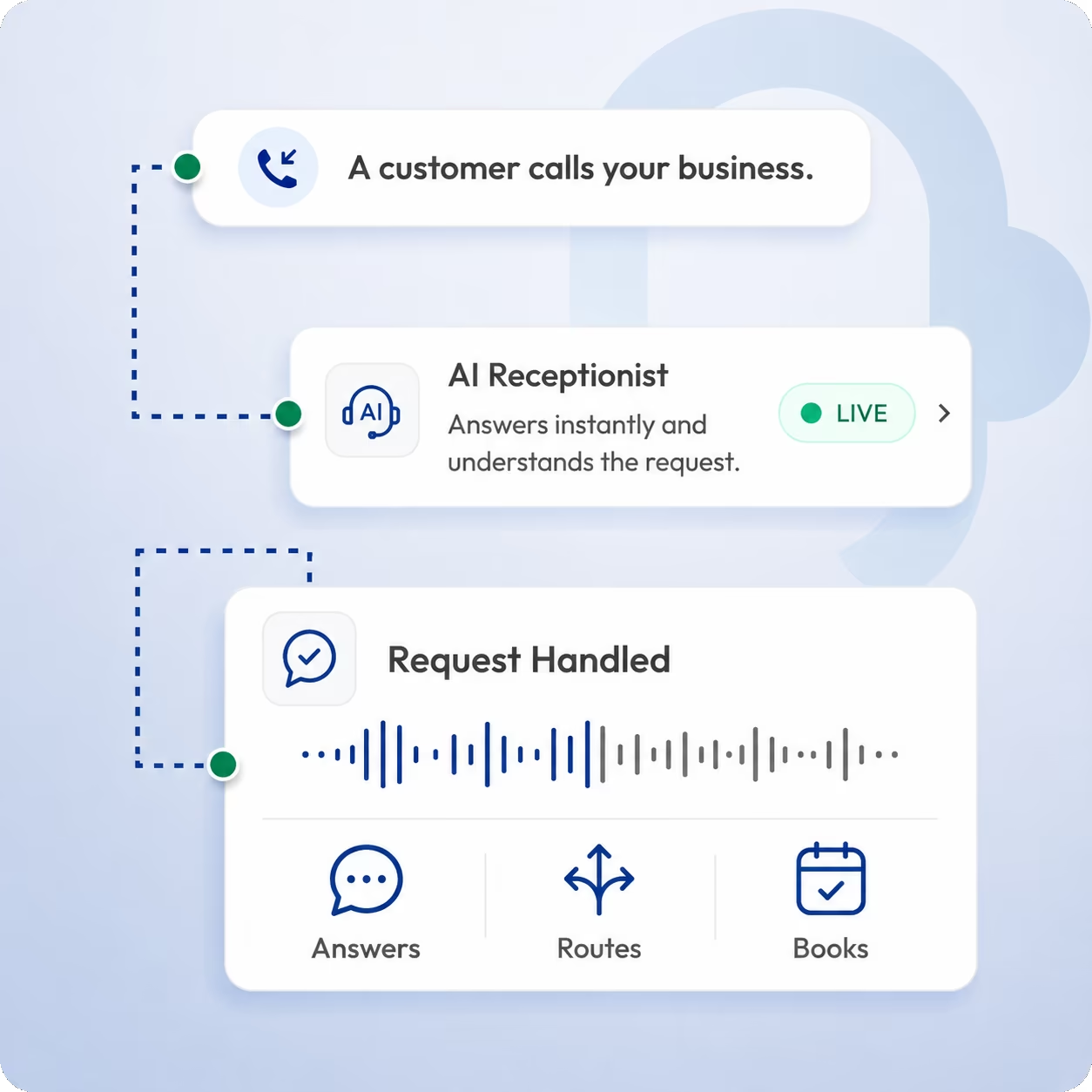
An AI answering service picks up incoming calls automatically, understands what the caller says in ordinary language, and resolves the request or hands it to a person — with no keypad menu and no hold music. It is the automated successor to the human-staffed answering services that used to take messages after hours.
The term overlaps heavily with AI receptionist and virtual receptionist. Worth being precise about the difference before comparing anything.
Term | What It Actually Means |
| AI Answering Service | Software that answers calls automatically using natural language understanding. What this whole comparison is about. |
| AI Receptionist | The same thing under a different name — most vendors, including Calilio, use it interchangeably with AI answering service. |
| Virtual Receptionist | Usually a real person answering remotely through a staffed service, billed per call or per minute of live time. Not software. |
How we compared them
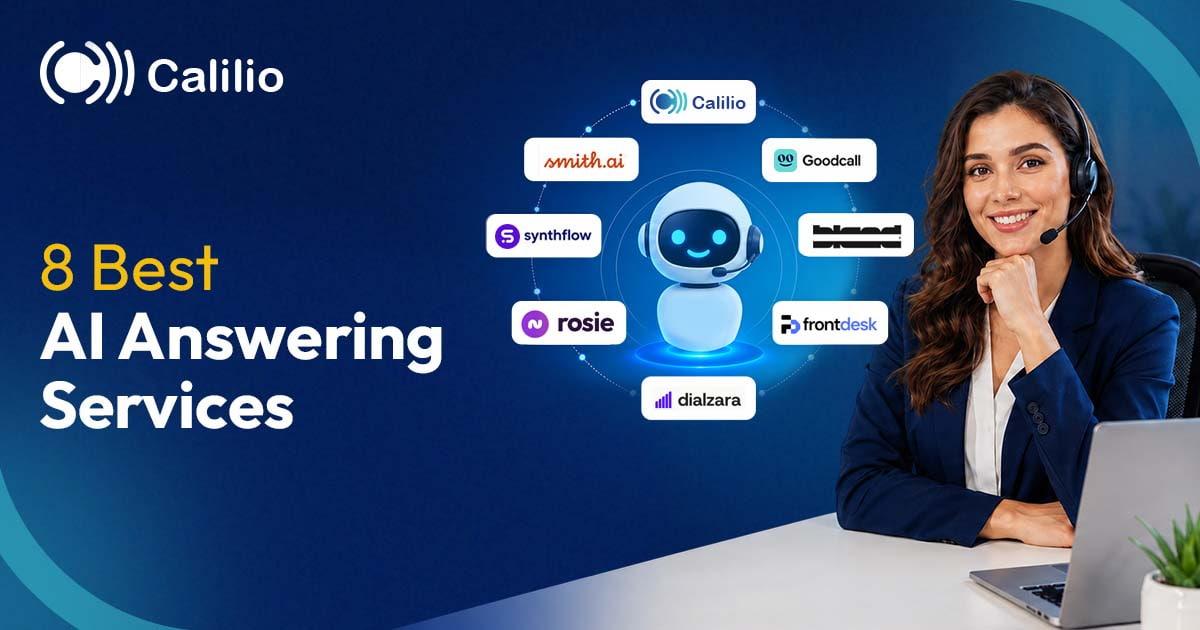
We weighted 6 criteria to compare 19 AI answering services and kept the 8 best.
Capabilities and pricing come from each vendor’s published product pages as of August 2026, read alongside current G2 and Capterra reviews so we could see where real customers hit accuracy, setup and billing problems. No vendor paid to be included or ranked higher, and this article has no affiliate links.
Calilio offers an AI receptionist as part of its phone system, so we compete here. Our own entry states its limits in the same detail as everyone else’s, and the verdict names other services as the better choice where they are.
The 8 best AI answering services in 2026
Ordered by overall value, conversation quality, and how naturally each fits into your existing phone setup rather than sitting on top of it.
# | Service | Best For | Plan | Overage / Charges |
| 1 | Calilio | Best value — bundled into a full phone system | Standard $15/user/mo ($12 annual) · Premium $35/user/mo ($28 annual) | 10 free min/user/mo then $0.25/min (Standard); 100 free min then $0.15/min (Premium) |
| 2 | Smith.ai | Most polished stand-alone receptionist | Free (25 calls/mo) · Pro from $150/mo (75 calls) · Enterprise from $500/mo (300 calls) | $2.50/call on Pro, $2.17/call on Enterprise beyond the included volume |
| 3 | Goodcall | Simple setup for small local businesses | Starter $79/mo · Growth $129/mo · Scale $249/mo (per agent/number) | $0.50 per unique caller beyond 100/mo included; unlimited minutes |
| 4 | Synthflow | Building custom voice agent flows | Pay-as-you-go, no monthly platform fee · Enterprise from $30,000/yr | Effective $0.8-0.14/min depending on voice, model and telephony chosen |
| 5 | Bland AI | Developers wanting full API control | Start (pay-as-you-go) · Build $299/mo · Scale $499/mo | $0.11-0.14/min depending on tier, plus separate transfer-time fees |
| 6 | Rosie (by Ruby) | Backed by a large human receptionist brand | $49/mo (250 min) · $149/mo (1,000 min) · $299/mo (2,000 min) | Going over the bucket auto-upgrades your plan for ~3 billing cycles |
| 7 | My AI Front Desk | Cheapest dedicated option | Free (20 min) · Business-in-a-Box $99/mo ($79 annual, 200 min) | $0.25/min beyond the included 200 minutes |
| 8 | Dialzara | Fast setup, no contract | Lite $29/mo (60 min) · Pro $99/mo (220 min) · Plus $199/mo (500 min) | $0.48/$0.45/$0.40 per minute above the bucket, by tier |
Pricing reflects each vendor’s published rates as of August 2026 and often scales with call volume — confirm cost against your real monthly calls before committing.
1. Calilio
Best value — the AI answering service lives inside your phone system
Calilio AI Receptionist answers incoming calls using natural language, drawing on knowledge sources you connect — a website, an uploaded document, or information already in your workspace. You write its instructions, choose a voice, test it with a sample call, then assign it to a number. It only answers calls; it does not place them.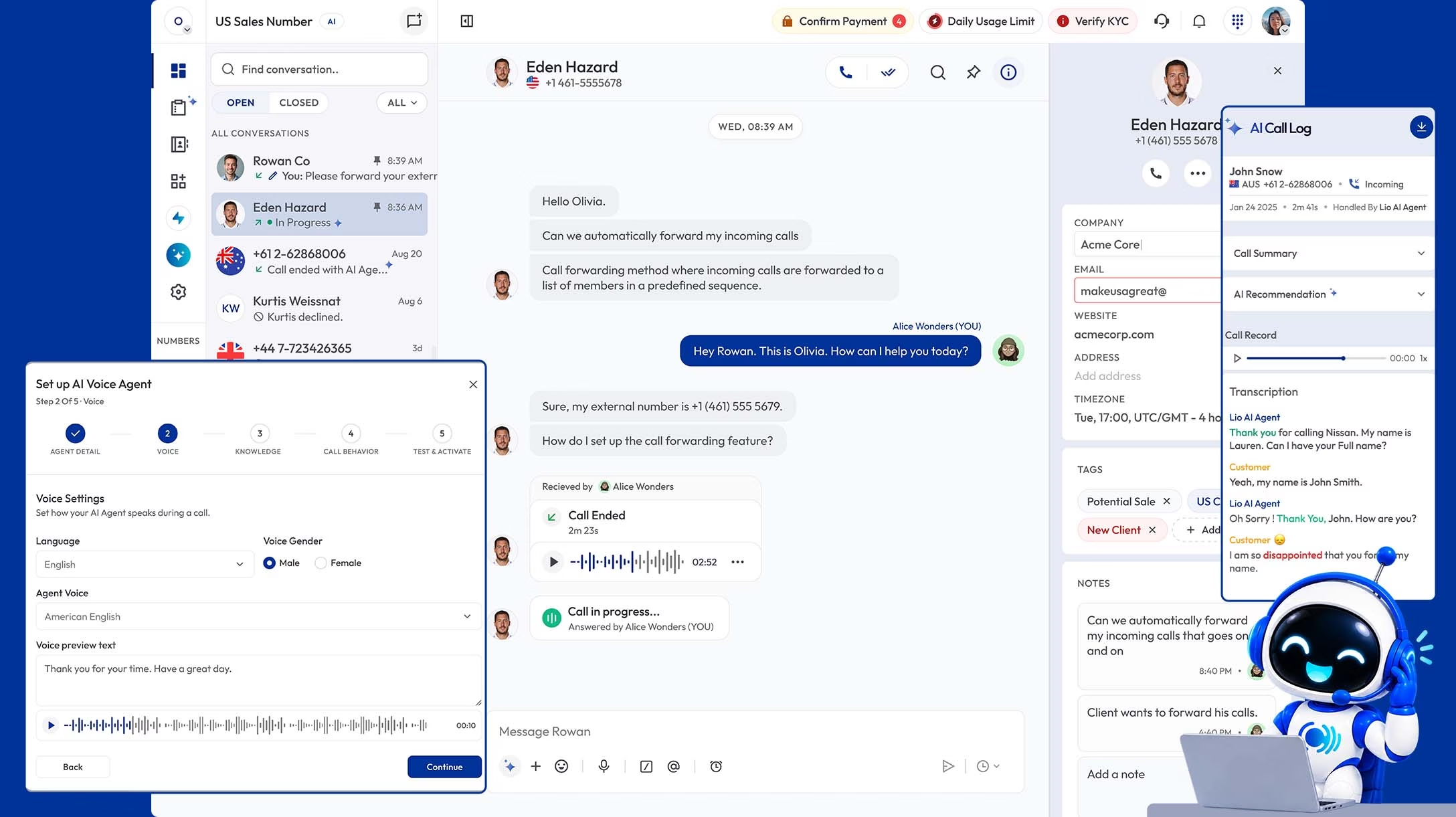
What makes it worth the top spot for most small and mid-sized businesses is that it is not a second subscription. Numbers, call recording, IVR, live monitoring and the AI receptionist all sit in one workspace, and every call it handles is logged with full transcription. The AI Voice Agent comes with both plans — Standard includes 10 free minutes per user a month, then $0.25/min; Premium includes 100 free minutes, then $0.15/min. It is newer than the dedicated answering-service specialists, so its integration library is smaller, and each agent handles up to 5 simultaneous calls.
2. Smith.ai
The most polished stand-alone AI receptionist
Smith.ai built its reputation on human virtual receptionists and has layered AI answering on top of that operational experience. Call handling is genuinely strong — it books appointments, qualifies leads and answers FAQs with noticeably natural phrasing, and its integration library covering CRMs and calendars is one of the deepest in this category.
It is priced and positioned as a dedicated receptionist replacement, which means a separate subscription on top of whatever phone system you already run. Billing is usage-based above an included allowance, so cost scales with call volume and is worth modelling against your actual numbers before committing.
3. Goodcall
Simple, fast setup aimed at small local businesses
Goodcall is built for a business owner who wants an AI receptionist running today without configuring much. Setup is largely guided — describe your business, and it builds a working agent from that description, with FAQs, hours and basic booking handled out of the box.
The trade for that simplicity is depth. Its integration list is shorter than Smith.ai’s, and complex multi-step call flows are harder to customise. For a single-location service business — a salon, a clinic, a repair shop — that is rarely a real limitation.
4. Synthflow
A builder for teams that want to design their own voice flows
Synthflow is a no-code platform for building voice AI agents rather than a pre-packaged receptionist. You design the conversation flow, connect it to your own tools via its integration and API layer, and deploy it across use cases beyond just answering the phone — outbound reminders, lead qualification, and more.
That flexibility means real setup time. It is the right tool when your call handling needs are specific enough that a fixed receptionist product will not fit, and the wrong one if you just want something that works with minimal configuration.
5. Bland AI
A developer-first platform for full programmatic control
Bland AI is infrastructure rather than a receptionist product — an API for building voice agents that developers wire directly into their own systems. It offers granular control over the conversation logic, voice, and call handling that a packaged product does not expose.
This is squarely for engineering teams. There is no guided setup, no built-in booking widget, and no small-business onboarding flow. If your team is not writing code against an API, this is the wrong entry on this list for you.
6. Rosie (Ruby)
An AI product backed by an established virtual receptionist company
Rosie is Ruby’s AI answering product, built by a company with a long track record in human virtual receptionist services. That heritage shows in the call-handling design — sensible defaults for common small-business call types, and the option to escalate to one of Ruby’s human receptionists for calls the AI cannot handle.
It sits at a similar price point to the other dedicated services and is a separate subscription from your phone system. The human-escalation option is a genuine differentiator if you specifically want a safety net beyond routing to your own team.
7. My AI Front Desk
One of the cheaper dedicated AI receptionist options
My AI Front Desk covers the core job — answering calls, taking messages, basic booking — at a lower price point than Smith.ai or Rosie. Setup is straightforward and aimed at small businesses that want a working answering service without a large monthly commitment.
Reviewers note the conversation handling is competent rather than exceptional, and the integration list is shorter than the premium options. For a business whose calls are simple and repetitive, that is a fair trade for the lower price.
8. Dialzara
Fast setup with no long-term contract
Dialzara positions itself on speed of setup and flexible, no-contract billing — a reasonable fit for a business that wants to trial an AI answering service without committing to an annual term. Core features cover answering, FAQs and basic call routing.
It is a lighter product than the category leaders, with a smaller feature set and integration list. That is a fair trade if your requirement is genuinely simple and you value being able to leave without penalty.
What to check before you buy
Five checks that reveal more than any feature list, all doable on a single demo call.
1
2
3
4
5
The Verdict
If you want the single most polished dedicated receptionist and are happy running it alongside your existing phone system, Smith.ai is the strongest all-round pick, with Rosie a close second for its human-escalation safety net. If you want to build something specific yourself, Synthflow or Bland AI give you that control at the cost of setup time.
For most small and mid-sized businesses, though, the more useful question is whether you need a second subscription at all. Calilio bundles the AI receptionist into the phone system itself, so calls, numbers and the AI answering service share one bill and one call history — with a smaller integration list and no outbound calling as the honest trade for that simplicity.
One Phone System, One Bill
Create your AI receptionist, connect your knowledge, and test it before customers ever hear it. Available on both plans — Standard from $15/user/month (10 free minutes, then $0.25/min) or Premium from $35/user/month (100 free minutes, then $0.15/min), cheaper billed annually.