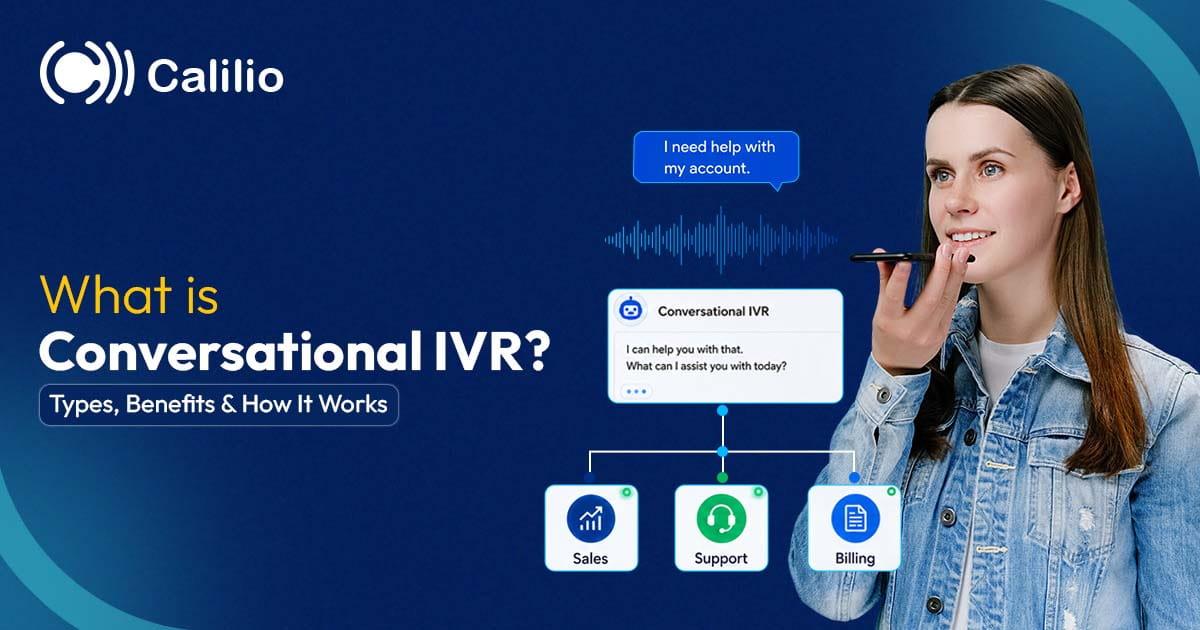
Everyone has been stuck in a phone menu, pressing 0 and saying "agent, agent, AGENT" at a machine that keeps reading out options. Conversational IVR exists to end that experience: instead of making callers learn your menu, the system understands what they say in their own words.
This guide covers what conversational IVR is, how it differs from the keypad menus it replaces, the main types of IVR, where it genuinely helps, and where it still falls short.
What is conversational IVR?
Conversational IVR is an interactive voice response system that lets callers speak naturally — "I need to change my delivery address" — instead of pressing keys through a menu. It uses speech recognition and natural language understanding (NLU) to work out what the caller wants, then answers directly or routes the call to the right person or department.
The word "conversational" is the point. A traditional IVR is a decision tree the caller walks through one keypress at a time. A conversational IVR flips the interaction: the caller states the goal once, and the system does the navigating.
How conversational IVR works
Under the hood, four things happen in the seconds between a caller speaking and the system responding:
1
Speech recognition converts voice to text
Automatic speech recognition (ASR) transcribes what the caller says in real time, handling accents, filler words and background noise as well as it can.
2
Natural language understanding extracts the intent
NLU works out what the caller wants — "I was double charged last month" becomes a billing-dispute intent — along with details like dates, amounts or account references.
3
The system decides what to do
Based on the intent, it either answers directly, asks a clarifying question ("Which order is this about?"), or routes the call to the right team with the context attached.
4
Text-to-speech responds in a natural voice
The reply is spoken back in a synthesized voice, and the loop repeats — each exchange refining what the system knows about the caller's goal.
Types of IVR: from keypads to conversation
IVR is best understood as a spectrum of four generations. Most businesses today run the first or second; the interesting decisions are about the third and fourth.
Type 1Touch-tone (DTMF) IVR
The classic keypad menu: a recorded voice reads options and the caller presses digits. Reliable, cheap, and fine for simple routing between a handful of departments.
Caller experience: "Press 1 for sales, press 2 for support." The caller navigates; the system just follows the tree.
Type 2Directed-dialog (speech-enabled) IVR
The first step toward voice: callers speak, but only from a scripted list — "say sales, support, or billing." The system matches keywords rather than understanding language.
Caller experience: The caller must guess the magic words. Saying "I have a problem with my invoice" often gets "Sorry, I didn't catch that."
Type 3Conversational IVR
Full natural language understanding. Callers state their need in their own words and the system interprets intent, asks follow-ups, and routes or self-serves within its defined flows.
Caller experience: "I need to reschedule Thursday's appointment" is understood the first time, without the caller learning a menu.
Type 4AI voice agent
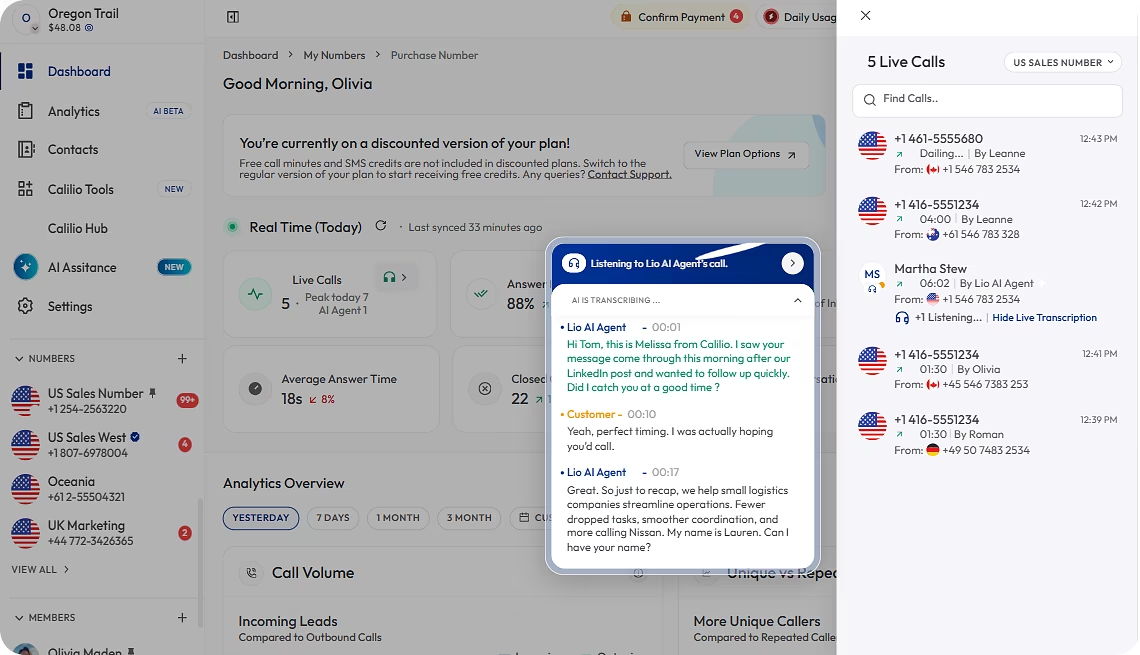
The step beyond IVR: a generative-AI agent that holds a genuine conversation, answers questions from a knowledge base, and completes calls end-to-end — routing to a human only when needed. This is what Calilio's AI Voice Agent does for incoming calls.
Caller experience: The caller talks to it like a person. It answers the question, books the slot, or takes the message — and produces a transcript and summary afterward.
The line between the last two is worth pausing on, because vendors blur it constantly. A conversational IVR understands and routes; an AI voice agent understands and finishes the job. If the system can answer "what are your opening hours?" itself, book the appointment itself, and only hand over to a human when it genuinely needs to, you are looking at a voice agent — the direction the whole category is moving.
Traditional IVR vs. conversational IVR
#
Traditional IVR
Conversational IVR
Input
Keypad presses through a fixed menu
Natural speech in the caller's own words
Caller effort
Caller navigates the tree, one level at a time
Caller states the goal once; the system navigates
Handles unexpected requests
No — anything off-menu ends at "press 0"
Yes, within the intents it has been given
Setup
Simple: record prompts, map digits to destinations
Needs intents, flows and testing — or a knowledge base for AI agents
Cost
Included in most business phone systems
Ranges from bundled (phone-system AI agents) to enterprise per-minute pricing
No menu to memorise and no wrong turns. Stating the need once beats pressing through three levels of options, especially for first-time callers.
Fewer misroutes
Intent-based routing sends the billing dispute to billing, not to whichever department "3" happened to be — cutting the transfers that frustrate callers most.
More calls resolved without an agent
Routine requests — hours, status checks, bookings, FAQs — get answered by the system itself, freeing agents for calls that need judgment.
24/7 availability
The system answers identically at 2pm and 2am. For businesses that miss after-hours calls entirely, this is the single biggest win.
Consistent, reviewable service
Every interaction follows the same standard, and with AI-report-capable systems, every call leaves a transcript and summary a manager can review.
Scales without hiring
Call spikes — a promotion, an outage, a seasonal rush — are absorbed by software rather than a queue. Calilio's AI agents each handle 5 simultaneous calls.
Where conversational IVR still falls short
An honest picture matters more than a sales pitch here, because a badly deployed conversational IVR frustrates callers more than a clear keypad menu:
!Recognition still fails sometimes. Heavy accents, noisy lines and crosstalk degrade speech recognition, and a system that repeatedly mishears is more infuriating than a keypad menu ever was.
!A bad deployment traps callers. The cardinal sin is hiding the path to a human. Every conversational flow needs an obvious escape hatch to a person — systems that loop callers deliberately are why the category has a bad reputation.
!It only knows what you teach it. Conversational IVR handles the intents it was built for; an AI agent answers from the knowledge you connect. Gaps in either show up as "let me transfer you" — fine occasionally, failure if constant.
!Complex, emotional calls belong with humans. A grieving customer closing an account, a furious escalation, an ambiguous complaint — recognise these early and route them to a person fast.
Beyond conversational IVR: letting an AI agent take the call
If the appeal of conversational IVR is that callers stop navigating menus, the logical end point is a system that doesn't just route the call — it handles it. That is what Calilio's AI Voice Agentdoes for incoming calls: you create an agent, give it a name and voice, connect your business knowledge (your website, help docs, or uploaded files), and assign it to your number.
When someone calls, the agent greets them, understands the request in natural language, answers from your knowledge base, and holds a genuine conversation — with each agent able to handle 5 calls at once, so a busy moment doesn't create a queue. Every handled call produces an AI call report with the transcript, the reason for the call, its outcome and sentiment.
What it costs
The AI Voice Agent comes with both Calilio plans — Standard at $15/user/month ($12 billed annually) and Premium at $35/user/month ($28 billed annually). Handling minutes are free up to 10 min/user/month on Standard (then $0.25/min) and up to 100 min/user/month on Premium (then $0.15/min).
Which should you use?
If this is you
You get modest call volume and route between a few known departments.
Use
A classic IVR / call flow
Simple, predictable, and included in your phone system. Calilio's call flows cover this out of the box.
If this is you
Callers phone with varied, routine requests — hours, bookings, order status, FAQs.
Use
An AI voice agent
It answers most of these itself from your knowledge base instead of routing them anywhere. Included on every Calilio plan.
If this is you
You run an enterprise contact center with complex self-service transactions.
Use
Enterprise conversational IVR
Platforms like Genesys, Five9 or Talkdesk build deep custom flows tied to your backend systems — at enterprise cost.
Conclusion
Conversational IVR replaces menu navigation with natural language — a real improvement for callers, provided it's deployed with an easy path to a human. The category itself is moving one step further, toward AI voice agents that complete calls rather than just routing them. If you're evaluating options, decide first whether you want your system to direct conversations or to have them; that single question narrows the field more than any feature list.
Skip the Menu. Let Your Callers Just Talk.
Create an AI Voice Agent in Calilio, connect your business knowledge, and let it answer incoming calls in natural conversation — included on every plan.
Conversational IVR is an interactive voice response system that lets callers speak naturally — "I need to change my delivery address" — instead of pressing keys through a menu. It uses speech recognition and natural language understanding to work out what the caller wants, then answers directly or routes the call to the right place.
What is the difference between IVR and conversational IVR?
Traditional IVR presents a fixed menu the caller navigates with keypad presses. Conversational IVR removes the menu: the caller states their need in their own words and the system interprets it. Traditional IVR is rule-following; conversational IVR is language-understanding.
Is conversational IVR the same as an AI voice agent?
They overlap but are not identical. Conversational IVR mainly understands what the caller wants and routes or answers within a defined flow. An AI voice agent goes further — it holds a genuine back-and-forth conversation, answers questions from a connected knowledge base, and completes the call itself rather than just routing it. Calilio's AI Voice Agent is the latter, built for incoming calls.
How much does conversational IVR cost?
Enterprise conversational IVR built on contact center platforms is typically quoted per interaction or per minute and can run thousands per month. AI voice agents bundled into business phone systems are far cheaper — Calilio includes its AI Voice Agent on plans from $15/user/month ($12 billed annually), with free handling minutes each month and a low per-minute rate after.
Do callers actually prefer conversational IVR?
They prefer whatever gets them resolved fastest. A well-built conversational system beats a deep keypad menu; a badly built one that mishears and loops is worse than a clear three-option menu. The deciding factors are recognition quality and an easy path to a human.
Can a small business use conversational IVR?
Yes — this is the biggest recent change. What used to require enterprise contact center contracts is now available inside ordinary business phone systems. Calilio's AI Voice Agent takes minutes to set up: name it, pick a voice, connect your website or docs as its knowledge, and assign it to your number.
Summarize this blog with:
Everything you need to know about Calilio. Can't find your answer? .
Stay in the loop
Get the latest call insights, trends, and updates delivered straight to your inbox.
By subscribing, you agree to receive updates from Calilio. You can unsubscribe anytime.